


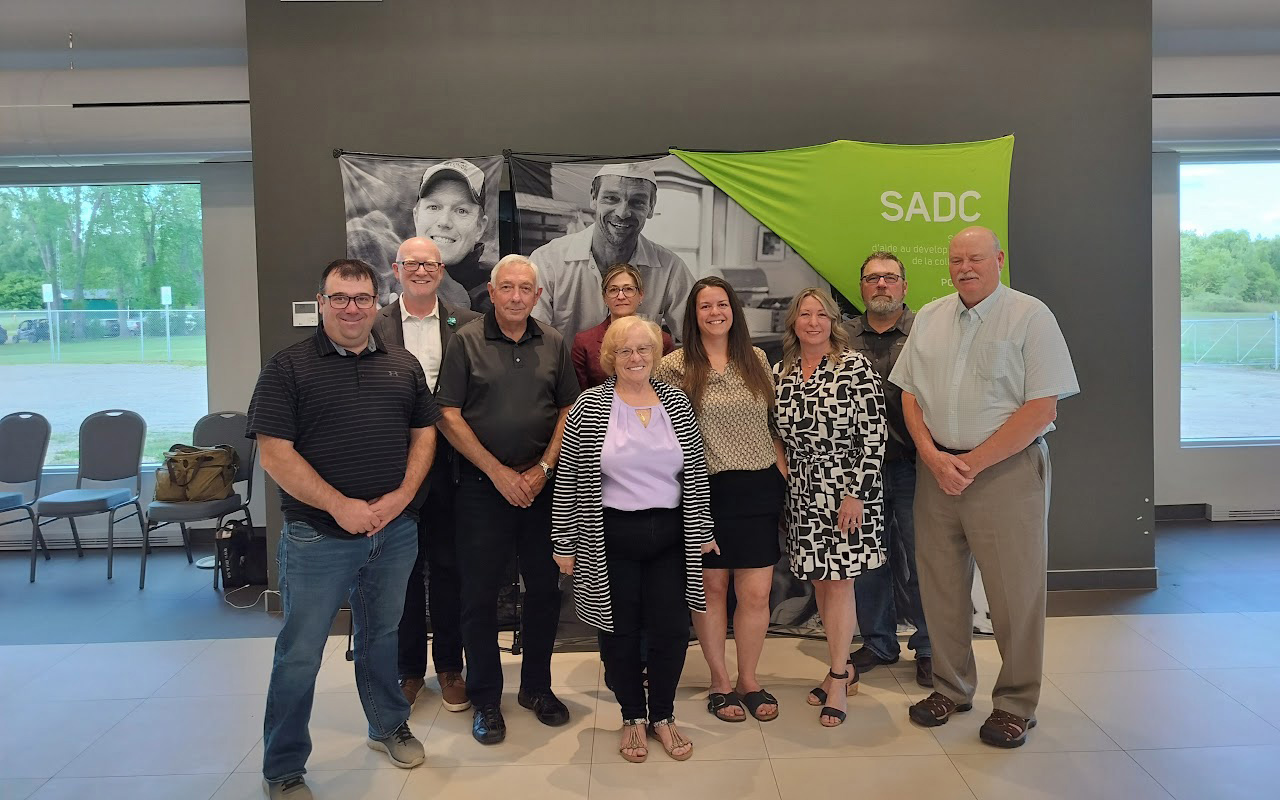



SADC Pontiac held its annual general meeting on Thursday night at the Quyon Community Centre on the occasion of the 40th year of the organization’s existence.
The organization supports local entrepreneurs in building their businesses by way of loans, skills training, and other events and services for local entrepreneurs.
On Thursday, it welcomed guests and board members alike for the AGM of its 40th year, an occasion heralded by general manager Rhonda Perry.
“Welcome to our AGM, which is a special AGM this year, it’s our 40th year. Congratulations, SADC,” she said before passing the mic over to start the evening’s meeting.
Members passed the minutes of last year’s AGM before proceeding to the 2024-25 meeting, where Perry discussed the loss of Emploi Québec’s Soutien au travail autonome (STA) program designated for start-up businesses.
“We’ve had that program [for] maybe 25 years in the region, and they’ve suspended it [ . . . ] Many individuals got their business startup due to that program,” she said in an interview after the meeting.
SADC business advisor Tracy Francoeur said in an email that three new agreements have been signed to fill the revenue gap the program’s departure has left, including agreements with the Chutes Coulonge Park, the Pontiac Chamber of Commerce, and CBDC Restigouche in New Brunswick.
“These three new partnerships have contributed to offsetting the revenue shortfall resulting from the suspension of the Soutien au travail autonome (STA) program by Emploi Québec,” she wrote.
In the meeting, Perry also discussed three new programs the SADC began offering this year, including one for green shifts, one for succession planning, and another for digital transitions.
She added that the digital shift is one that is particularly in demand in the Pontiac, and that they are organizing a conference this year on the topic to teach business owners how to use it to their advantage.
“What we’re focusing on is different AI programming platforms to showcase to the businesses what’s available to them,” she said. “People want to be able to book online reservations. They want to see things online. They want a response.”
Perry said the organization had more applications this year, although it did not see a huge shift in the kinds of applications being submitted.
“We had a busy year,” she said. “The sectors were agriculture, we had tourism, eco-adventure, accommodations, retail sectors for some of our basic needs in the communities, those types of businesses.”
Fifty-three per cent of applicants for 2024-25 were from the service/commercial sector, compared to 71.5 per cent the previous year. Tourism applications rose to 28 per cent this year versus 14.5 per cent the year prior, and agriculture applications rose to 11 per cent from 7 per cent the year before.
Francoeur said in 2024-25 the SADC issued 21 new loans representing $1,171,200, as compared to 16 loans at $781,000 the year prior.
“The increase in small business loan applications [ . . . ] can be attributed to a combination of enhanced government support, targeted loan programs, a focus on green and digital transitions, increased demand for financial assistance and support for key sectors,” she wrote.
Francoeur added that some businesses that may have struggled during the pandemic are finally finding the stability to seek growth opportunities.
“Businesses previously operating in survival mode during the pandemic years may now have found the confidence and stability to pursue growth and innovation initiatives,” she said.
The meeting concluded with the board election. Five members were re-elected to the board, including Donald Gagnon in the Pontiac West entrepreneur seat, Kristine Amyotte-Beck in the Pontiac East entrepreneur seat, Ken Pack in the entrepreneur seat, Paul Boisvert in the youth entrepreneur seat, and Rita Payne in the business seat.
On the occasion of the organization’s 40th anniversary, Perry said the organization will be visiting each of the Pontiac’s 19 municipalities, a project she said plays two roles: to see what the situation is for businesses in various communities, and to remind people the organization is there to help.
“Programs have changed, people are not up to date. It’s tough to communicate to people with these chances, and I think just going to hear what their concerns are, what challenges they’re living, or what’s going on. [It’s] to be more present, more grassroots,” she said.
La SADC Pontiac a tenu son assemblée générale annuelle jeudi soir au Centre communautaire de Quyon à l’occasion de son 40e anniversaire.
L’organisation soutient les entrepreneurs locaux dans le développement de leurs entreprises par le biais de prêts, de formations et d’autres événements et services.
Jeudi, elle a accueilli invités et membres du conseil d’administration pour son AGA à l’occasion de sa 40e année, un événement salué par la directrice générale Rhonda Perry.
« Bienvenue à notre AGA, qui est une AGA spéciale cette année, c’est notre 40e année. Félicitations, SADC », a-t-elle déclaré avant de passer le micro pour commencer la réunion de la soirée.
Les membres ont adopté le procès-verbal de l’AGA de l’année dernière avant de passer à la réunion 2024-2025, où Mme Perry a discuté de la perte du programme Soutien au travail autonome (STA) d’Emploi Québec, destiné aux entreprises en démarrage.
« Nous avons eu ce programme pendant peut-être 25 ans dans la région, et ils l’ont suspendu [ . . . ] De nombreuses personnes ont pu démarrer leur entreprise grâce à ce programme », a-t-elle déclaré dans une entrevue après la réunion.
La conseillère aux entreprises de la SADC, Tracy Francoeur, a déclaré dans un courriel que trois nouvelles ententes ont été signées pour combler le manque à gagner laissé par le départ du programme, notamment des ententes avec le Parc des Chutes Coulonge, la Chambre de commerce du Pontiac et la CBDC Restigouche au Nouveau-Brunswick.
« Ces trois nouveaux partenariats ont contribué à compenser le manque à gagner résultant de la suspension du programme Soutien au travail autonome (STA) par Emploi Québec », a-t-elle écrit.
Lors de la réunion, Mme Perry a également discuté de trois nouveaux programmes que la SADC a commencé à offrir cette année, dont un pour les virages verts, un pour la planification de la relève et un autre pour les transitions numériques.
Elle a ajouté que le virage numérique est particulièrement en demande dans le Pontiac, et qu’ils organisent cette année une conférence sur le sujet pour enseigner aux propriétaires d’entreprise comment l’utiliser à leur avantage.
« Ce sur quoi nous nous concentrons, ce sont différentes plateformes de programmation d’IA pour montrer aux entreprises ce qui leur est offert », a-t-elle déclaré. « Les gens veulent pouvoir faire des réservations en ligne. Ils veulent voir les choses en ligne. Ils veulent une réponse. »
Mme Perry a déclaré que l’organisation avait reçu plus de demandes cette année, bien qu’elle n’ait pas constaté de changement majeur dans le type de demandes soumises.
« Nous avons eu une année occupée », a-t-elle déclaré. « Les secteurs étaient l’agriculture, le tourisme, l’écotourisme, l’hébergement, les commerces de détail pour certains de nos besoins fondamentaux dans les communautés, ces types d’entreprises. »
Cinquante-trois pour cent (53 %) des demandeurs pour 2024-2025 provenaient du secteur des services/commercial, comparativement à 71,5 % l’année précédente. Les demandes liées au tourisme ont augmenté pour atteindre 28 % cette année, contre 14,5 % l’année précédente, et les demandes liées à l’agriculture ont augmenté pour atteindre 11 % contre 7 % l’année d’avant.
Mme Francoeur a déclaré qu’en 2024-2025, la SADC a octroyé 21 nouveaux prêts représentant 1 171 200 $, comparativement à 16 prêts de 781 000 $ l’année précédente.
« L’augmentation des demandes de prêts aux petites entreprises [ . . . ] peut être attribuée à une combinaison de soutien gouvernemental accru, de programmes de prêts ciblés, d’un accent sur les transitions vertes et numériques, d’une demande accrue d’aide financière et de soutien aux secteurs clés », a-t-elle écrit.
Mme Francoeur a ajouté que certaines entreprises qui ont pu être en difficulté pendant la pandémie trouvent enfin la stabilité nécessaire pour rechercher des opportunités de croissance.
« Les entreprises qui fonctionnaient auparavant en mode survie pendant les années de pandémie pourraient maintenant avoir trouvé la confiance et la stabilité nécessaires pour poursuivre des initiatives de croissance et d’innovation », a-t-elle déclaré.
La réunion s’est terminée par l’élection du conseil d’administration. Cinq membres ont été réélus au conseil, notamment Donald Gagnon au poste d’entrepreneur du Pontiac Ouest, Kristine Amyotte-Beck au poste d’entrepreneure du Pontiac Est, Ken Pack au poste d’entrepreneur, Paul Boisvert au poste d’entrepreneur jeunesse, et Rita Payne au poste d’affaires.
À l’occasion du 40e anniversaire de l’organisation, Mme Perry a déclaré que l’organisation visitera chacune des 19 municipalités du Pontiac, un projet qui, selon elle, a un double rôle : voir quelle est la situation des entreprises dans les diverses communautés, et rappeler aux gens que l’organisation est là pour aider.
« Les programmes ont changé, les gens ne sont pas à jour. C’est difficile de communiquer avec les gens au sujet de ces changements, et je pense que le fait d’aller simplement écouter leurs préoccupations, les défis qu’ils vivent, ou ce qui se passe. C’est pour être plus présente, plus proche de la base », a-t-elle déclaré.