


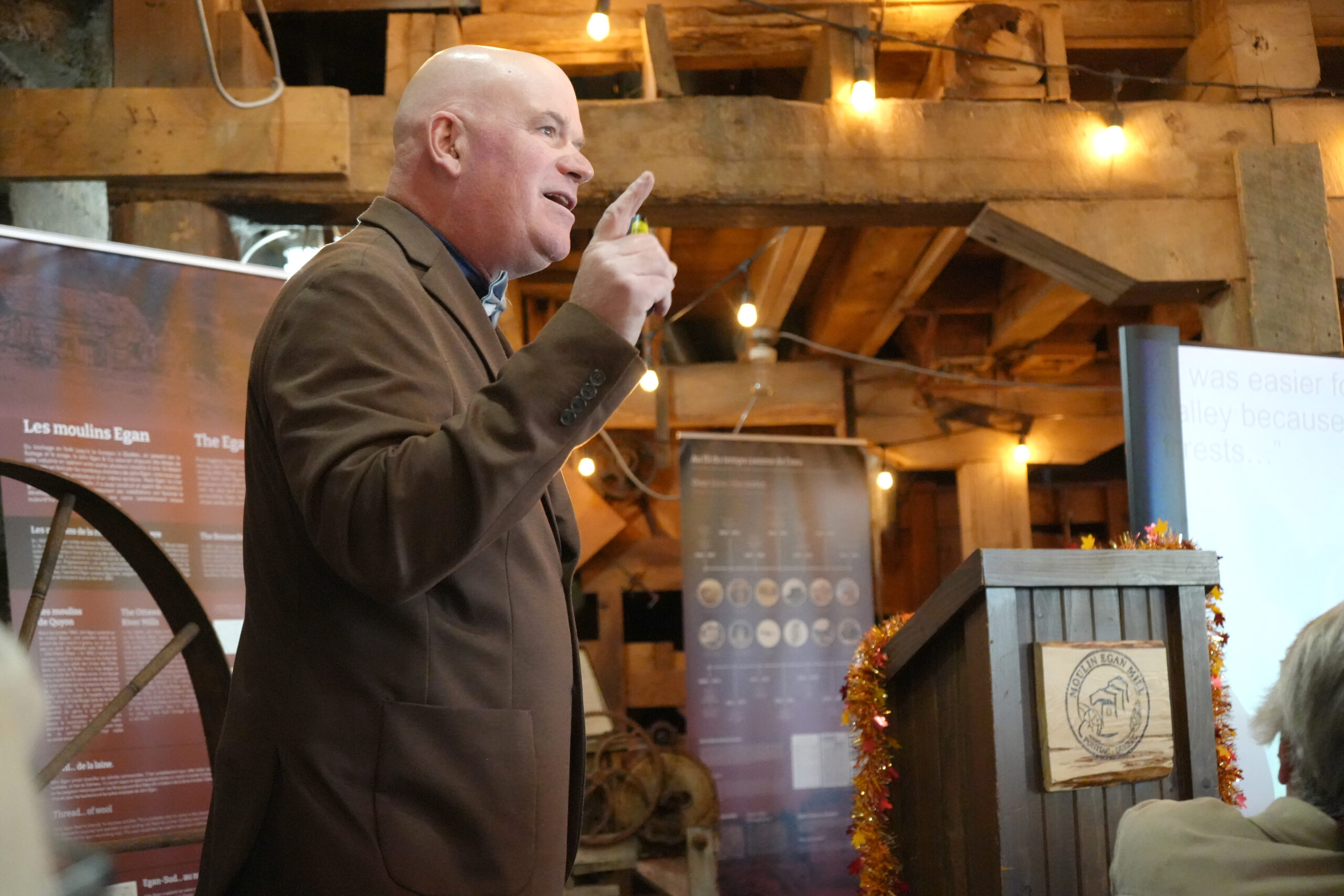



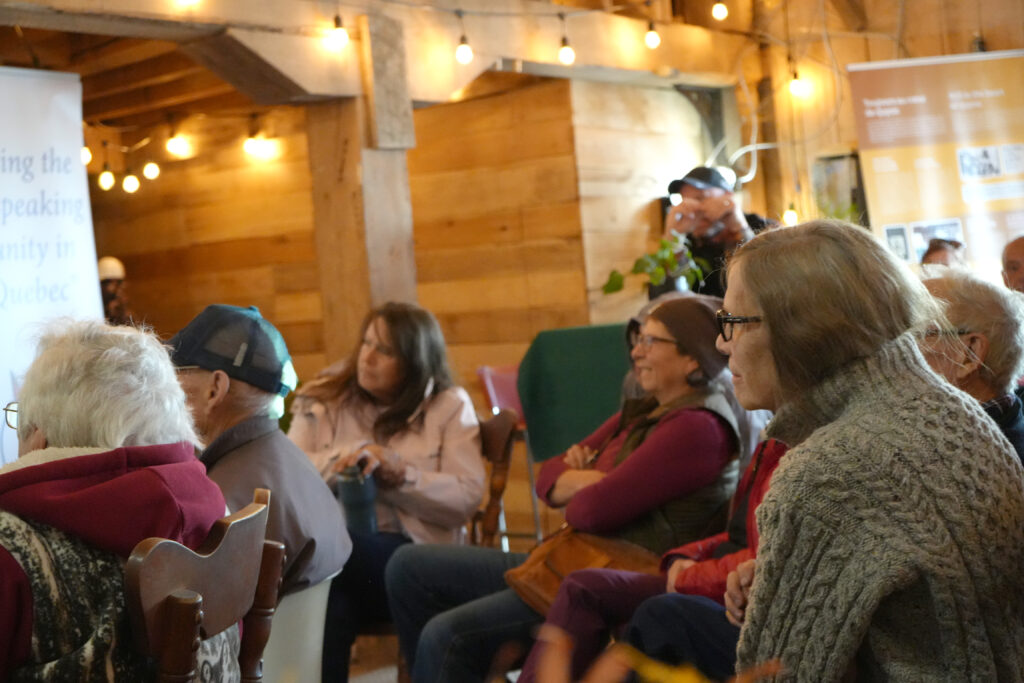
The Egan Mill in Quyon played host to a talk from local history buff Gord Graham on Saturday afternoon about some of the Pontiac’s first settlers.
The event was the third in a series of talks organized by the Regional Association of West Quebecers (RAWQ) meant to illuminate the region’s anglophone history.
Graham, a former teacher at Pontiac High School, presented a talk encouraging the packed crowd to put themselves in the shoes of the original Pontiac settlers, many of whom were Irish Catholics, Irish Protestants and Scottish immigrants, while others yet were Loyalists who had come north from America to Canada to remain loyal to the British Crown.
“By 1810, there were people living in the Quyon area, most of them were Loyalists,” said Graham, adding that many settlers came for the promise of land and vast open spaces.
“Land gave you independence, it gave you the means to support yourself, and for so many from the British Isles who were tenants, here was the true link to liberty.”
Graham described the early conditions that many settlers had to face, including having to clear the land before building on it. Then, once the land was cleared and a house was built, many of life’s necessities we take for granted today were well-earned.
“How many hours do we have to devote today to our food and shelter, compared to what they would have [done]?,” he asked, noting that every family member played a crucial role in the workings of the farmstead.
“The wife was so key to the farmstead. She did the dairy, did the milking, looked after the livestock, made sure there was food on the table when you came in.”
Graham guided attendees through the transition from sparse rough-shod settlements to, in the late 1800s, an emerging timber industry that was a major economic driver of the region.
“The timber industry was really good for the Pontiac, because the farmers could supply the timber industry with food, with hay, with oats
[ . . . ] and the merchants were the link between the farmers and the timber industry.”
Graham said that is the “traditional” story of the Pontiac, the one we have heard over and over. But he said it is often the “fiddly bits”, or the small details, of history that make it interesting to us today even though they were taken for granted in a previous time.
“A lot of this stuff was common sense, but who writes it down? Everybody knew.”
Graham also encouraged attendees to reflect on some of these “unanswered” questions from the history of the Pontiac – questions he said cannot easily be found in the history books.
What was everyday life like in the lumber camps? How did settlers decide where on their big lots to build their houses? Why did the original settlers come here? Did those settlers consider themselves as immigrants?
Graham summed up his talk by adding that the Pontiac story is the Canadian story in a nutshell, featuring themes such as industry, boom and bust, language diversity, and more.
“We’re part of the Canadian story right here. Every theme in Canadian history [is] right here.”
RAWQ director Alina Holmes, who organized the event alongside three other events in the Outaouais celebrating the anglophone heritage of the region, said the idea was to connect the history of English-speaking communities in Aylmer, Wakefield, the Pontiac and beyond.
“What I wanted to do was have a series [ . . . ] that went place to place throughout the Outaouais and connected all of these spots, because they’re so intertwined and I think it’s so important for people to understand why there are so many English speakers in this area,” she said.
Holmes said when she found out Graham was retiring in the spring (and that suddenly he’d have a bit more time on his hands) she asked him to be a part of the series.
“Gord has an incredible database of knowledge in his brain about local history. He’s also a phenomenal speaker and has a way of relaying that knowledge that is engaging and relatable,” she said.
“It’s often forgotten how we got here and why we’re here, and why it’s so important that the knowledge and the vitality of these communities is promoted and supported.”
Le moulin Egan, à Quyon, a accueilli samedi après-midi une conférence de Gord Graham, un passionné d’histoire locale, sur certains des premiers colons du Pontiac.
L’événement était le troisième d’une série de conférences organisées par l’Association régionale des Ouest-Québécois (RAWQ), destinées à éclairer l’histoire anglophone de la région.
M. Graham, ancien professeur à l’école secondaire Pontiac, a présenté une conférence encourageant la foule nombreuse à se mettre dans la peau des premiers colons du Pontiac, dont beaucoup étaient des catholiques irlandais, des protestants irlandais et des immigrants écossais, tandis que d’autres étaient des Loyalistes venus du sud, des États-Unis au Canada, pour rester fidèles à la Couronne britannique.
« Dès 1810, il y avait des gens qui vivaient dans la région de Quyon, la plupart étaient des Loyalistes », a déclaré M. Graham, ajoutant que de nombreux colons étaient venus pour la promesse de terres et de vastes espaces ouverts.
« La terre vous donnait l’indépendance, elle vous donnait les moyens de subvenir à vos besoins, et pour tant de gens des îles britanniques qui étaient locataires, c’était le véritable lien avec la liberté. »
M. Graham a décrit les premières conditions auxquelles de nombreux colons ont dû faire face, y compris le défrichage des terres avant d’y construire. Puis, une fois la terre défrichée et une maison construite, beaucoup des nécessités de la vie que nous tenons pour acquises aujourd’hui étaient bien méritées.
« Combien d’heures devons-nous consacrer aujourd’hui à notre nourriture et à notre logement, comparativement à ce qu’ils auraient [fait] ? », a-t-il demandé, notant que chaque membre de la famille jouait un rôle crucial dans le fonctionnement de la ferme.
« L’épouse était si essentielle à la ferme. Elle s’occupait des produits laitiers, trayait, s’occupait du bétail, s’assurait qu’il y avait de la nourriture sur la table quand vous rentriez. »
M. Graham a guidé les participants à travers la transition des maigres établissements rudimentaires vers, à la fin des années 1800, une industrie forestière émergente qui était un moteur économique majeur de la région.
« L’industrie forestière était vraiment bonne pour le Pontiac, car les agriculteurs pouvaient approvisionner l’industrie forestière en nourriture, en foin, en avoine
[ . . . ] et les marchands étaient le lien entre les agriculteurs et l’industrie forestière. »
M. Graham a dit que c’est l’histoire « traditionnelle » du Pontiac, celle que nous avons entendue maintes et maintes fois. Mais il a ajouté que ce sont souvent les « petits détails », ou les petites particularités, de l’histoire qui la rendent intéressante pour nous aujourd’hui, même si elles étaient tenues pour acquises à une époque précédente.
« Beaucoup de ces choses relevaient du bon sens, mais qui les écrivait ? Tout le monde savait. »
M. Graham a également encouragé les participants à réfléchir à certaines de ces questions « sans réponse » de l’histoire du Pontiac – des questions qui, selon lui, ne se trouvent pas facilement dans les livres d’histoire.
À quoi ressemblait la vie quotidienne dans les camps de bûcherons ? Comment les colons décidaient-ils où construire leurs maisons sur leurs grands lots ? Pourquoi les premiers colons sont-ils venus ici ? Ces colons se considéraient-ils comme des immigrants ?
M. Graham a résumé sa conférence en ajoutant que l’histoire du Pontiac est l’histoire canadienne en résumé, mettant en vedette des thèmes tels que l’industrie, les cycles d’expansion et de récession, la diversité linguistique, et plus encore.
« Nous faisons partie de l’histoire canadienne, ici même. Chaque thème de l’histoire canadienne [est] ici même. »
La directrice de la RAWQ, Alina Holmes, qui a organisé l’événement en parallèle à trois autres dans l’Outaouais célébrant le patrimoine anglophone de la région, a déclaré que l’idée était de relier l’histoire des communautés anglophones d’Aylmer, de Wakefield, du Pontiac et d’ailleurs.
« Ce que je voulais faire, c’était une série [ . . . ] qui allait de lieu en lieu dans tout l’Outaouais et reliait tous ces endroits, parce qu’ils sont si liés et je pense qu’il est si important pour les gens de comprendre pourquoi il y a tant d’anglophones dans cette région », a-t-elle déclaré.
Mme Holmes a dit que lorsqu’elle a appris que M. Graham prenait sa retraite au printemps (et qu’il aurait soudainement un peu plus de temps libre), elle lui a demandé de faire partie de la série.
« Gord a une base de données de connaissances incroyable dans son cerveau sur l’histoire locale. C’est aussi un orateur phénoménal et il a une façon de transmettre ces connaissances qui est engageante et pertinente », a-t-elle déclaré.
« On oublie souvent comment nous sommes arrivés ici et pourquoi nous sommes ici, et pourquoi il est si important que la connaissance et la vitalité de ces communautés soient promues et soutenues. »