


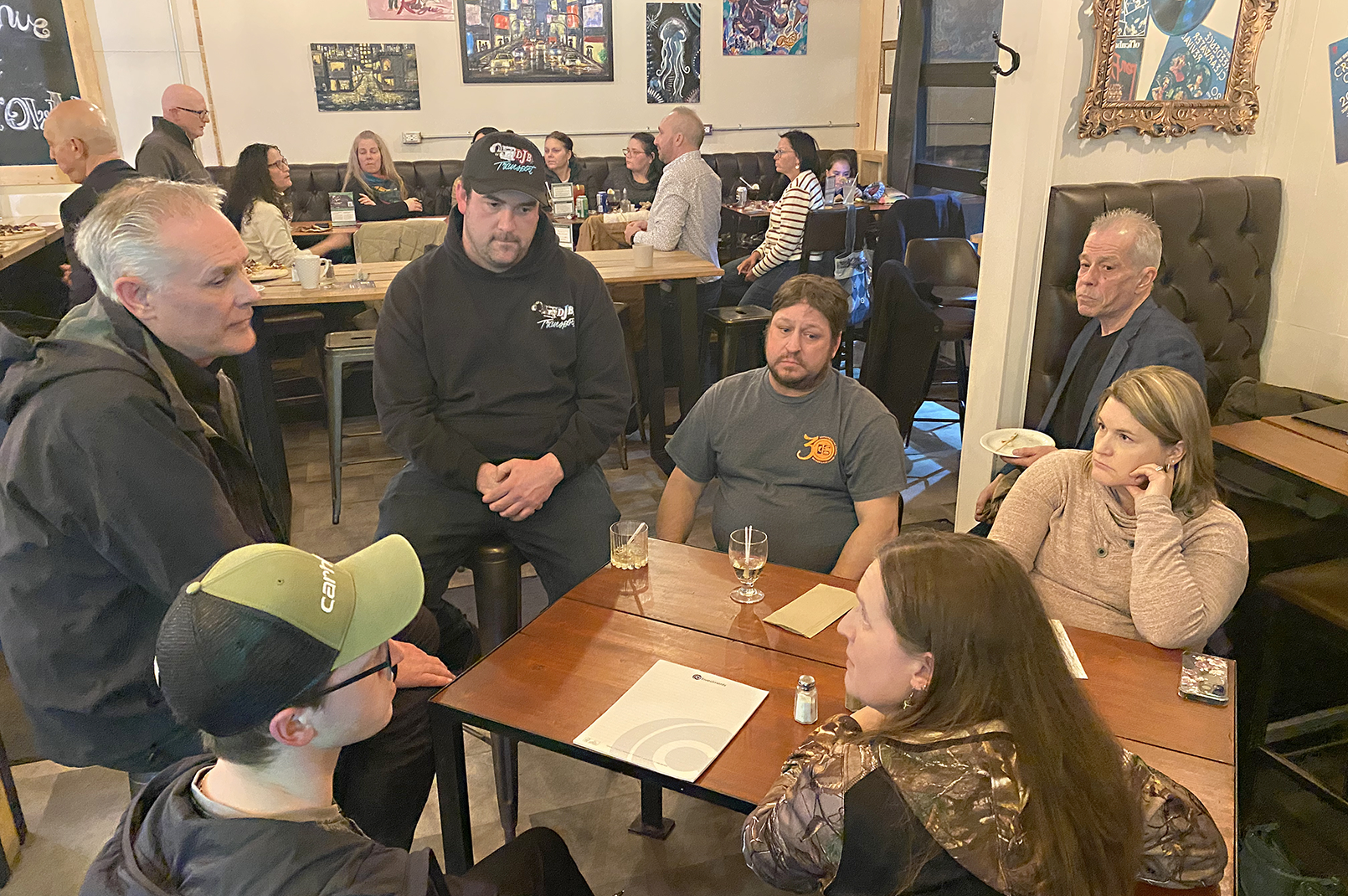



The Pontiac Chamber of Commerce brought together local business owners, organization directors and municipal leaders from across the Pontiac last Wednesday evening for a discussion about how to make sense of the chaos caused by tariff threats, and how to use this moment of economic volatility to build a more resilient local economy.
The evening’s guest speaker was Pedro Antunes, chief economist with the Conference Board of Canada. He offered his analysis of what the U.S. administration is trying to accomplish with its attack on its longstanding trade relationship with Canada, ultimately concluding the tariff threats are mostly bark, and a little bite.
“The hope that I have is that there is a strategy, and that is to create this anxiety, to create this uncertainty, so that he moves investment even without the bite of tariffs,” Antunes said, reminding the audience that President Donald Trump used a similar strategy when he first entered office in 2016.
“What scares me a little more this time is that the U.S. has a second problem now which is not only this move to try to bring investment home but it’s also the issue of its deficit [ . . . ] They’ve got a problem where they need to raise revenues, and if they’re looking at tariffs to generate their revenues, that’s a really scary thought.”
Antunes said he doesn’t believe the tariffs scheduled for Apr. 2 will be placed on resources, as this would be too damaging to the U.S. economy, but does believe they will still be hurtful.
While leading with a message of hope, Antunes still provided a forecast for how 25 per cent tariffs, combined with 10 per cent tariffs on resources, and counter-tariffs applied by the Canadian government, would affect the Canadian economy.
“A 25 per cent tariff for one quarter, it would be huge. It would shut down most of our manufacturing, at least temporarily [ . . . ] because all of our manufacturing goes back and forth across the border.”
He said the hit to the Canadian economy would be about $35 billion at the national level and 136,000 jobs lost, which he said is about a 1.3 per cent out of the economy, in one quarter.
“The longer we get a tariff, the bigger the hit would be to the point that we end up with a recession [ . . . ] if these tariffs last more than four quarters,” Antunes said. “The point here I’m trying to make is that there’s too much uncertainty about how long these tariffs might last to know how deep the impacts might be.”
Responding to volatility
It’s to help local leaders make sense of and claim agency in relation to this economic uncertainty that the Chamber decided to host Wednesday’s event.
“When there’s volatility, it then challenges every dimension of your business, but we’re all trying to build predictable organizations, predictable systems so that we know where our products, our supplies, our resources, are coming from, we know how to transform and improve them, we know how to sell and distribute them,” said Trefor Munn-Venn, local business owner and board member with the Pontiac Chamber of Commerce.
“And now all those pieces are less clear than before, and with that volatility comes uncertainty and fear [ . . . ] I think the recent volatility is helping to reveal that the greatest economic strength we have is each other. It’s the relationships we have, the partnerships we have, the supply chains we have, to be able to problem solve together. It’s the collective piece that needs to come together.”
Following Antunes’ presentation, Munn-Venn invited attendees to brainstorm ways their businesses and organizations could build resilience into the local supply chain.
“I think at the end of the day, to be able to come together to do that problem-solving, to use that collaboration as an economic asset , this is how we thrive,” Munn-Venn said.
Among the business owners in attendance was Denis LeBrun, who’s been running Bryson Lake Lodge with his family for over 30 years.
“We’re a little nervous because our clientele base is about 25 per cent from the States, which has always been good because we try to have balanced groups coming from different regions,” LeBrun said.
“We’re noticing a lot of Americans are calling us and some are cancelling right now. The [new customers] are too worried about the border problems and they’re feeling not welcome by Canadians.”
In response, LeBrun said he’s spending more time advertising his outfitter business at local trade shows, rather than trying to reach U.S. customers.
“I think it’s going to be like covid, where people are not going to want to travel far and we’re really promoting shop local, fish local.”
Also in attendance was Mansfield councilor Sébastien Denault, also co-owner of Mansfield-based Méo Excavation.
“I feel we need to support ourselves as business people, as contractors, I feel we need to work together to build a stronger economy, instead of turning our backs to our competitors,” he said.
“I wish there were more contractors here who buy lots of stuff exported like aluminum, let’s say for building houses [ . . . ] It’s eye-opening.”
La Chambre de commerce de Pontiac a réuni des propriétaires d’entreprises locales, des directeurs d’organisations et des dirigeants municipaux de partout au Pontiac mercredi soir dernier pour discuter de la manière de comprendre le chaos causé par les menaces tarifaires, et comment utiliser ce moment de volatilité économique pour bâtir une économie locale plus résiliente.
Le conférencier invité de la soirée était Pedro Antunes, économiste en chef du Conference Board du Canada. Il a offert son analyse de ce que l’administration américaine tente d’accomplir avec son attaque contre sa relation commerciale de longue date avec le Canada, concluant finalement que les menaces tarifaires sont surtout du bluff, et un peu de mordant.
« L’espoir que j’ai, c’est qu’il y a une stratégie, et c’est de créer cette anxiété, de créer cette incertitude, afin qu’il déplace les investissements même sans le mordant des tarifs », a dit M. Antunes, rappelant à l’auditoire que le président Donald Trump a utilisé une stratégie similaire lors de son entrée en fonction en 2016.
« Ce qui me fait un peu plus peur cette fois-ci, c’est que les États-Unis ont maintenant un deuxième problème qui n’est pas seulement cette volonté de rapatrier les investissements, mais aussi la question de leur déficit [ . . . ] Ils ont un problème où ils doivent augmenter leurs revenus, et s’ils envisagent les tarifs pour générer leurs revenus, c’est une pensée vraiment effrayante. »
M. Antunes a déclaré qu’il ne croyait pas que les tarifs prévus pour le 2 avril seraient imposés sur les ressources naturelles, car cela serait trop dommageable pour l’économie américaine, mais il croit qu’ils seront tout de même nuisibles.
Tout en commençant par un message d’espoir, M. Antunes a tout de même fourni des prévisions sur la façon dont des tarifs de 25 %, combinés à des tarifs de 10 % sur les ressources naturelles, et à des contre-tarifs appliqués par le gouvernement canadien, affecteraient l’économie canadienne.
« Un tarif de 25 % pour un trimestre, ce serait énorme. Cela paralyserait la majeure partie de notre industrie manufacturière, du moins temporairement [ . . . ] parce que toute notre fabrication traverse la frontière dans les deux sens. »
Il a indiqué que l’impact sur l’économie canadienne s’élèverait à environ 35 milliards $ au niveau national et à 136 000 emplois perdus, ce qui représente, selon lui, environ 1,3 % de l’économie, en un seul trimestre.
« Plus un tarif dure, plus l’impact sera important au point que nous nous retrouverons avec une récession [ . . . ] si ces tarifs durent plus de quatre trimestres », a dit M. Antunes. « Le point que j’essaie de faire valoir ici est qu’il y a trop d’incertitude quant à la durée de ces tarifs pour savoir quelle sera l’ampleur des impacts. »
Réagir à la volatilité
C’est pour aider les dirigeants locaux à comprendre cette incertitude économique et à y prendre part que la Chambre a décidé d’organiser l’événement de mercredi.
« Quand il y a de la volatilité, cela remet en question toutes les dimensions de votre entreprise, mais nous essayons tous de bâtir des organisations prévisibles, des systèmes prévisibles afin de savoir d’où proviennent nos produits, nos fournitures, nos ressources, nous savons comment les transformer et les améliorer, nous savons comment les vendre et les distribuer », a déclaré Trefor Munn-Venn, propriétaire d’entreprise locale et membre du conseil d’administration de la Chambre de commerce de Pontiac.
« Et maintenant, toutes ces pièces sont moins claires qu’avant, et avec cette volatilité viennent l’incertitude et la peur [ . . . ] Je pense que la récente volatilité contribue à révéler que la plus grande force économique que nous ayons, c’est nous-mêmes. Ce sont les relations que nous entretenons, les partenariats que nous avons, les chaînes d’approvisionnement que nous avons, pour être capables de résoudre les problèmes ensemble. C’est la pièce collective qui doit s’assembler. »
Après la présentation de M. Antunes, M. Munn-Venn a invité les participants à réfléchir à des façons dont leurs entreprises et organisations pourraient renforcer la résilience de la chaîne d’approvisionnement locale.
« Je pense qu’en fin de compte, être capables de nous réunir pour résoudre des problèmes, d’utiliser cette collaboration comme un atout économique, c’est ainsi que nous prospérons », a dit M. Munn-Venn.
Parmi les propriétaires d’entreprises présents se trouvait Denis LeBrun, qui gère le Bryson Lake Lodge avec sa famille depuis plus de 30 ans.
« Nous sommes un peu nerveux parce qu’environ 25 % de notre clientèle provient des États-Unis, ce qui a toujours été bien parce que nous essayons d’avoir des groupes équilibrés provenant de différentes régions », a dit M. LeBrun.
« Nous remarquons que beaucoup d’Américains nous appellent et certains annulent en ce moment. Les [nouveaux clients] sont trop inquiets des problèmes frontaliers et ils ne se sentent pas les bienvenus chez les Canadiens. »
En réponse, M. LeBrun a dit qu’il passait plus de temps à faire la promotion de son entreprise de pourvoirie lors de salons professionnels locaux, plutôt que d’essayer d’atteindre les clients américains.
« Je pense que ce sera comme la COVID, où les gens ne voudront pas voyager loin et nous faisons vraiment la promotion d’acheter local, de pêcher local. »
Était également présent Sébastien Denault, conseiller municipal de Mansfield, également copropriétaire de Méo Excavation, basée à Mansfield.
« Je pense que nous devons nous soutenir en tant qu’hommes d’affaires, en tant qu’entrepreneurs, je pense que nous devons travailler ensemble pour bâtir une économie plus forte, au lieu de tourner le dos à nos concurrents », a-t-il dit.
« J’aimerais qu’il y ait plus d’entrepreneurs ici qui achètent beaucoup de produits exportés comme l’aluminium, disons pour la construction de maisons [ . . . ] C’est révélateur. »