


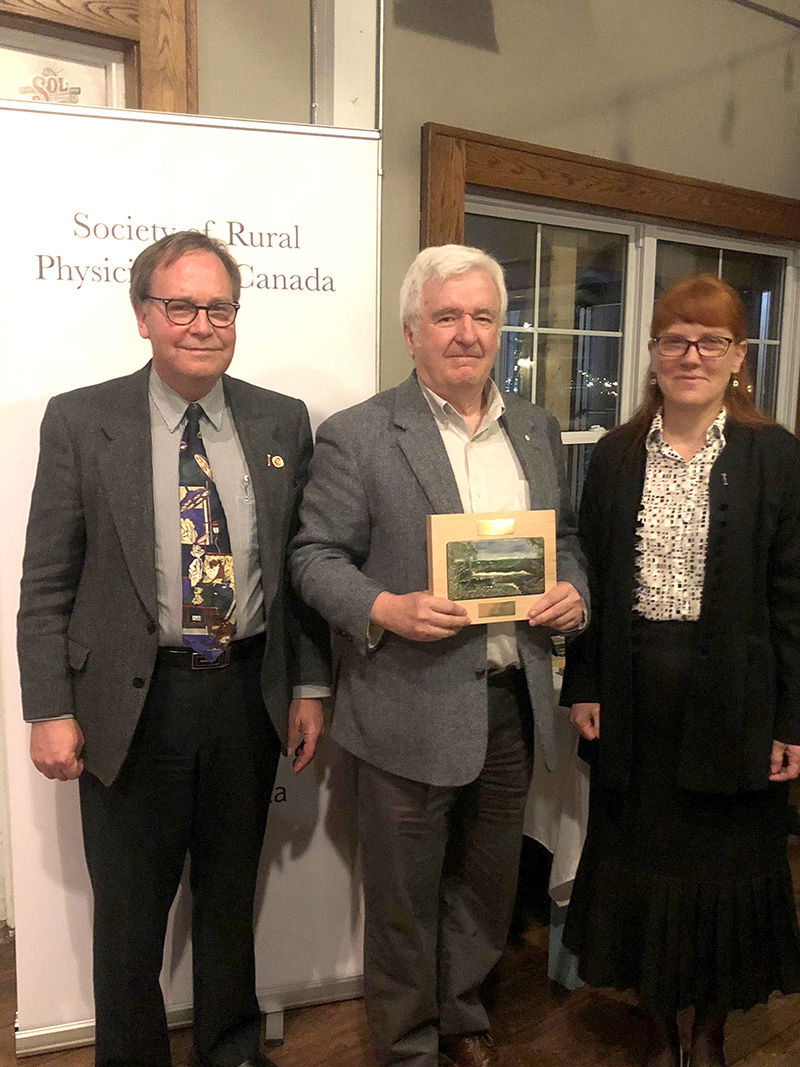



Two local physicians were recognized earlier this month for their longstanding contributions to rural medicine.
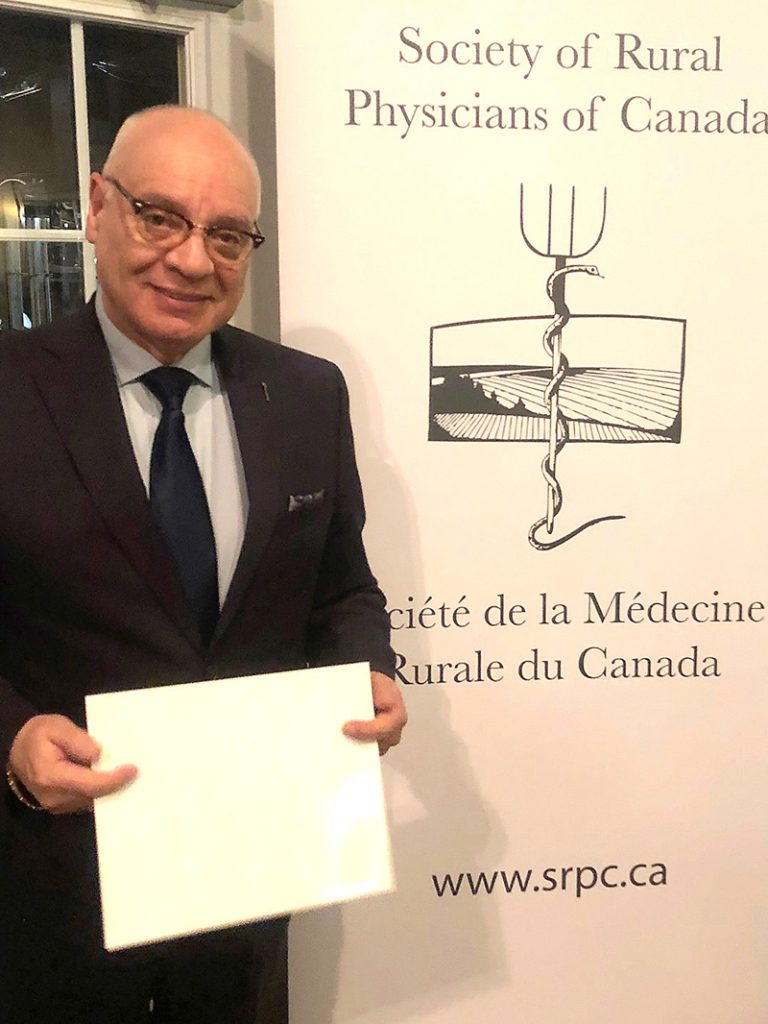
Dr. Luis Rivero Pinelo was presented with the Rural Long Service Award and Dr. Keith MacLellan was honoured with the Rural Leadership Award from the Society of Rural Physicians of Canada (SRPC). The awards were presented at the Society’s 27th Annual Rural and Remote Medicine Course in Halifax, N.S. on April 5.
The SRPC was founded in 1992 to champion rural medical care through education, advocacy, collaboration and research. The group has over 1,500 members nation-wide and is based in Shawville.
Pinelo started working in the area in 1998 after emigrating from Argentina and completing a master’s degree in Montreal. He was very pleased to be recognized by the organization.
“We work hard, we try to provide good care, be ahead of many big centres around, so yes it’s very rewarding,” he said, noting that he quickly became involved in the SRPC once he moved here. “Shawville is kind of the crown of rural medicine in Canada.”
The Rural Long Service award is given to physicians who have served in a rural setting for more than 20 years and have already received the Rural Service Award.
As both a GP and a gastroenterologist, Pinelo was very involved with the endoscopy unit at the Pontiac Community Hospital (PCH), which he said has greatly expanded its capabilities. He added that 60 to 65 per cent of the patients he sees travel from the city.
“It’s not only a service we provide locally but regionally,” he said. “Our endoscopy unit is above all standards in Quebec.”
He said that rural medicine has plenty of challenges, from retaining new doctors to keeping various services available in the local community. Despite all these hurdles, he said that it is also incredibly rewarding to work as a country doctor.
“It’s different, the relationship with colleagues is more familiar,” he said. “This is a place that patients are more thankful, [they] recognize your efforts, [they] recognize you as a person … that is very rewarding.”
MacLellan co-founded the SRPC back in 1992, and in 2015 he received an appointment to the Order of Canada for his contribution to rural medicine. The Rural Leadership Award that he received is one of the SRPC’s most prestigious and has only been given out four times before. In 2008 it was awarded to another Shawville physician, Dr. John Wootton.
“When you get an award from your own peers, it’s pretty good,” MacLellan said. “I like it a lot.”
He spoke about how rural medicine has changed since he arrived in the region.
“In the 80s and 90s, the doctors in Shawville, there weren’t very many of us to serve the whole of the Pontiac,” he explained. “We were working, probably at least 120 hours a week or more, each. We were doing a whole wide range of practices, from obstetrics to intensive care, emergency room, to psychiatry and home calls. It occurred to me that there were, of course, lots other doctors across Canada in a similar position.”
He began organizing national conferences where physicians could educate themselves and discuss best practices from around the country. When these conferences proved popular and membership grew, MacLellan saw an avenue for the SRPC to influence healthcare policy across the country.
“So our twin goals were sustainable working conditions for rural physicians and equitable healthcare for rural communities,” he said. “That started a whole advocacy side for the society, so we did quite a lot of advocacy and we’re still doing quite a bit of it on a national level, both with our national medical organizations … our federal government and some provincial governments as well. Then came a number of policy papers, joint position papers, curriculum and so on, so it’s really snowballed.”
He said one of the highlights of his work in rural medicine was when the society presented to the Commission on the Future of Health Care in Canada (known as the Romanow Commissson) in the early 2000s.
“Chapter seven of report was on healthcare in rural and remote areas in Canada,” he said. “It just quoted exactly what we had been saying in our policy papers and so on, so we were very proud about that.”
He said that the society’s work has led to broad improvements in education, but there is plenty more work to be done.
“The short answer is, there’s been a lot of improvement on the educational front,” he said. When we started, there were no rural-specific courses, they weren’t exposing doctors in training to rural areas so they were all getting much more exposure to city medicine and specialization. Now, all the universities are sending their medical students and residents to do part of their training out in rural areas. It’s much more organized.”
He said that the tendency towards specialization in urban healthcare settings doesn’t reflect the needs of rural areas, where the limited number of doctors, nurses and other workers have to have expertise in multiple fields to distribute the workload. He pointed out several GPs in the area who also have a specialization, such as PCH’s head of anaesthesiology, Dr. Tom O’Neill.
MacLellan said that issues such as the recent surgery interruptions at the PCH could be alleviated if more rural GPs in Quebec were trained to perform caesarean sections, a practice common in the western provinces.
“There are about 800 across Canada, so it’s not rare,” he said, noting that the SRPC has produced policy papers and curriculum on the subject. “If you had something like that, one or two in Shawville, then our general surgeons doing cancer surgeries and a whole bunch of other complicated stuff in the daytime wouldn’t be woken up so much to do caesarean sections.”
“It would be politically challenging but totally doable to get the medical licensing authorities and … the Quebec Association of Obstetricians and Gynecologists to support having GP or family practice obstetricians with advanced skills, like caesarean sections,” he continued. “Take the load off the surgeons. The models are already out there, it’s just a question of putting it together politically.”
He added that it can be difficult for citizens to advocate for reforms when rural services are being pared back in a number of areas.
“Our own representatives, I don’t think are getting a consistent message from the population, that their ability to access care locally is eroding very quickly,” he said. “I think that should happen, I think we should be really complaining about it … I do think these things are fixable.”
Despite all the challenges currently faced by rural areas, MacLellan said he was pleased with all the work the SRPC has accomplished over the years in education and healthcare policy.
“I feel very proud to have been a part of starting something that has produced all these position papers, who have done all the stats and the research, that has documented what is done in other parts of the country to solve some of these problems,” he said. “It’s a good feeling that at least the information is there.”