


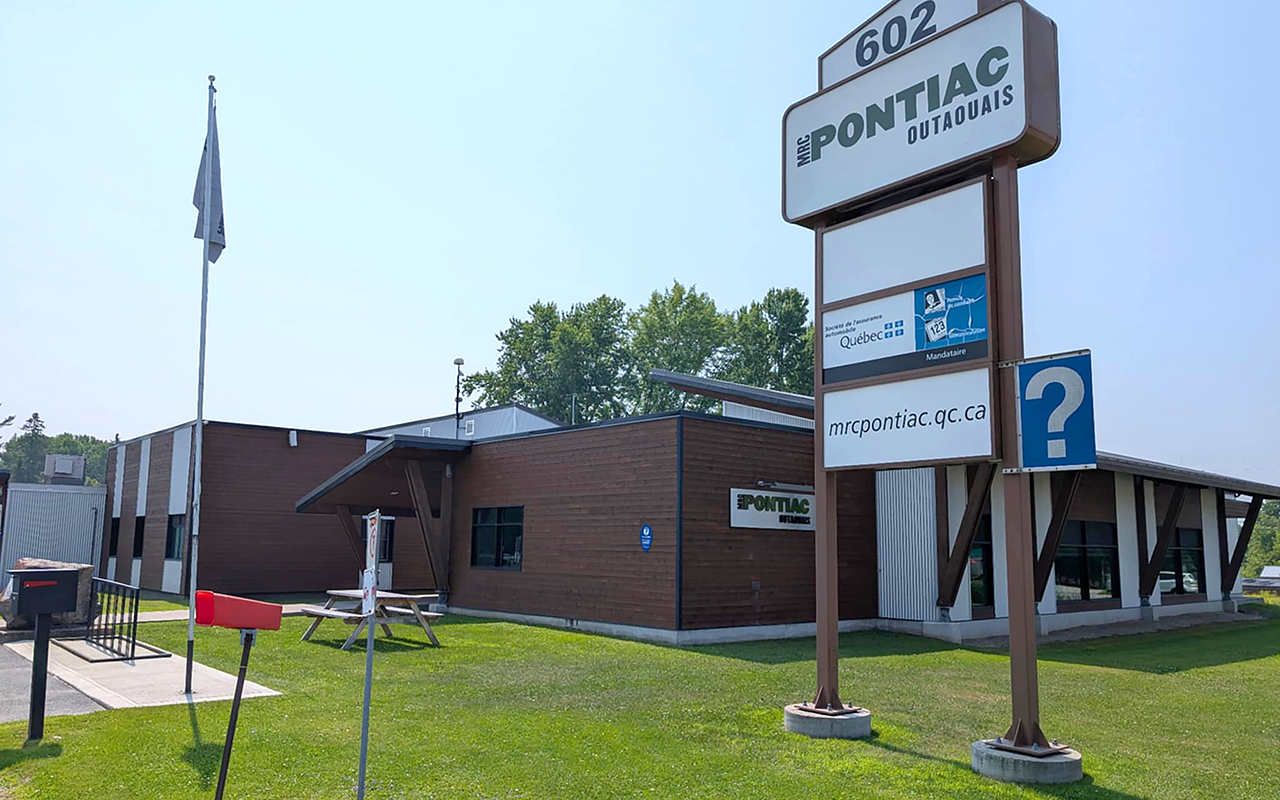



MRC Pontiac is nearing the end of its work developing a climate action plan for the region that could be used as a guide to help local municipalities adapt to climate change.
The end product will offer municipalities strategies for both how to reduce the greenhouse gas emissions they produce, as well as for to protect their residences from the impacts of climate change.
Kari Richardson, environment manager with the MRC, has been working with a consulting firm for over a year to develop this action plan. She says she expects it will be done by the end of 2025.
“[It’s] to improve [municipalities’] public security and safety policies, or change their regulations with regards to flood plains. I mean, obviously there’s provincial legislation for those things, but [it’s] just to, at the municipal level, be thinking about some of those things as well,” Richardson said.
This spring the consulting firm met with a small group of leaders from various local sectors to better understand priority areas of concern this plan should work to address.
Based on those workshops, it was determined that local infrastructure, transportation, renewable energy, waste management, civil security and emergency management, urban planning and green infrastructure, local economy and local food, and governance and mobilization were the key areas on which this action plan should focus.
The firm then developed a public survey, which closed last week, to better understand what tangible actions within those priority areas residents wanted to see included in a local climate adaptation plan, and there will be additional public consultations done before the plan is finalized.
“Our job is to be a support to the local municipalities, [and] help them help their residents,” Richardson said. “What is the technical support they need to make sure the public is safe, and to make sure their municipal infrastructures are maintained? That’s really what it’s about.”
Rural communities more vulnerable, report finds
A report published by the federal government in 2023 found Canadians living in rural and remote communities are more vulnerable to climate change and encounter more challenges when trying to adapt to mitigate its impacts.
The synthesis report, titled “Canada in a Changing Climate,” looks at research published since 2017 that offers insight into what impacts climate change is having on Canadians, and how governments are doing when it comes to adaptation.
“Compared with urban areas, rural and remote communities – including those located in northern Canada – experience higher risks to health, safety and well-being from critical infrastructure decline or failure,” the report found. “This is due to their geographic isolation, reliance on limited access points into and out of their communities, and limited access to services.”
The report also highlighted that rural economies, often dependent on industries such as agriculture and natural resource extraction, are more sensitive to a changing climate, “as they rely on favourable weather conditions and are vulnerable to extreme weather.”
The report emphasizes municipal governments are those that will be most effective in developing and implementing action plans to help protect residents from these threats.
It said that while many municipalities across the country have been developing adaptation plans, the implementation of these plans is slow, and even more so in rural communities.
One significant barrier to effective adaptation, according to the report, beyond a lack of financial resources, is a lack of human resources capacity, “often more evident in communities and organizations that are most vulnerable to climate change risks, including in rural, northern and Indigenous communities.”
Richardson said the MRC was given the green light to use some of a previous round of FRR funding from the province’s Ministry of Municipal Affairs and Housing to hire consultants to develop this plan, and has been working with MRC Papineau and MRC des Collines-de-l’Outaouais to do so.
While each MRC will have its own plan that reflects the unique challenges on its territory, teaming up with neighbouring counties made the plans’ development more cost-efficient, according to Richardson.
She said because the MRC got moving on this work before the province had announced funding specifically for the purpose of developing plans like these, the MRC will be able to use the $1 million or so it has since received to support the implementation of the adaptation plan, which Richardson said is often the more costly work.
La MRC de Pontiac est sur le point d’achever ses travaux d’élaboration d’un plan d’action climatique pour la région qui pourrait servir de guide pour aider les municipalités locales à s’adapter aux changements climatiques.
Le produit final offrira aux municipalités des stratégies à la fois pour réduire les émissions de gaz à effet de serre qu’elles produisent, et pour protéger leurs résidences des impacts des changements climatiques.
Kari Richardson, directrice de l’environnement à la MRC, travaille avec une firme de consultants depuis plus d’un an pour élaborer ce plan d’action. Elle s’attend à ce qu’il soit terminé d’ici la fin de 2025.
« [C’est] pour améliorer les politiques de sécurité publique des municipalités, ou changer leurs règlements en ce qui concerne les plaines inondables. Je veux dire, évidemment, il y a des législations provinciales pour ces choses, mais c’est juste pour que, au niveau municipal, on réfléchisse aussi à certaines de ces choses », a déclaré Mme Richardson.
Ce printemps, la firme de consultants a rencontré un petit groupe de leaders de divers secteurs locaux afin de mieux comprendre les domaines de préoccupations prioritaires que ce plan devrait viser à aborder.
Suite à ces ateliers, il a été déterminé que les infrastructures locales, le transport, l’énergie renouvelable, la gestion des déchets, la sécurité civile et la gestion des urgences, l’urbanisme et l’infrastructure verte, l’économie locale et l’alimentation locale, ainsi que la gouvernance et la mobilisation, étaient les domaines clés sur lesquels ce plan d’action devrait se concentrer.
La firme a ensuite élaboré un sondage public, qui a pris fin la semaine dernière, pour mieux comprendre quelles actions concrètes au sein de ces domaines prioritaires les résidents souhaitaient voir incluses dans un plan local d’adaptation aux changements climatiques, et des consultations publiques supplémentaires seront menées avant la finalisation du plan.
« Notre rôle est de soutenir les municipalités locales [et] de les aider à aider leurs résidents », a déclaré Mme Richardson. « Quel est le soutien technique dont elles ont besoin pour assurer la sécurité du public, et pour s’assurer que leurs infrastructures municipales sont entretenues ? C’est vraiment de cela qu’il s’agit. »
Les communautés rurales plus vulnérables, selon un rapport
Un rapport publié par le gouvernement fédéral en 2023 a révélé que les Canadiens vivant dans les communautés rurales et éloignées sont plus vulnérables aux changements climatiques et rencontrent plus de défis lorsqu’ils tentent de s’adapter pour en atténuer les impacts.
Le rapport de synthèse, intitulé « Le Canada dans un climat en évolution », examine les recherches publiées depuis 2017 qui donnent un aperçu des impacts des changements climatiques sur les Canadiens, et de la manière dont les gouvernements s’en sortent en matière d’adaptation.
« Comparées aux zones urbaines, les communautés rurales et éloignées – y compris celles situées dans le Nord canadien – sont exposées à des risques plus élevés pour la santé, la sécurité et le bien-être en raison du déclin ou de la défaillance des infrastructures essentielles », indique le rapport. « Cela est dû à leur isolement géographique, à leur dépendance à l’égard de points d’accès limités vers et depuis leurs communautés, et à l’accès limité aux services. »
Le rapport a également souligné que les économies rurales, souvent dépendantes d’industries telles que l’agriculture et l’extraction de ressources naturelles, sont plus sensibles à un climat changeant, « car elles dépendent de conditions météorologiques favorables et sont vulnérables aux phénomènes météorologiques extrêmes. »
Le rapport souligne que les gouvernements municipaux sont ceux qui seront les plus efficaces pour élaborer et mettre en œuvre des plans d’action afin d’aider à protéger les résidents de ces menaces.
Il a été dit que si de nombreuses municipalités à travers le pays ont élaboré des plans d’adaptation, la mise en œuvre de ces plans est lente, et encore plus dans les communautés rurales.
Un obstacle important à une adaptation efficace, selon le rapport, au-delà du manque de ressources financières, est un manque de capacité en ressources humaines, « souvent plus évidentes dans les communautés et les organisations les plus vulnérables aux risques liés aux changements climatiques, y compris dans les communautés rurales, nordiques et autochtones. »
Mme Richardson a déclaré que la MRC avait reçu le feu vert pour utiliser une partie d’une enveloppe précédente de financement du FRR du ministère des Affaires municipales et de l’Habitation de la province afin d’embaucher des consultants pour élaborer ce plan, et a collaboré avec la MRC de Papineau et la MRC des Collines-de-l’Outaouais pour ce faire.
Bien que chaque MRC aura son propre plan qui reflète les défis uniques de son territoire, faire équipe avec les MRC voisines a rendu l’élaboration des plans plus rentable, selon Mme Richardson.
Elle a dit que parce que la MRC avait commencé ce travail avant que la province n’ait annoncé un financement spécifiquement destiné à l’élaboration de plans comme ceux-ci, la MRC pourra utiliser le million de dollars environ qu’elle a depuis reçu pour soutenir la mise en œuvre du plan d’adaptation, ce qui, selon Mme Richardson, est souvent le travail le plus coûteux.