


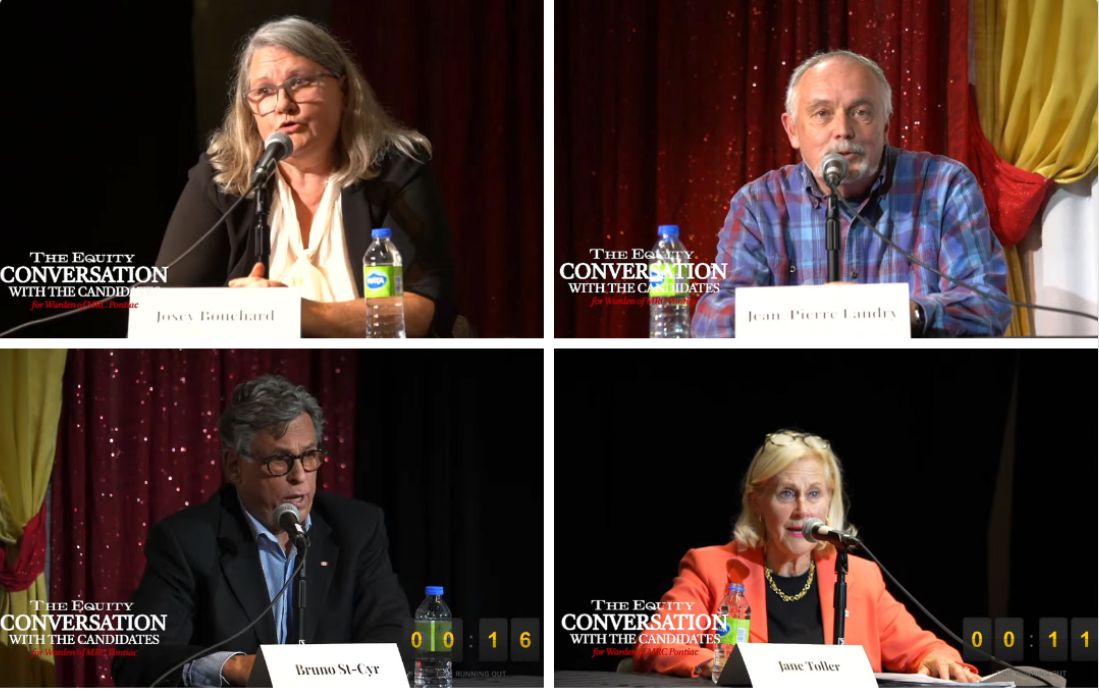



On Oct. 22, THE EQUITY hosted a livestreamed conversation with the candidates running to be MRC Pontiac’s next warden. Candidates were asked eight questions – some in French, most in English – that were based on concerns and voting priorities collected in a survey THE EQUITY circulated. Questions and answers published here have been edited for clarity and length. Candidates introductions, and discussion portions of questions four and seven are not included here, but can be viewed in our video recording of the event below.
Q1: How will you approach bringing much needed economic development to the region, as warden?
Bouchard: Of course we’re a resource-first MRC, [with] a lot of lumber industry, a lot of mining before. And now we know we need to move away from that. We need to go to secondary and tertiary types of industries. Of course, going for agriculture, agritourism, and tourism, are the three main pillars on which we can build our economy. Of course it’s always hard to move away from something we know towards something that’s different, something that might not be in our wheelhouse, but I think it’s super important to be doing that. Because this is the future of the Pontiac. We know that in the last eight years things haven’t moved a whole lot, so I think we need to pursue those ventures and go even further with those.
Landry: The forestry industry is not necessarily dead but we have to reimagine it. There are possibilities in the wood industry, but not in the type of products we used to know. We have to be innovative, we have to think outside the box, so there is a possibility there. The biomass is a great resource to develop. Also in the agro-alimentaire – agriculture is a large part of the economy and I’ve noticed that it’s diversifying itself gradually, with products and services that are quite interesting. That would be good to promote and develop. But above all, I think that before any major industrial development we have to think of our energy network, because without any proper hydro or proper energy, we can’t attract Rio Tinto or . . . . so that would need to be looked into.
St-Cyr: I always work with objectives in my career, and I would like to ask to all mayors to get objectives of economic development. I’m not the guy who can say, ‘Oh could be good, could be bad,’ about business development projects. I think that all municipalities are different. We cannot ask the municipality of Chichester to do the same thing as the municipality of Bristol or Bryson. Anyway, I think that all the mayors and all the councillors, knows better than me what kind of people they have, what kind of resources they have, and what they can do in each of their municipalities. It’s for that reason I’d like to get an objective of each municipality to get at least one project per year of economic development.
Toller: I think the most important thing is to drive job creation and to attract investors, and our biggest employer is our hospital. We really have to protect our hospital and our doctors. I had focused on forestry and agriculture because I agree, there are innovative ways to have forestry. [ . . . ] We also have a lot of local wood producers that we really need to work more closely with. I think agritourism and just tourism in general has really taken on a life of its own. We have to, with agriculture, get the abattoir and Agrisaveur projects moving forward, and contrary to what’s been in the media, the solar project is far from over. Also a trade school for the youth. We have jobs in the trades that are needed [ . . . ] I think the opportunity to have carpentry and plumbing and electrical, it will keep our youth here, and those are good paying jobs.
Q2: [This question and the answers were given in French and translated to English by THE EQUITY.] A lot of our challenges in the Pontiac are of provincial jurisdiction. If you could speak with one provincial minister, which minister would you choose, and what would you tell them about our most pressing needs here in the Pontiac?
Landry: Ministre Madame Fréchette, la ministre du développement économique. I think that if we want to bring economic development, she’s the person to target. There are certainly plenty of other ministers . . . we have healthcare problems, we have education problems, but at the economic development level I’d be very keen to see Madame Frechette first, to explain to her our geo-economic situation.
St-Cyr: I’m a member of the Pontiac user committee for healthcare services in the Pontiac. [ . . . ] I would go see Minister Dubé, to show him what needs to happen in the Pontiac, based on where we are and where we need to go. We all know life expectancy in the Pontiac is lower than the Outaouais life expectancy, which is lower than the provincial average. [ . . . ] We have no reason to not have the same life expectancy as the best region in Quebec. And all of that is going to start with a better economy, which will lead to less stress and anxiety, which will have a great influence on the life expectancy of our seniors.
Toller: What I would say today to the Minister of Health Monsieur Dubé is that we have to change Bill 106, which will have devastating effects on our healthcare. It introduces a quota system that penalizes the salaries of our doctors, while the responsibilities of rural doctors are completely different from urban doctors. Our doctors have to work in emergency care, as well as in palliative care and long-term care, and care for hospitalized patients, and will be paid by the number of patients they see in family medicine. We must fight against this so we don’t lose a single doctor in the Pontiac because there’s an imminent threat we’ll see them leave to Ontario.
Bouchard: It’s certain we have challenges in health care, with the economy, with forestry, with primary resources. We have challenges as big as, if not bigger than the Outaouais. The Outaouais is very forgotten in Quebec, and I think we must absolutely stand together with people across the Outaouais and that a big delegation from the Outaouais show up in Quebec and make their voices heard because it’s all of us that are punished, and even more so when we’re a little further away. So I think it’s really through concerted action that we’ll get the ear of one or several ministers, and ideally the premier.So I think having a bigger delegation that insists on meetings with the ministers and premier could have a slightly stronger effect.
Q3: As warden, you’ll represent both anglophone and francophone communities. How do you understand those communities’ different needs, and how would you make sure those needs are fairly represented at the MRC level?
St-Cyr: The MRC of Pontiac is very rich because we have two languages. [ . . . ] I’m not a perfectly bilingual guy, but I try, and I will be more bilingual in the next future, when I’ll be with the mayors, then I can learn very fast. We all know we are bilingual, and we need to stay bilingual. For me it’s a richesse that we have in the province in Quebec. We are the only MRC that is bilingual, and we need to stay bilingual.
Toller: Fifteen out of 18 [Pontiac] municipalities have bilingual status. Now with Bill 96, all of these will have a major impact on the livelihoods of all Quebecers. In particular, I know that it’s very challenging for our English farmers and businesses who receive all communications from the government in French. It is true that our MRC and our municipalities do their best to translate, but I think we need more at an MRC level to help our constituents. Our council meetings at the moment are held in English, but we always invite people to speak in the language of their choice. [ . . . ] I think everyone should make the effort to be bilingual. I started later in life, in my sixties, and I’m not completely bilingual but working at it. [ . . . ] I think it’s very important that we never forget that and remember that in our roots, we’ve always been bilingual.
Bouchard: I’m fully bilingual. For me the day to day is whatever language people wish to use, so it’s not an obstacle for me. I do know that some of our anglophone constituents do need help with all the forms in French, so for me it would be important that we have a translation office at the MRC so people can drop there if they need help, or have all the paperwork that comes down from Quebec City, which is in French, translated in correct and proper English so that whenever the council of mayor has to take a decision, they have the sense of the law, and the exactitude of whatever was parachuted down from Quebec City.
Landry: I know it’s a touchy subject, and yes it’s something to be proud of to be bilingual. [Translated from French:] But there’s also the question of the culture. To preserve a language is to preserve one’s culture as well. And I’m not only talking about the French language, I’m also talking about other nationalities, because in the Pontiac we have several nationalities, including Indigenous people. And they, among other things, are fighting for the preservation of their language. So I think it’s a question of respect. [Back to English:] To be bilingual, like Josey says, it’s an asset to me. [ . . . ] But I think it’s to be conciliant, at the base, and to be respectful.
Q4: For the new candidates, why are you calling for change at the MRC, and how will you bring this change? But first, to Jane Toller, why, based on your past eight years, do you believe you should be given a third term in this position?
Toller: I feel that we have brought the MRC Pontiac from a devitalized state to, well revitalization has certainly started. It’s partially helped by the $5 million we received from municipal affairs. I feel that in the last eight years we’ve had lots of challenges, such as the flood of 2019, and then watching that flooding since, I’m very absorbed with that. I think COVID-19 was another challenge. Now we’ve got the hydro outages, and I feel we have a modernization plan in place but it’s just too far off in the future so we need urgency to have that rolled out, and it’s certainly not the only reason we’re having all of these outages. When you’re trying to move a region forward with economic development, it’s very difficult when you’ve got power outages, plus to say nothing of the people that rely on it, as well as the hospitals. One thing that I offer for this next term is the opportunity to complete some of my original 11 priorities. I believe you need to start with a plan. I have accomplished quite a bit of my original list, but there are some things I think I’m the only person that will see them through, for example the Pontiac pool. Another would be forestry. I think I am the most motivated candidate to see a community forest in the Pontiac, and to also see a solution for pulp and biomass.
Bouchard: I think motivating people to working together is something that’s an asset for me. I feel that a lot of priorities makes our MRC disperse its effort into focusing on two or three objectives. More than that, makes it very hard and very like we’re going here and there and everywhere. I feel that $5 million is not a whole lot. I think we should be getting more. We know the Outaouais has always been underfunded, and I think the Pontiac has always been underfunded. There are similar regions to us who have far greater funding so we have to find the root cause of why we’re being underfunded. And I feel that sometimes we need to speak to the reason why we might not be funded as equally as the others. So I think we need to dig a lot and focus on a few issues to get those done. Too many issues makes us dispersed and does not bring about results. You’re saying we’re doing better. We’re still second to the last in the province, in the last eight years nothing has moved. So I think we need new blood, and new ideas.
Landry: Yes we do need change, definitely. I think we need change of perspective, a change in our way of seeing things, a change in our vision. We’re lacking patriotism. It seems that ever since the forestry crisis a few years back, we’ve lost courage, we’ve lost our identity, we’ve lost confidence in ourselves, and we need to regain that. To look at things in a different way, we have to think outside the box, and we have to be open, have an open dialogue with the community, with the table of mayors, and with the employees at the MRC, because they have a great deal to do with whatever accomplishments we may produce. So I think we have to open our minds and be more positive. One gentleman told me, ‘You know, whenever a region is economically depressed, its citizens are also depressed.’ So I think we need to work on that. We need to boost our ego, and give ourselves confidence and hope.
St-Cyr: I’m 100 per cent with Mr. Landry. When the economy is depressed, everybody is depressed. Kids are depressed. As a member of the [user committee] and because I am a representative of Pontiac at the Outaouais region [user committee], we saw a lot of bad numbers about the Outaouais, and in the Pontiac, it’s bad on every line. The only trick that we need to re-put good numbers on those lines, it’s to work on economic development projects. And this is the only way we can go where we were. Now where do we need to go? Which one do we need to choose? It’s not for me and it’s not for the MRC to choose. The municipalities know better than me and everybody what kinds of projects they can do in their own municipalities. When you have a very good project, and when it’s bankable, after that we can go to the Government of Quebec and say ‘I have a good project there, and this is time to invest.’
Q5: We want to hear from you on if, and where, you think municipalities should be sharing services to save taxpayers money, and how you would encourage this as warden at the council of mayors.
Bouchard: I think everybody is taxed enough. We’re all at the max of what can be happening. I think being many municipalities together will help alleviate a lot of the costs and will help maintain all the taxes at a reasonable rate. If we can do it for fire coverage, why not see what else can we do. Let’s sit down and seriously talk about what we have, what we can share, to make sure that we don’t go out and buy a truck when it’s not necessary. So we need to be very strategic about whatever we have. Is there a way to share so we limit the taxpayers burden?
Landry: Yes it is a reality we have to face, unfortunately, especially being a community of small municipalities. Duplicating, we cannot afford to do so anymore. And like Josey was saying, the fire safety coverage plan is forcing us to look at that avenue because we have to comply with the safety cover plan. So it is a start. There are other fields, for instance in professional services. I look at certain municipalities where they have a hard time to hire DGs or administrative personnel. Well maybe if we could share those services, because now DGs’ responsibilities are way greater than back when I started where it was a secretary treasurer and all she did was collect tax, write out letters, and issue receipts.
St-Cyr: It’s a must for me, between the municipalities. They need to cooperate together. The need to do something together to less expenses, when it’s possible. First of all, I think we need to analyse what other municipalities do, and show that to the mayors. And they can maybe choose what they want to do. There is no place to duplicate services we can do in our MRC. There is no sense to do that. For example, I saw the project of the fire department, and it’s very logical. But we need to focus with our mayors where we can do the same thing. We need to do the most cooperation that we can do. And we can do the same thing with the other MRC too.
Toller: One of the things I’m hearing at the door is that taxpayers need us to do our very best to keep taxes affordable, and the evaluation, so that no one has to leave the Pontiac. The MAMH, as I said earlier, is now offering grants where municipalities have to work together. So we’re thinking less and less, especially at the MRC council of mayors table – you know they’re a mayor in their own municipality, but when they come to that table we’re looking for best practices and the best way, in a business-like way, for the sake of our taxpayers, to share and avoid duplication.
Q6: Knowing the MRC does have some power to control how property assessments are done and how municipal shares are calculated, what would you do as warden to ensure this system is fair for all?
Landry: I think that it is probably time to question the mathematics behind it, to see if it would be possible to change the way the evaluation is made, especially in defavourised parts of the province like ours, where the taxes are going up but our income isn’t and our population isn’t. Because we have to be aware that the more we have to chip into the pie, the smaller the pieces will be. So that is another way of looking at it, is that we need to increase the number of tax payers to alleviate the burden on everybody’s tax. So it’s a file that’s worth quite a bit of attention I think.
St-Cyr: I would like to mention the first job I did after my university degree was at an evaluation company, and actually they are using exactly the same file that we were using to evaluate properties. It’s a good system. In the MRC, it’s a very bad place to do what we have right now. It’s not normal to get what we have right now. We need to find a way to do better than we are. If we need to reevaluate all the properties in the MRC to get the perfect match between all municipalities, why not, if it costs half a million dollars . . . it’s the way to be fair.
Toller: The evaluation situation was caused by a real estate spike. One thing I’m really proud that our MRC council did is we have changed things so that the real estate spike, or comparative factor, can only be 50 per cent of the amount, and the other is based on the assessed value. We’re also allowing flexibility of the inspectors that come, so that when they see something unusual, that they don’t just say, ‘Well I guess it;s going to have a 370 per cent increase.’ That won’t happen anymore.
Bouchard: We know properties, because of covid, went way out of whack. Why was that not addressed before everybody got an increase in taxes beyond belief. So I think it’s super important to, whenever there is a problem like that, that we indeed take it into account before we start calculating, to avoid the tax shock that everybody received. And of course calculating difficulty, and getting everybody done in one year, let’s hire extra people and let’s get it done, so that way we don’t have such big discrepancies.
Q7: Do you believe the current level of transparency and accountability around MRC decision making is adequate, and if not, what would you do to improve it?
St-Cyr: The best way we can do business is to say the truth, and everybody has to know what’s happening at the MRC and what we are doing. It’s for that reason, when I’m planning to get some objectives with every municipality to get new projects, we need to do a round table at each meeting to know what’s happened in their municipality in business development.
Toller: I suggested [open plenary meetings] in 2018 but I didn’t have enough support, with the mayors. I think we can always be more transparent. And so what are some ways we can do that? Well we are now making sure we read out the resolutions and explain them beforehand. I think we could have the agendas available earlier. But another thing that I think is positive is when I was first elected, I noticed there was no question of conflict of interest on the agenda, and I was the one that asked for that, so that was a turning point. You need to know that everyone around the table declares if there is a conflict, or a perceived conflict.
Bouchard: In my opinion, no it’s not transparent enough. An MRC is a government level, and a government is there for everyone. The plenaries, as far as I’m concerned, should be strictly limited to, either there is something, a lawsuit of some sort, or its a human resources question. The rest should be dealt in [open] committees and the committees bring back their findings to the table of mayors. Right now, people feel they’re not heard because when it gets to the council of mayors, this is when the decision is made. They’ve not been through the process, they’ve not been through the reflection, they haven’t heard the expert talk to them or explain what’s happening, so of course there’s a level of frustration that’s quite understandable.
Landry: Transparency is a big word a lot of people seem to be using without honesty or without depthness of the meaning. Being transparent is informing the people with no hidden agenda, and it’s saying things as they are. Of course, certain things cannot all be revealed, but I think if the public is basically informed without going into details, and we have all kinds of means, if they are made aware of the basics of certain projects or decisions that will be taken in the near future, it would eliminate a lot of questions. [ . . . ] If you have a plan, what is that plan. If you have possibilities of a project, and there’s no jeopardy for the success of that project, why not put it out forward. I think the basics is information, and saying it as it is, and that is what transparency is. And I think it could be changed at the MRC. It could be improved.
Q8: [This question and the answers were given in French and translated to English by THE EQUITY.] Outside of politics, what qualities do you possess as individuals that make you the best candidate to lead this MRC into the future.
Toller: In my opinion, for this position of warden, there are many qualities that are very necessary. I am a leader. I’m a person with action, with urgency for the Pontiac. In my heart, I want Pontiac to succeed. Revitalization. Also, I have a lot of experience. It’s very important to understand matters in the Pontiac, the challenges, the issues. [ . . . ] I am almost bilingual but the reality is that a lot of people speak in English. I am a defender of bilingualism. It’s very important for the Pontiac.
Bouchard: I’m perfectly bilingual, it’s been over 20 years that I’ve worked in politics, more so behind the scenes but still fairly actively. So I know regional, provincial and federal leaders, so all the people who might come support us in all we have to do. For me, the Pontiac, it’s a love story. I love the people from here, I love the youth that I taught, and I absolutely want to see them return here and have the chance to have a job that will bring them back here. [ . . . ] It’s certain that for me, I’ll devote myself to defending the Pontiac until my last breath.
Landry: I think my experience across various domaines, including at the municipal level, because I was a councillor from 2000 to 2002, and from 2017 until today; I’ve sat on various committees, including of CPE 1-2-3 Picabou; I’m also at l’Office de l’habitation du Pontiac, and different committees that I’m forgetting, but I think it gives me a good knowledge of the territory and the needs here. It’s important to understand the realities of every community to be able to defend our region. But it’s also about keeping a dialogue going, being open, being transparent, being honest, believing in our region, which I’ve been doing for 60 years. This is why I’m still here in the Pontiac.
St-Cyr: When we have self-confidence, everything is open to us. I have confidence in myself to be able to make a difference in the Pontiac, and to bring it, now or in four years, a good number of people who work outside the Pontiac will be able to return to working in the Pontiac with good salaries. Another statistic is that the average Pontiac salary is about $31,000 a year. So we have to find projects in a new economy that bring added value. It does us nothing to compare ourselves or to return to the wood industry. We have to go find other places where we’ll be able to make better salaries.
Le 22 octobre, THE EQUITY a organisé une discussion en direct avec les candidats qui se présentent pour devenir le prochain préfet de la MRC Pontiac. Les candidats ont répondu à huit questions – certaines en français, la plupart en anglais – basées sur les préoccupations et les priorités de vote recueillies dans un sondage diffusé par THE EQUITY. Les questions et les réponses publiées ici ont été modifiées pour plus de clarté et de concision. Les introductions des candidats et les discussions des questions quatre et sept ne sont pas incluses ici, mais peuvent être visionnées dans notre enregistrement vidéo de l’événement ci-dessous.
Q1 : Comment aborderez-vous le développement économique tant nécessaire dans la région, en tant que préfet ?
Bouchard : Bien sûr, nous sommes une MRC axée sur les ressources, [avec] beaucoup d’industrie forestière, beaucoup d’exploitation minière avant. Et maintenant, nous savons que nous devons nous éloigner de cela. Nous devons passer aux industries secondaires et tertiaires. Bien sûr, viser l’agriculture, l’agrotourisme et le tourisme sont les trois piliers sur lesquels nous pouvons bâtir notre économie. Bien sûr, il est toujours difficile de s’éloigner de ce que nous connaissons pour aller vers quelque chose de différent, quelque chose qui n’est peut-être pas dans nos cordes, mais je pense qu’il est super important de le faire. Parce que c’est l’avenir du Pontiac. Nous savons que ces huit dernières années, les choses n’ont pas beaucoup bougé, donc je pense que nous devons poursuivre ces initiatives et aller encore plus loin avec celles-ci.
Landry : L’industrie forestière n’est pas nécessairement morte, mais nous devons la réimaginer. Il y a des possibilités dans l’industrie du bois, mais pas dans le type de produits que nous connaissions auparavant. Nous devons être innovants, nous devons sortir des sentiers battus, donc il y a une possibilité là. La biomasse est une excellente ressource à développer. Aussi dans l’agroalimentaire – l’agriculture est une grande partie de l’économie et j’ai remarqué qu’elle se diversifie progressivement, avec des produits et services assez intéressants. Ce serait bien de promouvoir et de développer. Mais avant tout, je pense qu’avant tout développement industriel majeur, nous devons penser à notre réseau énergétique, car sans une hydroélectricité adéquate ou une énergie adéquate, nous ne pouvons pas attirer Rio Tinto ou… donc cela devrait être examiné.
St-Cyr : J’ai toujours travaillé avec des objectifs dans ma carrière, et j’aimerais demander à tous les maires de se fixer des objectifs de développement économique. Je ne suis pas la personne qui peut dire « Oh, ça pourrait être bon, ça pourrait être mauvais » à propos des projets de développement d’entreprises. Je pense que toutes les municipalités sont différentes. Nous ne pouvons pas demander à la municipalité de Chichester de faire la même chose que la municipalité de Bristol ou Bryson. Quoi qu’il en soit, je pense que tous les maires et tous les conseillers savent mieux que moi quel genre de personnes ils ont, quelles ressources ils ont, et ce qu’ils peuvent faire dans chacune de leurs municipalités. C’est pour cette raison que je voudrais avoir un objectif pour chaque municipalité afin de réaliser au moins un projet par an de développement économique.
Toller : Je pense que le plus important est de stimuler la création d’emplois et d’attirer les investisseurs, et notre plus grand employeur est notre hôpital. Nous devons vraiment protéger notre hôpital et nos médecins. Je me suis concentrée sur la foresterie et l’agriculture parce que je suis d’accord, il existe des façons innovantes d’avoir une industrie forestière. [ . . . ] Nous avons aussi beaucoup de producteurs de bois locaux avec qui nous devons vraiment travailler plus étroitement. Je pense que l’agrotourisme et le tourisme en général ont vraiment pris leur essor. Nous devons, avec l’agriculture, faire avancer les projets d’abattoir et d’Agrisaveur, et contrairement à ce qui a été dit dans les médias, le projet solaire est loin d’être terminé. Aussi une école de métiers pour la jeunesse. Nous avons des emplois dans les métiers qui sont nécessaires [ . . . ] Je pense que l’opportunité d’avoir la menuiserie, la plomberie et l’électricité, cela gardera nos jeunes ici, et ce sont des emplois bien rémunérés.
Q2 : [Cette question et les réponses ont été données en français et traduites en anglais par THE EQUITY.] Beaucoup de nos défis au Pontiac relèvent de la compétence provinciale. Si vous pouviez parler à un seul ministre provincial, lequel choisiriez-vous et que lui diriez-vous au sujet de nos besoins les plus pressants ici au Pontiac ?
Landry : Ministre Madame Fréchette, la ministre du Développement économique. Je pense que si nous voulons apporter le développement économique, c’est la personne à cibler. Il y a certainement beaucoup d’autres ministres… nous avons des problèmes de santé, nous avons des problèmes d’éducation, mais au niveau du développement économique, je serais très désireux de voir Madame Frechette en premier, pour lui expliquer notre situation géoéconomique.
St-Cyr : Je suis membre du comité d’usagers du Pontiac pour les services de santé du Pontiac. [ . . . ] J’irais voir le ministre Dubé, pour lui montrer ce qui doit se passer au Pontiac, en fonction de là où nous sommes et où nous devons aller. Nous savons tous que l’espérance de vie au Pontiac est inférieure à l’espérance de vie en Outaouais, qui est inférieure à la moyenne provinciale. [ . . . ] Nous n’avons aucune raison de ne pas avoir la même espérance de vie que la meilleure région du Québec. Et tout cela commencera par une meilleure économie, qui entraînera moins de stress et d’anxiété, ce qui aura une grande influence sur l’espérance de vie de nos aînés.
Toller : Ce que je dirais aujourd’hui au ministre de la Santé Monsieur Dubé, c’est qu’il faut changer le projet de loi 106, qui aura des effets dévastateurs sur nos soins de santé. Il introduit un système de quotas qui pénalise les salaires de nos médecins, alors que les responsabilités des médecins de campagne sont complètement différentes de celles des médecins de ville. Nos médecins doivent travailler aux urgences, ainsi qu’aux soins palliatifs et aux soins de longue durée, et prendre en charge les patients hospitalisés, et seront payés au nombre de patients qu’ils voient en médecine familiale. Nous devons lutter contre cela pour ne pas perdre un seul médecin au Pontiac car il y a une menace imminente de les voir partir en Ontario.
Bouchard : C’est certain que nous avons des défis en matière de soins de santé, avec l’économie, avec la foresterie, avec les ressources primaires. Nous avons des défis aussi grands, sinon plus grands, que ceux de l’Outaouais. L’Outaouais est très oublié au Québec, et je pense que nous devons absolument nous unir aux gens de tout l’Outaouais et qu’une grande délégation de l’Outaouais se présente au Québec et fasse entendre sa voix car c’est nous tous qui sommes punis, et encore plus quand nous sommes un peu plus loin. Donc je pense que c’est vraiment par une action concertée que nous obtiendrons l’oreille d’un ou plusieurs ministres, et idéalement du premier ministre. Donc je pense qu’avoir une plus grande délégation qui insiste pour des rencontres avec les ministres et le premier ministre pourrait avoir un effet légèrement plus fort.
Q3 : En tant que préfet, vous représenterez les communautés anglophones et francophones. Comment comprenez-vous les différents besoins de ces communautés et comment vous assurerez-vous que ces besoins soient équitablement représentés au niveau de la MRC ?
St-Cyr : La MRC du Pontiac est très riche car nous avons deux langues. [ . . . ] Je ne suis pas parfaitement bilingue, mais j’essaie, et je serai plus bilingue dans le futur proche, quand je serai avec les maires, alors je peux apprendre très vite. Nous savons tous que nous sommes bilingues, et nous devons rester bilingues. Pour moi, c’est une richesse que nous avons dans la province au Québec. Nous sommes la seule MRC bilingue, et nous devons le rester.
Toller : Quinze municipalités sur 18 [du Pontiac] ont un statut bilingue. Maintenant, avec la Loi 96, toutes ces municipalités auront un impact majeur sur la vie de tous les Québécois. En particulier, je sais que c’est très difficile pour nos agriculteurs et nos entreprises anglophones qui reçoivent toutes les communications du gouvernement en français. Il est vrai que notre MRC et nos municipalités font de leur mieux pour traduire, mais je pense que nous avons besoin de plus au niveau de la MRC pour aider nos électeurs. Nos réunions de conseil se tiennent actuellement en anglais, mais nous invitons toujours les gens à s’exprimer dans la langue de leur choix. [ . . . ] Je pense que tout le monde devrait faire l’effort d’être bilingue. J’ai commencé tard dans la vie, dans la soixantaine, et je ne suis pas complètement bilingue mais j’y travaille. [ . . . ] Je pense qu’il est très important que nous n’oubliions jamais cela et que nous nous souvenions que dans nos racines, nous avons toujours été bilingues.
Bouchard : Je suis parfaitement bilingue. Pour moi, le quotidien se fait dans la langue que les gens souhaitent utiliser, donc ce n’est pas un obstacle pour moi. Je sais que certains de nos électeurs anglophones ont besoin d’aide pour tous les formulaires en français, donc pour moi, il serait important que nous ayons un bureau de traduction à la MRC où les gens pourraient se présenter s’ils ont besoin d’aide, ou avoir tous les documents officiels qui viennent de Québec, qui sont en français, traduits en anglais correct et approprié afin qu’à chaque fois que le conseil des maires doit prendre une décision, ils aient le sens de la loi et l’exactitude de ce qui a été parachuté de Québec.
Landry : Je sais que c’est un sujet sensible, et oui, c’est une source de fierté d’être bilingue. [Traduit du français :] Mais il y a aussi la question de la culture. Préserver une langue, c’est préserver sa culture également. Et je ne parle pas seulement de la langue française, je parle aussi d’autres nationalités, car au Pontiac, nous avons plusieurs nationalités, y compris des Autochtones. Et eux, entre autres, luttent pour la préservation de leur langue. Donc, je pense que c’est une question de respect. [Retour à l’anglais :] Être bilingue, comme dit Josey, c’est un atout pour moi. [ . . . ] Mais je pense qu’il faut être conciliant, à la base, et être respectueux.
Q4 : Pour les nouveaux candidats, pourquoi appelez-vous au changement à la MRC, et comment apporterez-vous ce changement ? Mais d’abord, à Jane Toller, pourquoi, compte tenu de vos huit dernières années, pensez-vous mériter un troisième mandat à ce poste ?
Toller : J’ai l’impression que nous avons sorti la MRC Pontiac d’un état de dévitalisation pour entamer une revitalisation, certainement aidée par les 5 millions de dollars reçus du ministère des Affaires municipales. Je pense que ces huit dernières années, nous avons eu beaucoup de défis, comme l’inondation de 2019, et depuis, en observant ces inondations, je suis très préoccupée par cela. Je pense que la COVID-19 a été un autre défi. Maintenant, nous avons les pannes d’électricité, et je pense que nous avons un plan de modernisation en place, mais il est trop lointain pour l’avenir, donc nous avons besoin d’urgence qu’il soit déployé, et ce n’est certainement pas la seule raison pour laquelle nous avons toutes ces pannes. Quand on essaie de faire progresser une région en matière de développement économique, c’est très difficile quand on a des pannes de courant, sans parler des gens qui en dépendent, ainsi que des hôpitaux. Une chose que j’offre pour ce prochain mandat, c’est l’opportunité de réaliser certaines de mes 11 priorités initiales. Je crois qu’il faut commencer par un plan. J’ai accompli pas mal de choses sur ma liste originale, mais il y a certaines choses que je pense être la seule personne à pouvoir mener à terme, par exemple la piscine du Pontiac. Une autre serait la foresterie. Je pense être la candidate la plus motivée pour voir une forêt communautaire au Pontiac, et aussi pour trouver une solution pour la pâte et la biomasse.
Bouchard : Je pense que la capacité à motiver les gens à travailler ensemble est un atout pour moi. Je sens qu’un trop grand nombre de priorités amène notre MRC à disperser ses efforts en se concentrant sur deux ou trois objectifs. Plus que cela, rend les choses très difficiles et donne l’impression que nous allons dans tous les sens. Je pense que 5 millions de dollars, ce n’est pas beaucoup. Je pense que nous devrions en obtenir davantage. Nous savons que l’Outaouais a toujours été sous-financé, et je pense que le Pontiac a toujours été sous-financé. Il existe des régions similaires à la nôtre qui bénéficient d’un financement bien plus important, donc nous devons trouver la cause fondamentale de notre sous-financement. Et je pense que parfois, nous devons parler de la raison pour laquelle nous ne sommes peut-être pas financés aussi équitablement que les autres. Je pense donc que nous devons creuser beaucoup et nous concentrer sur quelques problèmes pour les résoudre. Trop de problèmes nous dispersent et n’apportent pas de résultats. Vous dites que nous allons mieux. Nous sommes toujours avant-derniers dans la province, et rien n’a bougé ces huit dernières années. Je pense donc qu’il nous faut du sang neuf et de nouvelles idées.
Landry : Oui, nous avons besoin de changement, absolument. Je pense que nous avons besoin d’un changement de perspective, d’un changement dans notre façon de voir les choses, d’un changement de vision. Il nous manque du patriotisme. Il semble que depuis la crise forestière il y a quelques années, nous avons perdu notre courage, nous avons perdu notre identité, nous avons perdu confiance en nous-mêmes, et nous devons la retrouver. Pour voir les choses différemment, nous devons sortir des sentiers battus, et nous devons être ouverts, avoir un dialogue ouvert avec la communauté, avec la table des maires, et avec les employés de la MRC, car ils contribuent grandement à nos réalisations éventuelles. Donc, je pense que nous devons ouvrir notre esprit et être plus positifs. Un monsieur m’a dit : « Vous savez, quand une région est économiquement déprimée, ses citoyens le sont aussi. » Donc, je pense que nous devons travailler là-dessus. Nous devons renforcer notre ego, nous donner confiance et espoir.
St-Cyr : Je suis à 100 % d’accord avec M. Landry. Quand l’économie est déprimée, tout le monde est déprimé. Les enfants sont déprimés. En tant que membre du [comité d’usagers] et parce que je suis un représentant du Pontiac au comité d’usagers de la région de l’Outaouais, nous avons vu beaucoup de mauvais chiffres concernant l’Outaouais, et au Pontiac, c’est mauvais sur toutes les lignes. La seule astuce pour remettre de bons chiffres sur ces lignes, c’est de travailler sur des projets de développement économique. Et c’est la seule façon de revenir là où nous étions. Maintenant, où devons-nous aller ? Lequel devons-nous choisir ? Ce n’est pas à moi et ce n’est pas à la MRC de choisir. Les municipalités savent mieux que moi et tout le monde quels types de projets elles peuvent réaliser dans leurs propres municipalités. Quand vous avez un très bon projet, et qu’il est bancable, après cela, nous pouvons aller au gouvernement du Québec et dire : « J’ai un bon projet là, et il est temps d’investir. »
Q5 : Nous voulons entendre votre avis sur la question de savoir si, et où, les municipalités devraient partager des services pour réduire les coûts pour les contribuables, et comment vous encourageriez cela en tant que préfet à la table du conseil des maires.
Bouchard : Je pense que tout le monde est suffisamment imposé. Nous sommes tous au maximum de ce qui peut arriver. Je pense qu’être plusieurs municipalités ensemble aidera à alléger une grande partie des coûts et aidera à maintenir toutes les taxes à un taux raisonnable. Si nous pouvons le faire pour la couverture incendie, pourquoi ne pas voir ce que nous pouvons faire d’autre. Asseyons-nous et parlons sérieusement de ce que nous avons, de ce que nous pouvons partager, pour nous assurer de ne pas acheter un camion quand ce n’est pas nécessaire. Nous devons donc être très stratégiques quant à ce que nous avons. Y a-t-il un moyen de partager afin de limiter le fardeau du contribuable ?
Landry : Oui, c’est une réalité à laquelle nous devons faire face, malheureusement, surtout en étant une communauté de petites municipalités. La duplication, nous ne pouvons plus nous le permettre. Et comme Josey le disait, le plan de couverture de sécurité incendie nous oblige à examiner cette voie car nous devons nous conformer au plan de couverture de sécurité. C’est donc un début. Il existe d’autres domaines, par exemple dans les services professionnels. Je regarde certaines municipalités où elles ont du mal à embaucher des DG ou du personnel administratif. Eh bien, peut-être si nous pouvions partager ces services, car maintenant les responsabilités des DG sont bien plus grandes qu’à mes débuts où il y avait un secrétaire-trésorier et tout ce qu’elle faisait, c’était collecter les impôts, rédiger des lettres et délivrer des reçus.
St-Cyr : C’est un incontournable pour moi, entre les municipalités. Elles doivent coopérer ensemble. Elles doivent faire quelque chose ensemble pour réduire les dépenses, quand c’est possible. Tout d’abord, je pense que nous devons analyser ce que font les autres municipalités et le montrer aux maires. Et ils pourront peut-être choisir ce qu’ils veulent faire. Il n’y a pas de raison de dupliquer des services que nous pouvons faire dans notre MRC. Il n’y a aucun sens à le faire. Par exemple, j’ai vu le projet du service d’incendie, et c’est très logique. Mais nous devons nous concentrer avec nos maires sur ce que nous pouvons faire de la même manière. Nous devons coopérer le plus possible. Et nous pouvons faire de même avec les autres MRC également.
Toller : L’une des choses que j’entends à la porte, c’est que les contribuables ont besoin que nous fassions de notre mieux pour maintenir les impôts abordables, ainsi que l’évaluation, afin que personne n’ait à quitter le Pontiac. Le MAMH, comme je l’ai dit plus tôt, offre maintenant des subventions où les municipalités doivent travailler ensemble. Nous pensons donc de moins en moins, surtout à la table du conseil des maires de la MRC – vous savez qu’ils sont maires dans leur propre municipalité, mais quand ils viennent à cette table, nous cherchons les meilleures pratiques et la meilleure façon, de manière commerciale, pour le bien de nos contribuables, de partager et d’éviter la duplication.
Q6 : Sachant que la MRC a un certain pouvoir pour contrôler la manière dont les évaluations foncières sont effectuées et dont les quotes-parts municipales sont calculées, que feriez-vous en tant que préfet pour garantir l’équité de ce système pour tous ?
Landry : Je pense qu’il est probablement temps de remettre en question les mathématiques qui sous-tendent cela, pour voir s’il serait possible de changer la façon dont l’évaluation est faite, surtout dans les régions défavorisées de la province comme la nôtre, où les impôts augmentent mais nos revenus et notre population n’augmentent pas. Car nous devons être conscients que plus nous devons contribuer au gâteau, plus les parts seront petites. C’est donc une autre façon de voir les choses : nous devons augmenter le nombre de contribuables pour alléger le fardeau fiscal de chacun. C’est donc un dossier qui mérite beaucoup d’attention, je pense.
St-Cyr : J’aimerais mentionner le premier emploi que j’ai eu après mon diplôme universitaire était dans une société d’évaluation, et en fait, ils utilisent exactement le même dossier que nous utilisions pour évaluer les propriétés. C’est un bon système. Dans la MRC, c’est un très mauvais endroit pour faire ce que nous avons actuellement. Ce n’est pas normal d’avoir ce que nous avons actuellement. Nous devons trouver un moyen de faire mieux que ce que nous faisons. Si nous devons réévaluer toutes les propriétés de la MRC pour obtenir une correspondance parfaite entre toutes les municipalités, pourquoi pas, si cela coûte un demi-million de dollars… c’est le moyen d’être juste.
Toller : La situation d’évaluation a été causée par une flambée immobilière. Une chose dont je suis très fière, c’est que notre conseil de MRC a apporté des changements de sorte que la flambée immobilière, ou le facteur comparatif, ne peut représenter que 50 % du montant, et l’autre partie est basée sur la valeur imposable. Nous accordons également de la flexibilité aux inspecteurs qui viennent, de sorte que lorsqu’ils voient quelque chose d’inhabituel, ils ne disent pas simplement : « Eh bien, je suppose que cela entraînera une augmentation de 370 %. » Cela ne se produira plus.
Bouchard : Nous savons que les propriétés, à cause de la COVID, sont devenues totalement déraisonnables. Pourquoi cela n’a-t-il pas été abordé avant que tout le monde subisse une augmentation d’impôts incroyable. Je pense donc qu’il est super important, chaque fois qu’il y a un problème de ce genre, que nous en tenions compte avant de commencer à calculer, afin d’éviter le choc fiscal que tout le monde a reçu. Et bien sûr, la difficulté de calcul, et faire en sorte que tout le monde soit traité en un an, embauchons du personnel supplémentaire et faisons-le, de sorte que nous n’ayons pas de si grands écarts.
Q7 : Croyez-vous que le niveau actuel de transparence et de reddition de comptes concernant la prise de décision à la MRC est adéquat et, si non, que feriez-vous pour l’améliorer ?
St-Cyr : La meilleure façon de faire des affaires est de dire la vérité, et tout le monde doit savoir ce qui se passe à la MRC et ce que nous faisons. C’est pour cette raison que, lorsque je prévois de fixer des objectifs avec chaque municipalité pour réaliser de nouveaux projets, nous devons organiser une table ronde à chaque réunion pour savoir ce qui s’est passé dans leur municipalité en matière de développement d’entreprises.
Toller : J’ai suggéré [des séances plénières ouvertes] en 2018, mais je n’avais pas assez de soutien de la part des maires. Je pense que nous pouvons toujours être plus transparents. Alors, quelles sont quelques façons d’y parvenir ? Eh bien, nous nous assurons maintenant de lire les résolutions et de les expliquer au préalable. Je pense que nous pourrions avoir les ordres du jour disponibles plus tôt. Mais une autre chose que je pense être positive, c’est que lorsque j’ai été élue pour la première fois, j’ai remarqué qu’il n’y avait pas de question de conflit d’intérêts à l’ordre du jour, et c’est moi qui l’ai demandée, donc ce fut un tournant. Vous devez savoir que tout le monde à la table déclare s’il y a un conflit, ou un conflit perçu.
Bouchard : À mon avis, non, ce n’est pas assez transparent. Une MRC est un niveau de gouvernement, et un gouvernement est là pour tout le monde. Les plénières, en ce qui me concerne, devraient être strictement limitées, soit à une affaire en litige, soit à une question de ressources humaines. Le reste devrait être traité dans des comités [ouverts] et les comités ramènent leurs conclusions à la table des maires. En ce moment, les gens ont l’impression de ne pas être entendus car c’est au conseil des maires que la décision est prise. Ils n’ont pas suivi le processus, ils n’ont pas suivi la réflexion, ils n’ont pas entendu l’expert leur parler ou expliquer ce qui se passe, donc bien sûr, il y a un niveau de frustration tout à fait compréhensible.
Landry : La transparence est un grand mot que beaucoup de gens semblent utiliser sans honnêteté ou sans profondeur dans son sens. Être transparent, c’est informer les gens sans agenda caché, et c’est dire les choses telles qu’elles sont. Bien sûr, certaines choses ne peuvent pas être entièrement révélées, mais je pense que si le public est informé des bases sans entrer dans les détails, et nous avons toutes sortes de moyens, s’il est informé des bases de certains projets ou décisions qui seront prises dans un avenir proche, cela éliminerait beaucoup de questions. [ . . . ] Si vous avez un plan, quel est ce plan. Si vous avez des possibilités de projet, et qu’il n’y a pas de risque pour le succès de ce projet, pourquoi ne pas le présenter. Je pense que les bases, c’est l’information, et la dire telle qu’elle est, et c’est cela la transparence. Et je pense que cela pourrait être changé à la MRC. Cela pourrait être amélioré.
Q8 : [Cette question et les réponses ont été données en français et traduites en anglais par THE EQUITY.] En dehors de la politique, quelles qualités possédez-vous en tant qu’individus qui font de vous le meilleur candidat pour diriger cette MRC vers l’avenir.
Toller : À mon avis, pour ce poste de préfet, de nombreuses qualités sont très nécessaires. Je suis une leader. Je suis une personne d’action, avec une urgence pour le Pontiac. Dans mon cœur, je veux que le Pontiac réussisse. Revitalisation. De plus, j’ai beaucoup d’expérience. Il est très important de comprendre les enjeux du Pontiac, les défis, les problèmes. [ . . . ] Je suis presque bilingue, mais la réalité est qu’un grand nombre de personnes parlent anglais. Je suis une défenseure du bilinguisme. C’est très important pour le Pontiac.
Bouchard : Je suis parfaitement bilingue, cela fait plus de 20 ans que je travaille en politique, plutôt en coulisses mais toujours assez activement. Donc je connais les leaders régionaux, provinciaux et fédéraux, donc toutes les personnes qui pourraient nous soutenir dans tout ce que nous avons à faire. Pour moi, le Pontiac, c’est une histoire d’amour. J’aime les gens d’ici, j’aime les jeunes que j’ai enseignés, et je veux absolument les voir revenir ici et avoir la chance d’avoir un emploi qui les ramènera ici. [ . . . ] Il est certain que pour moi, je me consacrerai à défendre le Pontiac jusqu’à mon dernier souffle.
Landry : Je pense que mon expérience dans divers domaines, y compris au niveau municipal, car j’ai été conseiller de 2000 à 2002, et de 2017 à aujourd’hui ; j’ai siégé à divers comités, y compris celui du CPE 1-2-3 Picabou ; je suis également à l’Office de l’habitation du Pontiac, et à différents comités que j’oublie, mais je pense que cela me donne une bonne connaissance du territoire et des besoins ici. Il est important de comprendre les réalités de chaque communauté pour pouvoir défendre notre région. Mais il s’agit aussi de maintenir un dialogue, d’être ouvert, d’être transparent, d’être honnête, de croire en notre région, ce que je fais depuis 60 ans. C’est pourquoi je suis toujours ici au Pontiac.
St-Cyr : Quand on a confiance en soi, tout nous est ouvert. J’ai confiance en moi pour pouvoir faire une différence au Pontiac, et pour y amener, maintenant ou dans quatre ans, un bon nombre de personnes qui travaillent à l’extérieur du Pontiac pourront revenir travailler au Pontiac avec de bons salaires. Une autre statistique est que le salaire moyen au Pontiac est d’environ 31 000 $ par an. Nous devons donc trouver des projets dans une nouvelle économie qui apportent de la valeur ajoutée. Cela ne nous sert à rien de nous comparer ou de revenir à l’industrie du bois. Nous devons aller chercher d’autres endroits où nous pourrons obtenir de meilleurs salaires.