





As we drive anywhere in eastern Canada, we wonder, “Why are the roads so crooked?” Or “Why did they ever build that town or city there?” You probably will have to talk to your grandparents, or dig deep into some old Canadian history books that know or document our beginnings better than I have.
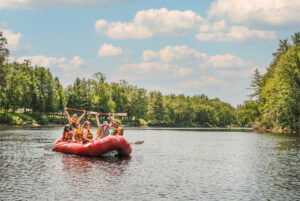
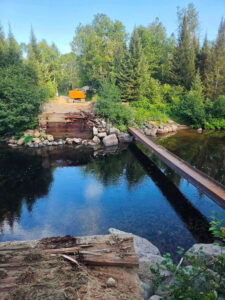
We soon find out that our ancestors came to North America by ship, not by plane. They also came to our neck of the wilderness by a canoe or small boat on the river, not on any road. Whether it was Montreal, Toronto, Wright’s Town, Fort William or Portage-du-Fort, our earliest settlements were on the banks of a river.
Canada’s earliest trade was furs delivered by canoe on the rivers and timber that was floated down the river. Our earliest trade took place on the banks of some river. A system of canals and locks were developed decades before good roads. Although the first canals were built for defense purposes to move our military, most of our canals and locks were, and are still, used for efficient movement of . . .
grain and other heavy items of trade.
Early roads were brushed out of the wilderness so people could travel from a waterway to centres of agriculture and business. These trails were called forced roads and didn’t follow any lot lines or even a direct path. They started in a general direction towards a destination, often taking a jog to avoid a swamp, mountain, lake, deep gully or some other hard to cross obstruction.
The first use of these trails was on foot or horseback if you had one. They were later widened out so wagons, or sleighs in winter, could pass. When the more affluent folks could afford a buggy or cutter and a driver horse that was no benefit for heavy work, wanted a little smoother ride, the trails had to be made a little smoother. Many of these crooked little trails are used to this day, but graveled, graded and maybe even paved.
Some of the more recent roads or even highways have a crook in them every now and again. Because townships were surveyed into ranges and lots at different times by different surveyors who were often army personnel in need of work between battles or wars, the ranges did not line up from one township to another. Hence there is a jog in the road when going from one township to another, even though they tried to follow ranges and not cut up farms. Most early roads and even highways went right through the middle of towns and cities because that is where the early trails went.
In most western provinces that were settled many years later than eastern provinces, they learned from our mistakes and roads and highways followed lot lines. Farms were surveyed into sections a mile square or 640 acres or half or quarter sections. The roads, even in cities, either go east-west or north-south. If you fly over a European country and look out the plane window you will know that their ancestors walked the trails for many years before we did because of all the little crooked roads and small ill-shaped fields.
In our county, road allowances were taken off the south end of each lot to avoid confusion. Side lines going from one range to another were decided by farm owners and elected people. Usually, half the width of the side-line was given by each adjoining land owner. Early road work was completed by landowners. Part of their municipal tax was paid in road work or maybe gravel if you had gravel on your property.
If you supplied a team of horses and a wagon to draw gravel, you were awarded a time compensation or less work time. There were no loaders then, so all the gravel had to be shoveled on by hand. There were no dump trucks or dumps on those little horse drawn wagons, so the wagons had board floors that were not nailed down. When the wagon load of gravel arrived at the required place, men just tipped each floor plank allowing the gravel to fall through the floor.
We were lucky to have gravel pits on our farm and my dad brought a team and wagon to help with road work which was also a social event like threshing, sawing wood and corn cutting which most farmers looked forward to. There was also great pride in having the best team of horses who could lift the biggest load of gravel from the pit.
Back to Mervin’s Lane. The Main Street in our town, as in many towns in the valley, used to be the highway. In our town it was Highway 8 to be exact. Now, it changes names from Calumet- East, to Main Street, to John Dale Road, to Calumet-West. John Dale was an early mayor in our town and the Dales were some of the very first settlers in our township.
The first Dale house still stands at the corner of John Dale Road, Main Street, and Rectory Road. Mervin Dale owned the lot just west of the original Dale house. Mervin donated half of a to be sideline hoping that the adjoining landowner would donate the other half of the sideline. The other half was never donated so the narrow road that Mervin donated became known as Mervin’s Lane. Dales’ had an ice house just at the south end of Mervin’s Lane. In winter, the ice to keep Shawville’s food cool all summer was cut from the crystal clear ice on Green Lake only two miles north of the ice house that was on John Dale Road, if you went up Mervin’s Lane and straight north from there to the east end of Green Lake. Thousands of blocks of ice were drawn by a team of horses and the ice sleigh down Mervin’s Lane.
For many years, there was also a little abattoir that supplied much of the meat for Shawville on that same little lane. Refrigerators have replaced the icebox and Dale’s ice house is gone. The little abattoir is gone and Mervin’s Lane that was used to bring the milk cows down twice each day and used by dirt bikes and Skidoos is grown up in brush and trees today. A lane that was used to reduce time and extra work moving ice, hay, corn silage and cows to and from pasture is no more. I wonder with todays high gas prices, should there be more Mervin’s Lanes built to save gas and time?
Chris Judd is a farmer in Clarendon on land that has been in his family for generations.
gladcrest@gmail.com