


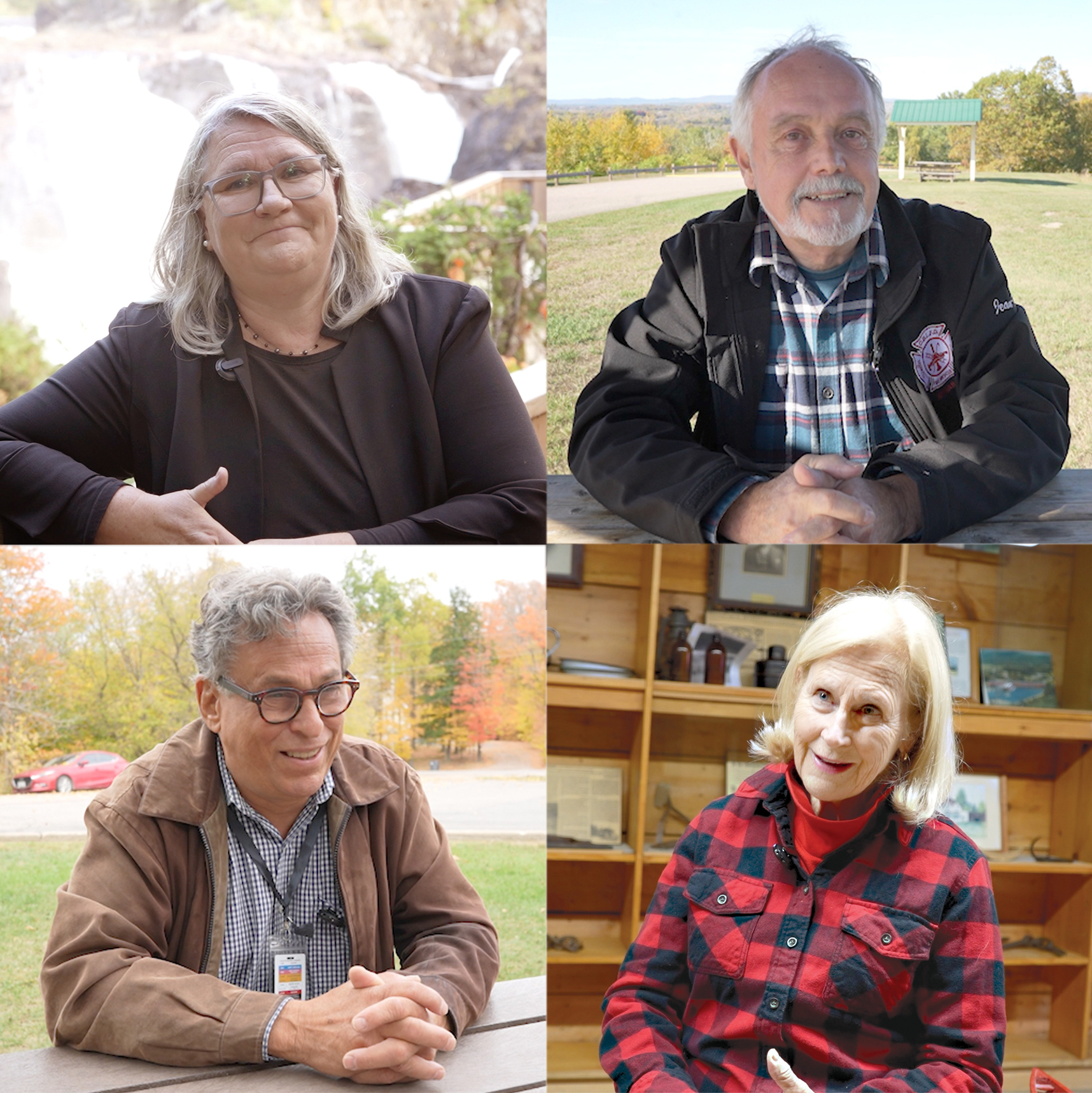



Over the past few weeks, THE EQUITY sat down with each of the candidates running to become MRC Pontiac’s next warden in the Nov. 2 election. We asked them to take us to place in the Pontiac that is somehow special to them, with hopes this would help you all get to know them a little better.
Josey Bouchard
Who are you and why did you choose Chutes Coulonge for this interview?
I’m a teacher by trade but have been an activist with Pontiac Voice, also sitting on council in Campbell’s Bay. And for me it was the next logical step to run for warden. I feel that we need some changes and that’s why I put my name in.
I came [to Chutes Coulonge] because, first of all it’s a beautiful site, but I think it represents the way the Pontiac has sort of changed over – what was the Pontiac before, what it is now, and what it could be in the future. I think it shows how we can renew ourselves. When one industry dies, there is a hope and a way to be better at what we do.
Why are you running for warden?
I’m running because I feel I have a vision for tomorrow’s Pontiac. The Pontiac right now is at a crossroad. We do have a few little industries but we need to do a better inventory of all that we have and how we can help support those industries and go up one level.
I think we also need to have a strong voice. The Outaouais has always struggled to have a strong voice in Quebec City. The more of us there are stomping our feet and making our issues known, it will help.
What do you see as key to the role of warden?
I see the role in twofold. One is being representative in the Outaouais and in Quebec City to make sure our issues are brought forward, and the other role is really getting all the mayors to work together, and to make sure we commit to different intermunicipal agreements, because the taxpayers deserve all the services they need, at a reasonable cost.
Why would you make a good warden?
I think the fact that I’m fully bilingual, and I would even go so far as to say bi-cultural. The mindset of francophone versus anglophone, there are differences.
I think being an advocate and spokesperson for Pontiac Voice, we got our issues heard. We had journalists coming up and inquiring all the time, so in that sense I think I have a credibility, and we can get our message across through the media, which is an essential component nowadays, in both languages.
Also, I’ve been a principal, I’ve been a vice-principal, I’ve been dealing with a lot of people, I’ve been a conseiller pédagogique, so I’ve worked in all different kinds of sectors in education, and I think a big part of that is assuming leadership with people and getting them to understand why we need to do certain changes and where we’re heading with all of that.
What would be your priorities in your first year?
[Translated from French:] For me the priority in year one would be to sit down and do an analysis of the current situation, and make decisions that people may not appreciate, or they will be surprised or happy. I think having more inter-municipal agreements will be essential. To make sure people who are very good at grant applications for infrastructure become of service to our municipalities [ . . . ] to make sure everyone is helping everyone.
Ideally, in my dream, in the first two years we will have grouped what can be grouped, in terms of services. Not in terms of municipalities or councils.
What do you see as step one to bringing economic development to the Pontiac?
We need to help small businesses to be a bit bigger, so they can hire a bit more people, so we can start having more people coming back to the Pontiac.
Large industries will not come back in most places in Quebec. We’re fighting right now against Brazil, where trees grow twice as fast as here and people are paid one tenth of what people used to have. So we have to create small industries. Again, to move forward we need to know where we stand right now.
If you have a small industry that’s building kitchen cupboards, what can feed it? It’s to try to see how we can intertwine the different components we have. And they stay alive because they’re interdependent. So even if one has problems, you might lose five to 10 jobs, but you’re not going to lose 600 jobs like when Smurfit Stone closed up.
And we have to move away from natural resources, because the international market is so up and down, it doesn’t guarantee much of anything.
We just have to make sure we grow with industries that will remain viable, 20, 25 years from now.
How will you shift your focus from what’s good for Campbell’s Bay to what’s best for the whole county?
For me it is a preoccupation that people don’t assume I will give preferential treatment to Campbell’s Bay because I’m from Campbell’s Bay. For me, we need to look at the region as a whole, so each area has their strength and that’s what we need to [develop]. I’m not going to favour anyone. What’s the strength of that community, what does it bring to the Pontiac, and how can we better that?
Why vote for Josey Bouchard?
You vote for Josey Bouchard because she wants to get the job done, she wants the Pontiac to be better and that people are heard, and that we take into consideration everyone in the Pontiac. She’ll be there for you and she’ll have your back.
Jean-Pierre Landry
Who are you and why did you choose the Litchfield rest stop for this interview?
I’ve been living here in Campbell’s Bay for almost 60 years now. We moved up here ‘67 with the pulp and paper mill in Portage. The Pontiac is my hometown. I have a bachelor’s in industrial relations, I’ve done a professional training course in pulp and paper, I’ve been with the Campbell’s Bay-Litchfield Fire Department for 25 years. My career was here in Campbell’s Bay at Service Quebec. I was also teaching part time for the past two years.
I’m here today in this beautiful spot, the Litchfield halte, which brings back memories for me, from as far as when I was a teenager. We’d come at night, sit around the fire, and one of the things that I like is the view. It shows to me the immensity of our territory, which I’ve always appreciated and loved, and that’s why I’ve been in the Pontiac for almost 60 years now.
Why are you running for warden?
I would say the main reason is I’m tired of seeing us going down the hill, as one of the poorest MRCs in Quebec. More or less we’re not moving ahead. It’s not by feuding and battling and wasting time on petty matters that we’re going to get out of our lethargy. That’s what’s getting to me. There’s so much that can be done, and it’s not being done. I don’t promise to change the world. But I can’t do worse than what’s been done in the last eight years, which is not much.
What is key to the role of warden?
You need to be close to the people. You need to understand their needs. And also you have to be bilingual, at least. You’re dealing with the provincial government. Everything takes place in French. I think that by not being bilingual or French, you’re missing out on a lot of things.
We need to revive the patriotism of Pontiacers. The more you have people behind you, supporting you, and the more pressure there is, the greater the chances of you having results. So I think it’s to try to get the community behind you. But for that you have to be transparent, and relay the information. Also, to be able to take criticism, accept your faults, and respect people, those are certain values I think can help make a good warden.
What would be your priorities in your first year?
First the biomass file, which was axed a few years ago. For whatever reason, it was turned down. I won’t get into that subject but I find it very unfortunate. We need to find a niche, a specialty. Not two-by-fours, with all due respect, but you just look and almost every week there’s a sawmill that closes. I had seen some of the studies and documents that pertained to that [biomass] project, and it was very interesting. So I would explore that avenue, if there is any chance of reviving it.
What do you see as key to economic development in the Pontiac?
One of the big deterrents to our economic development is our electricity, because without any electricity we can’t attract any big businesses, or even household development. After the public consultation that took place last spring with Hydro-Quebec, I found out that from the Cadieux station in Bryson all the way to Allumette Island, more or less it’s a big extension cord. So that would be one of the major priorities economically wise. Again the other thing too is communications, all types of communications – internet, cell phones, roads and trail
I understand you were fired from your job at ESSC because of an altercation with a student. What happened?
A very unfortunate and regretful incident happened in one of my classes where there was an altercation with a student, which I truly regret, but there was a whole context to it which people aren’t aware, and that could explain how the incident happened. I know that what happened is inexcusable, but sometimes when you don’t look after your personnel, these things can happen.
It’s very unfortunate. I was willing to go back teaching the very next day, but they told me to wait for a call. I was suspended with pay in the meantime, and never heard back since.
I had a turbulent class. They were all piled up at the door five minutes before the end of class and anxious to get out. I was trying to hold them back and one of my students kept kicking in the door. After numerous times that I told her to please stop doing that, she won, so I hit her on her leg that she was using to kick the door. But like I say, I’ve never heard back since, never had a chance to explain myself, that’s why I say there’s a whole context behind it, which people aren’t aware.
Why vote for Jean-Pierre Landry?
Because I’m good! I’ve always worked for the provincial government and we dealt with many agencies, so right there that’s a good base. I’ve been a municipal councillor, so I have the knowledge in municipal affairs. I’ve sat on many board of directors, so I’m very at ease and familiar with assembly procedures and decorum. I know the needs of the area, and I’m perfectly bilingual, which I think is a major asset in this position.
My leadership, my ambition, the pride I have for the Pontiac. The best I can do is give it my best and see what comes out of it.
Bruno St-Cyr
Who are you and why did you choose the Pontiac Hospital for this interview?
I come from Quebec City. I’ve worked in Quebec City, Montreal, Toronto. I’ve moved a lot because work called me to travel and to get some new challenges. Now I am in Pontiac since approximately 20 years, and I love the countryside, and there’s a lot of things to do. It’s for that reason I’d like to be the warden of the Pontiçois and Pontiçoises.
We’re in front of the Shawville hospital because I’m a member of the user committee for the Pontiac, and I represent the Pontiac at the Outaouais user committee. [The committee] is a place to try to change things, and also to check if everything is okay, and to try to get a better service from our healthcare. But it’s not easy, but it’s coming. User committee in the Pontiac closed it’s doors a few years ago. So we are a new group. We now know each other.
The [life expectancy] in the Outaouais is two years below the average of the province of Quebec, and four years below the highest one. In the Pontiac, you don’t want to know. There is no reason that in the Pontiac we cannot live more than 84 years old. So there is something to do [about this] and I’m sure I’ll be able to do that. I came from the medical research centre in Quebec City, so I know a lot of things there and if I need something more I can call them.
Why are you running for warden?
[Translated from French:] My first goal is to bring economic development – a necessity for the Pontiac. Here we have all sorts of good natural resources. There are many things that can be done, but we need to work all together towards a common goal to make the Pontiac a better place to live. It’s not normal that we be one of the last MRC’s in the province in terms of wealth, jobs, in terms of all sorts of things. It’s not normal. Years ago, we weren’t one of the last. Why not return to how we were? We have to return to a higher quality of life.
What’s key to the role of warden?
I don’t want to be a warden to push projects. Every mayor has to bring projects around the table for their municipality. They know their people. They know their facilities. They know what they have in their community. I think every municipality needs to get an objective of at least one development project per year. Because it’s not up to the warden of the MRC Pontiac to do that, the projects have to come from the people.
Why would you make a good warden?
I did my university degree in business administration, before that I did a certificate in philosophy and theology, and before that I did a diploma in pedagogy. I think that I’ll be able to do this job. In every job I did before it was always in business development – when I was in the energy sector, when I was in building products, when I was in the research centre, because I worked at the centre de recherche industriel de quebec, and yeah, when I worked at the medical research centre. I was always in business development, and Pontiac needs something like that. And with that, I got a lot of contacts, which could help.
What would be your priorities in your first year?
I think the first thing would be to put some goals, per municipality. With goals, we have results. If each municipality has a goal of one or two development projects per year . . . and if they need my help, I’ll be the guy to help them. But I think there is no small economic development project. All development projects will be good. I know that we cannot get the big ones. But we are in 2025. Businesses are not the same as the last five years, 10 years, 15 years. It’s always in movement. But we can do something. And I can help a lot, with the contacts that I have.
What do you see as key to economic development in the Pontiac?
Every industry outside has to be reopened if it’s possible. Mayors have to listen to entrepreneurs projects and work with it. Sometimes they have the information, sometimes not. If they don’t, they can ask the MRC, but I’m sure that it’s possible. We all know that in forestry sectors we need a lot of things to operate. It’s not easy. But in our region, because the quality of the resource is there, it may be possible to do something.
We need to do exactly what the minister wants to do. We cannot push spaghetti. If people in Quebec City see an opportunity for this region that we didn’t see before, why not listen, and work with it?
I’m not there to do what I think could be done. I’m there to open my ear and check what we can do with what we have. If we want the MRC to do something for the whole Pontiac, we can wait, but until when? And do we have time to wait? I’m sure not.
Why vote for Bruno St-Cyr?
I’ve always wanted to be a winner. Sometimes we’re not, but we try. And I feel I really want to be a winner for MRC Pontiac. With the knowledge I have, with the education I have, with the people who are in the Pontiac, I feel completely at ease to do what needs to happen here, as much on the healthcare side as on the economic development side.
Jane Toller
Who are you and why did you choose Chutes Coulonge for this interview?
I’m currently the warden of MRC Pontiac and I’ve chosen the Chutes Coulonge as my favourite place in the Pontiac because I feel in many ways the forestry started here. And I’m really proud to be from the Bryson family. There are two pictures [in this museum] – my great-great-grandfather and my great-grandfather, also a George Bryson Jr., and in many ways I feel I’m here to continue their work. Because when they were here Pontiac was one of the wealthiest and largest counties in Canada, and when I arrived here things had crashed, and I found people very much in despair. I decided when I ran in 2017 for warden to say forestry is not dead.
Why are you running for warden?
I have the energy, I have the interest, I have the motivation, and also, I have started a few projects. I haven’t really talked about them because I don’t like to overpromise and under deliver. In particular I’m focused on a forestry project. I have my eye on the Jovalco mill. And I do have investors, and we do have a plan, and it will be to address the pulp and biomass.
What is key to the role of warden?
It’s a very important role. I really think the most important qualification for it is energy, because to really be effective and do your best for the people of the Pontiac, you need to be willing to work seven days a week. I will say I’ve realized you can’t accomplish things as quickly as you had hoped. I thought that with my mandate of my 11 priorities in my first term, that they would all be finished by the end of four years. You have to understand it’s not one person, it’s not a dictatorship: I wouldn’t ever want that anyways. You’re working with 18 mayors. And when you come to important decisions you need to have a majority of mayors agreeing. And I’m not the only person that comes up with ideas. I need to be a good listener, especially if we’re not going in a direction that’s supported by the majority of people in the Pontiac.
What are two things you’ve accomplished as warden?
One of the priorities was revitalization of our villages in our various municipalities. What I was able to do initially was to get $10,000 for each one of them through an FRR 1 fund which allowed for new signage and in some cases some street scaping. The best thing has been the FRR 4 money which has given us 5 million over the last five years, and we can see the evidence of the revitalization in all of our municipalities. I did not provide that money but I did make a case for rural Quebec to not be forgotten.
I had [also] said one of my priorities was to increase recycling and composting. I think the talk from energy from waste has played a very prominent and positive role to now finally getting us all engaged in what are we going to do with our waste. I give a lot of credit to Nina [Digioaccino], who is on our staff. And through that every municipality now has a plan for composting and recycling.
Did you learn anything from the criticism and push back your incinerator proposal received?
It taught me something I’ve always known, and that is you need to listen. What concerned me about that issue was the whole notion of it being very unhealthy and it was frightening people and I hated to see that. We would never have proposed something that was dangerous or unhealthy. I have no regrets. It was an experience. You never know until you try. And it took courage to be the person who was promoting it. But let’s not forget – for a good part of that period we had 18 mayors in support. Where things fell apart was I think the fear was being spread. People were attending the council meetings and mayors and councils had never seen that kind of opposition. In the end, I’ve actually decided that this beautiful wilderness doesn’t need an incinerator. When reality becomes that there are a significant number of people who are worried about health or are upset, then either you haven’t communicated it well to begin with , or it’s just not worth pushing forward anymore.
What would be your priorities in year one?
[Translated from French:] The two most important priorities for me for the next four years are economic development and health care for MRC Pontiac.
But I have seven priorities – putting an end to frequent power outages by insisting on better infrastructure, stimulating job creation, protecting our existing health care workers and demanding equal pay with Ontario, putting in place a taxi service, promoting sharing of municipal services, opening local agricultural infrastructure, and eliminating dead zones using satellite coverage promised by the provincial government.
Why vote for Jane Toller?
I believe people know that if I’m reelected I’ll work hard and I’m working for them. I’m always available to listen and we have a lot of work to do. My reason for being here is because these are my roots, because I was willing to be an investor, but my main reason is to try to do my best to ensure the Pontiac becomes a successful place again to live work and play, to improve the quality of life for everyone so everyone can afford to live here.
Au cours des dernières semaines, THE EQUITY s’est entretenu avec chacun des candidats à la succession du préfet de la MRC Pontiac lors de l’élection du 2 novembre. Nous leur avons demandé de nous emmener dans un endroit du Pontiac qui a une signification particulière pour eux, dans l’espoir que cela vous aidera à mieux les connaître.
Josey Bouchard
Qui êtes-vous et pourquoi avez-vous choisi les Chutes Coulonge pour cette entrevue ?
Je suis enseignante de profession, mais j’ai été militante pour Pontiac Voice, et je siège également au conseil de Campbell’s Bay. Pour moi, c’était l’étape logique à franchir pour me présenter comme candidate à la préfecture. Je pense que nous avons besoin de certains changements, et c’est pourquoi j’ai mis ma candidature.
Je suis venue [aux Chutes Coulonge] parce que, tout d’abord, c’est un site magnifique, mais je pense que cela représente la façon dont le Pontiac a évolué – ce qu’était le Pontiac avant, ce qu’il est maintenant, et ce qu’il pourrait être à l’avenir. Je crois que cela montre comment nous pouvons nous renouveler. Quand une industrie disparaît, il y a de l’espoir et un moyen de faire mieux ce que nous faisons.
Pourquoi vous présentez-vous comme candidate à la préfecture ?
Je me présente parce que je crois avoir une vision pour le Pontiac de demain. Le Pontiac est actuellement à la croisée des chemins. Nous avons quelques petites industries, mais nous devons faire un meilleur inventaire de tout ce que nous possédons et de la façon dont nous pouvons soutenir ces industries et les élever d’un cran.
Je pense que nous devons aussi avoir une voix forte. L’Outaouais a toujours eu du mal à avoir une voix forte à Québec. Plus nous serons nombreux à taper du pied et à faire connaître nos problèmes, plus cela nous aidera.
Qu’est-ce qui vous semble essentiel dans le rôle de préfet ?
Je vois le rôle en deux volets. Le premier est d’être représentative en Outaouais et à Québec pour s’assurer que nos enjeux sont portés à l’avant-plan, et l’autre rôle est de faire en sorte que tous les maires travaillent ensemble, et de s’assurer que nous nous engageons dans différents ententes intermunicipales, car les contribuables méritent tous les services dont ils ont besoin, à un coût raisonnable.
Pourquoi feriez-vous une bonne préfète ?
Je pense que le fait que je sois entièrement bilingue, et j’irais même jusqu’à dire biculturelle. L’état d’esprit francophone versus anglophone, il y a des différences.
Je pense qu’en tant que défenseure et porte-parole de Pontiac Voice, nous avons fait entendre nos préoccupations. Nous avons eu des journalistes qui sont venus s’enquérir tout le temps, donc à cet égard, je pense que j’ai une crédibilité, et nous pouvons faire passer notre message par les médias, ce qui est une composante essentielle de nos jours, dans les deux langues.
De plus, j’ai été directrice, j’ai été directrice adjointe, j’ai travaillé avec beaucoup de gens, j’ai été conseillère pédagogique, donc j’ai travaillé dans différents secteurs de l’éducation, et je pense qu’une grande partie de cela consiste à assumer un leadership auprès des gens et à leur faire comprendre pourquoi nous devons apporter certains changements et où nous allons avec tout cela.
Quelles seraient vos priorités durant votre première année ?
[Traduit du français :] Pour moi, la priorité durant la première année serait de s’asseoir et de faire une analyse de la situation actuelle, et de prendre des décisions que les gens n’apprécieront peut-être pas, ou qui les surprendront ou les satisferont. Je pense qu’avoir plus d’ententes intermunicipales sera essentiel. S’assurer que les personnes qui sont très bonnes pour les demandes de subvention pour les infrastructures deviennent un service à nos municipalités [ . . . ] pour que tout le monde s’entraide.
Idéalement, dans mon rêve, dans les deux premières années, nous aurons regroupé ce qui peut être regroupé, en termes de services. Pas en termes de municipalités ou de conseils.
Quelle est la première étape selon vous pour amener le développement économique au Pontiac ?
Nous devons aider les petites entreprises à grandir un peu, pour qu’elles puissent embaucher un peu plus de personnes, afin que nous puissions commencer à faire revenir plus de gens au Pontiac.
Les grandes industries ne reviendront pas dans la plupart des régions du Québec. Nous nous battons actuellement contre le Brésil, où les arbres poussent deux fois plus vite qu’ici et où les gens sont payés un dixième de ce que les gens recevaient autrefois. Nous devons donc créer de petites industries. Encore une fois, pour aller de l’avant, nous devons savoir où nous en sommes.
Si vous avez une petite industrie qui fabrique des armoires de cuisine, qu’est-ce qui peut l’alimenter ? C’est d’essayer de voir comment nous pouvons entrelacer les différentes composantes que nous avons. Et elles restent vivantes parce qu’elles sont interdépendantes. Ainsi, même si l’une connaît des problèmes, vous pourriez perdre cinq à dix emplois, mais vous n’allez pas perdre 600 emplois comme lorsque Smurfit Stone a fermé ses portes.
Et nous devons nous éloigner des ressources naturelles, car le marché international est si volatil qu’il ne garantit pas grand-chose.
Nous devons simplement nous assurer de croître avec des industries qui resteront viables, dans 20, 25 ans.
Comment allez-vous passer de ce qui est bon pour Campbell’s Bay à ce qui est le mieux pour tout le comté ?
Pour moi, c’est une préoccupation que les gens ne supposent pas que je vais accorder un traitement préférentiel à Campbell’s Bay parce que j’en viens. Pour moi, nous devons considérer la région dans son ensemble, donc chaque secteur a ses forces et c’est ce que nous devons [développer]. Je ne favoriserai personne. Quelle est la force de cette communauté, qu’apporte-t-elle au Pontiac, et comment pouvons-nous l’améliorer ?
Pourquoi voter pour Josey Bouchard ?
Vous votez pour Josey Bouchard parce qu’elle veut faire le travail, elle veut que le Pontiac soit meilleur et que les gens soient entendus, et que nous prenions en considération tout le monde au Pontiac. Elle sera là pour vous et elle vous soutiendra.
Jean-Pierre Landry
Qui êtes-vous et pourquoi avez-vous choisi l’aire de repos de Litchfield pour cette entrevue ?
J’habite à Campbell’s Bay depuis près de 60 ans. Nous avons déménagé ici en 1967 avec l’usine de pâte et papier de Portage. Le Pontiac est ma ville natale. J’ai un baccalauréat en relations industrielles, j’ai suivi une formation professionnelle en pâtes et papiers, j’ai été membre du service d’incendie de Campbell’s Bay-Litchfield pendant 25 ans. Ma carrière s’est déroulée ici à Campbell’s Bay chez Service Québec. J’ai aussi enseigné à temps partiel au cours des deux dernières années.
Je suis ici aujourd’hui dans ce bel endroit, l’aire de repos de Litchfield, qui me rappelle des souvenirs depuis mon adolescence. Nous venions la nuit, nous nous assoyions autour du feu, et j’aime particulièrement la vue. Elle me montre l’immensité de notre territoire, que j’ai toujours appréciée et aimée, et c’est pourquoi j’habite au Pontiac depuis près de 60 ans.
Pourquoi vous présentez-vous comme candidat à la préfecture ?
Je dirais que la raison principale est que je suis fatigué de voir le déclin, de voir que nous sommes l’une des MRC les plus pauvres du Québec. Nous n’avançons pas vraiment. Ce n’est pas en nous chamaillant, en nous battant et en perdant du temps sur des sujets mineurs que nous sortirons de notre léthargie. C’est ce qui me touche. Il y a tellement de choses qui peuvent être faites, et qui ne le sont pas. Je ne promets pas de changer le monde. Mais je ne peux pas faire pire que ce qui a été fait au cours des huit dernières années, c’est-à-dire pas grand-chose.
Qu’est-ce qui est essentiel dans le rôle de préfet ?
Il faut être proche des gens. Il faut comprendre leurs besoins. Et il faut aussi être bilingue, au moins. Vous traitez avec le gouvernement provincial. Tout se passe en français. Je pense qu’en n’étant pas bilingue ou francophone, on passe à côté de beaucoup de choses.
Nous devons raviver le patriotisme des Pontiacois. Plus vous avez de gens derrière vous, qui vous soutiennent, et plus il y a de pression, plus vous avez de chances d’obtenir des résultats. Donc, je pense qu’il faut essayer d’obtenir le soutien de la communauté. Mais pour cela, il faut être transparent et transmettre l’information. De plus, il faut être capable d’accepter la critique, de reconnaître ses torts et de respecter les gens; ce sont certaines valeurs qui, je crois, peuvent aider à faire un bon préfet.
Quelles seraient vos priorités durant votre première année ?
D’abord, le dossier de la biomasse, qui a été abandonné il y a quelques années. Pour une raison quelconque, il a été rejeté. Je n’entrerai pas dans ce sujet, mais je trouve cela très regrettable. Nous devons trouver une niche, une spécialité. Pas des deux par quatre, avec tout le respect que je dois, mais vous regardez et presque chaque semaine, une scierie ferme. J’avais vu certaines des études et des documents qui concernaient ce projet [de biomasse], et c’était très intéressant. J’explorerais donc cette voie, s’il y avait une possibilité de le relancer.
Quel est, selon vous, l’élément clé du développement économique au Pontiac ?
L’un des principaux freins à notre développement économique est notre électricité, car sans électricité, nous ne pouvons attirer aucune grande entreprise, ni même de développement résidentiel. Après la consultation publique qui a eu lieu au printemps dernier avec Hydro-Québec, j’ai appris que de la station Cadieux à Bryson jusqu’à l’île à l’Allumette, c’est plus ou moins une grosse rallonge électrique. Ce serait donc l’une des grandes priorités sur le plan économique. Encore une fois, l’autre chose, ce sont les communications, tous les types de communications – Internet, téléphones cellulaires, routes et sentiers
Je comprends que vous avez été congédié de votre poste à l’ESSC suite à une altercation avec un étudiant. Que s’est-il passé ?
Un incident très malheureux et regrettable s’est produit dans l’une de mes classes, où il y a eu une altercation avec une étudiante. Je le regrette sincèrement, mais il y avait tout un contexte que les gens ignorent, et qui pourrait expliquer comment l’incident s’est produit. Je sais que ce qui s’est passé est inexcusable, mais parfois, quand on ne s’occupe pas de son personnel, ces choses peuvent arriver.
C’est très malheureux. J’étais prêt à retourner enseigner le lendemain, mais on m’a dit d’attendre un appel. J’ai été suspendu avec traitement dans l’intervalle, et je n’ai jamais eu de nouvelles depuis.
J’avais une classe turbulente. Ils étaient tous entassés à la porte cinq minutes avant la fin du cours, impatients de sortir. J’essayais de les retenir et l’une de mes élèves ne cessait de donner des coups de pied dans la porte. Après lui avoir dit à plusieurs reprises de cesser, elle a eu le dessus, alors je lui ai donné un coup sur la jambe qu’elle utilisait pour taper dans la porte. Mais comme je l’ai dit, je n’ai jamais eu de nouvelles depuis, je n’ai jamais eu la chance de m’expliquer, c’est pourquoi je dis qu’il y a tout un contexte derrière cela, que les gens ignorent.
Pourquoi voter pour Jean-Pierre Landry ?
Parce que je suis bon ! J’ai toujours travaillé pour le gouvernement provincial et nous avons traité avec de nombreuses agences, donc là, c’est une bonne base. J’ai été conseiller municipal, donc j’ai des connaissances en affaires municipales. J’ai siégé à de nombreux conseils d’administration, donc je suis très à l’aise et familier avec les procédures d’assemblée et le décorum. Je connais les besoins de la région, et je suis parfaitement bilingue, ce qui est, je pense, un atout majeur dans ce poste.
Mon leadership, mon ambition, la fierté que j’ai pour le Pontiac. Le mieux que je puisse faire est de donner le meilleur de moi-même et de voir ce qui en ressort.
Bruno St-Cyr
Qui êtes-vous et pourquoi avez-vous choisi l’Hôpital Pontiac pour cette entrevue ?
Je viens de la ville de Québec. J’ai travaillé à Québec, Montréal, Toronto. J’ai beaucoup déménagé parce que le travail m’a appelé à voyager et à relever de nouveaux défis. Maintenant, je suis au Pontiac depuis environ 20 ans, et j’aime la campagne, et il y a beaucoup de choses à faire. C’est pour cette raison que j’aimerais être le préfet des Pontiacois et Pontiçoises.
Nous sommes devant l’hôpital de Shawville parce que je suis membre du comité des usagers pour le Pontiac, et je représente le Pontiac au comité des usagers de l’Outaouais. [Le comité] est un endroit pour essayer de changer les choses, et aussi pour vérifier si tout va bien, et pour essayer d’obtenir un meilleur service de nos soins de santé. Mais ce n’est pas facile, mais ça vient. Le comité des usagers du Pontiac a fermé ses portes il y a quelques années. Nous sommes donc un nouveau groupe. Nous nous connaissons maintenant.
L'[espérance de vie] en Outaouais est de deux ans inférieure à la moyenne de la province de Québec, et de quatre ans inférieure à la plus élevée. Au Pontiac, vous ne voulez pas savoir. Il n’y a aucune raison pour que nous ne puissions pas vivre plus de 84 ans au Pontiac. Il y a donc quelque chose à faire à ce sujet et je suis sûr que je pourrai le faire. Je viens du centre de recherche médicale de Québec, donc j’en sais beaucoup et si j’ai besoin de plus, je peux les appeler.
Pourquoi vous présentez-vous comme candidat à la préfecture ?
[Traduit du français :] Mon premier objectif est d’apporter le développement économique – une nécessité pour le Pontiac. Ici, nous avons toutes sortes de bonnes ressources naturelles. Il y a beaucoup de choses qui peuvent être faites, mais nous devons travailler tous ensemble vers un objectif commun pour faire du Pontiac un meilleur endroit où vivre. Il n’est pas normal que nous soyons l’une des dernières MRC de la province en termes de richesse, d’emplois, en termes de toutes sortes de choses. Ce n’est pas normal. Il y a des années, nous n’étions pas parmi les derniers. Pourquoi ne pas revenir à ce que nous étions ? Nous devons retrouver une meilleure qualité de vie.
Qu’est-ce qui est essentiel dans le rôle de préfet ?
Je ne veux pas être préfet pour pousser des projets. Chaque maire doit apporter des projets à la table pour sa municipalité. Ils connaissent leurs gens. Ils connaissent leurs installations. Ils savent ce qu’ils ont dans leur communauté. Je pense que chaque municipalité doit avoir pour objectif au moins un projet de développement par an. Parce que ce n’est pas au préfet de la MRC Pontiac de le faire, les projets doivent venir des gens.
Pourquoi feriez-vous un bon préfet ?
J’ai fait mon diplôme universitaire en administration des affaires, avant cela j’ai fait un certificat en philosophie et théologie, et avant cela j’ai fait un diplôme en pédagogie. Je pense que je serai capable de faire ce travail. Dans tous les postes que j’ai occupés auparavant, c’était toujours dans le développement des affaires – quand j’étais dans le secteur de l’énergie, quand j’étais dans les produits de construction, quand j’étais dans le centre de recherche, parce que j’ai travaillé au Centre de recherche industrielle du Québec, et oui, quand j’ai travaillé au centre de recherche médicale. J’étais toujours dans le développement des affaires, et le Pontiac a besoin de quelque chose comme ça. Et avec ça, j’ai beaucoup de contacts, ce qui pourrait aider.
Quelles seraient vos priorités durant votre première année ?
Je pense que la première chose serait de fixer des objectifs, par municipalité. Avec des objectifs, nous avons des résultats. Si chaque municipalité a pour objectif un ou deux projets de développement par an… et si elles ont besoin de mon aide, je serai là pour les aider. Mais je pense qu’il n’y a pas de petit projet de développement économique. Tous les projets de développement seront bons. Je sais que nous ne pouvons pas obtenir les grands. Mais nous sommes en 2025. Les entreprises ne sont pas les mêmes qu’au cours des cinq, dix, quinze dernières années. C’est toujours en mouvement. Mais nous pouvons faire quelque chose. Et je peux beaucoup aider, avec les contacts que j’ai.
Quel est, selon vous, l’élément clé du développement économique au Pontiac ?
Toutes les industries extérieures doivent être rouvertes si possible. Les maires doivent écouter les projets des entrepreneurs et travailler avec eux. Parfois, ils ont l’information, parfois non. S’ils ne l’ont pas, ils peuvent demander à la MRC, mais je suis sûr que c’est possible. Nous savons tous que dans les secteurs forestiers, nous avons besoin de beaucoup de choses pour fonctionner. Ce n’est pas facile. Mais dans notre région, parce que la qualité de la ressource est là, il peut être possible de faire quelque chose.
Nous devons faire exactement ce que le ministre veut faire. Nous ne pouvons pas pousser les spaghettis. Si les gens de Québec voient une opportunité pour cette région que nous n’avions pas vue auparavant, pourquoi ne pas écouter et travailler avec elle ?
Je ne suis pas là pour faire ce que je pense qui pourrait être fait. Je suis là pour ouvrir mon oreille et vérifier ce que nous pouvons faire avec ce que nous avons. Si nous voulons que la MRC fasse quelque chose pour l’ensemble du Pontiac, nous pouvons attendre, mais jusqu’à quand ? Et avons-nous le temps d’attendre ? Je suis sûr que non.
Pourquoi voter pour Bruno St-Cyr ?
J’ai toujours voulu être un gagnant. Parfois, nous ne le sommes pas, mais nous essayons. Et je sens que je veux vraiment être un gagnant pour la MRC Pontiac. Avec les connaissances que j’ai, avec l’éducation que j’ai, avec les gens qui sont au Pontiac, je me sens tout à fait à l’aise de faire ce qui doit être fait ici, autant sur le plan de la santé que sur le plan du développement économique.
Jane Toller
Qui êtes-vous et pourquoi avez-vous choisi les Chutes Coulonge pour cette entrevue ?
Je suis actuellement préfète de la MRC Pontiac et j’ai choisi les Chutes Coulonge comme mon endroit préféré du Pontiac parce que je pense qu’à bien des égards, l’exploitation forestière a commencé ici. Et je suis très fière d’être issue de la famille Bryson. Il y a deux portraits [dans ce musée] – mon arrière-arrière-grand-père et mon arrière-grand-père, également George Bryson Jr., et à bien des égards, je me sens ici pour continuer leur travail. Parce qu’à leur époque, le Pontiac était l’un des comtés les plus riches et les plus importants du Canada, et quand je suis arrivée ici, les choses s’étaient effondrées, et j’ai trouvé les gens très désespérés. J’ai décidé, lorsque je me suis présentée en 2017 pour la préfecture, de dire que l’industrie forestière n’était pas morte.
Pourquoi vous présentez-vous comme candidate à la préfecture ?
J’ai l’énergie, j’ai l’intérêt, j’ai la motivation, et aussi, j’ai lancé quelques projets. Je n’en ai pas vraiment parlé parce que je n’aime pas promettre trop et livrer peu. En particulier, je me concentre sur un projet forestier. J’ai un œil sur l’usine Jovalco. Et j’ai des investisseurs, et nous avons un plan, qui sera axé sur la pâte et la biomasse.
Qu’est-ce qui est essentiel dans le rôle de préfet ?
C’est un rôle très important. Je pense vraiment que la qualification la plus importante est l’énergie, car pour être vraiment efficace et faire de son mieux pour les gens du Pontiac, il faut être prêt à travailler sept jours sur sept. Je dois dire que j’ai réalisé qu’on ne peut pas accomplir les choses aussi rapidement qu’on l’espérait. Je pensais qu’avec mon mandat de 11 priorités lors de mon premier mandat, elles seraient toutes terminées à la fin de quatre ans. Il faut comprendre que ce n’est pas une personne, ce n’est pas une dictature : je ne voudrais jamais cela de toute façon. Vous travaillez avec 18 maires. Et lorsque des décisions importantes doivent être prises, il faut avoir la majorité des maires d’accord. Et je ne suis pas la seule personne à avoir des idées. Je dois être une bonne auditrice, surtout si nous ne nous dirigeons pas dans une direction qui est soutenue par la majorité des gens du Pontiac.
Quelles sont deux choses que vous avez accomplies en tant que préfète ?
L’une des priorités était la revitalisation de nos villages dans nos différentes municipalités. Ce que j’ai pu faire initialement, c’est obtenir 10 000 $ pour chacune d’entre elles grâce à un fonds FRR 1 qui a permis de nouvelles signalisations et, dans certains cas, de l’aménagement paysager. La meilleure chose a été l’argent du FRR 4 qui nous a donné 5 millions au cours des cinq dernières années, et nous pouvons voir les preuves de la revitalisation dans toutes nos municipalités. Je n’ai pas fourni cet argent, mais j’ai plaidé pour que le Québec rural ne soit pas oublié.
J’avais [également] dit que l’une de mes priorités était d’augmenter le recyclage et le compostage. Je pense que le discours sur la valorisation énergétique des déchets a joué un rôle très important et positif pour nous engager enfin tous à décider quoi faire de nos déchets. Je rends hommage à Nina [Digioaccino], qui fait partie de notre personnel. Et grâce à cela, chaque municipalité a maintenant un plan de compostage et de recyclage.
Avez-vous appris quelque chose des critiques et de l’opposition que votre proposition d’incinérateur a suscités ?
Cela m’a appris quelque chose que j’ai toujours su, c’est qu’il faut écouter. Ce qui me préoccupait dans cette affaire, c’était toute l’idée que ce soit très malsain et que cela effrayait les gens, et je détestais voir cela. Nous n’aurions jamais proposé quelque chose de dangereux ou de malsain. Je n’ai aucun regret. C’était une expérience. On ne sait jamais tant qu’on n’essaie pas. Et il a fallu du courage pour être la personne qui le promouvait. Mais n’oublions pas – pendant une bonne partie de cette période, nous avions 18 maires qui soutenaient. Les choses se sont effondrées quand, je pense, la peur s’est répandue. Les gens assistaient aux réunions du conseil et les maires et les conseils n’avaient jamais vu un tel type d’opposition. En fin de compte, j’ai en fait décidé que cette belle nature sauvage n’a pas besoin d’un incinérateur. Quand la réalité est qu’un nombre important de personnes s’inquiètent de leur santé ou sont contrariées, alors soit vous n’avez pas bien communiqué au départ, soit cela ne vaut plus la peine de continuer.
Quelles seraient vos priorités durant la première année ?
[Traduit du français :] Les deux priorités les plus importantes pour moi pour les quatre prochaines années sont le développement économique et les soins de santé pour la MRC Pontiac.
Mais j’ai sept priorités – mettre fin aux pannes de courant fréquentes en insistant sur une meilleure infrastructure, stimuler la création d’emplois, protéger nos travailleurs de la santé actuels et exiger un salaire égal à celui de l’Ontario, mettre en place un service de taxi, promouvoir le partage des services municipaux, ouvrir les infrastructures agricoles locales et éliminer les zones mortes en utilisant la couverture satellite promise par le gouvernement provincial.
Pourquoi voter pour Jane Toller ?
Je crois que les gens savent que si je suis réélue, je travaillerai fort et que je travaille pour eux. Je suis toujours disponible pour écouter et nous avons beaucoup de travail à faire. La raison pour laquelle je suis ici est que ce sont mes racines, parce que j’étais disposée à être une investisseuse, mais ma principale raison est d’essayer de faire de mon mieux pour assurer que le Pontiac devienne à nouveau un endroit prospère où vivre, travailler et se divertir, pour améliorer la qualité de vie de tous afin que chacun puisse se permettre d’y vivre.