





Those travelling to Ladysmith this weekend to celebrate the region’s German heritage at Oktoberfest will also be prompted to remember and reflect upon another aspect of Canadian history.
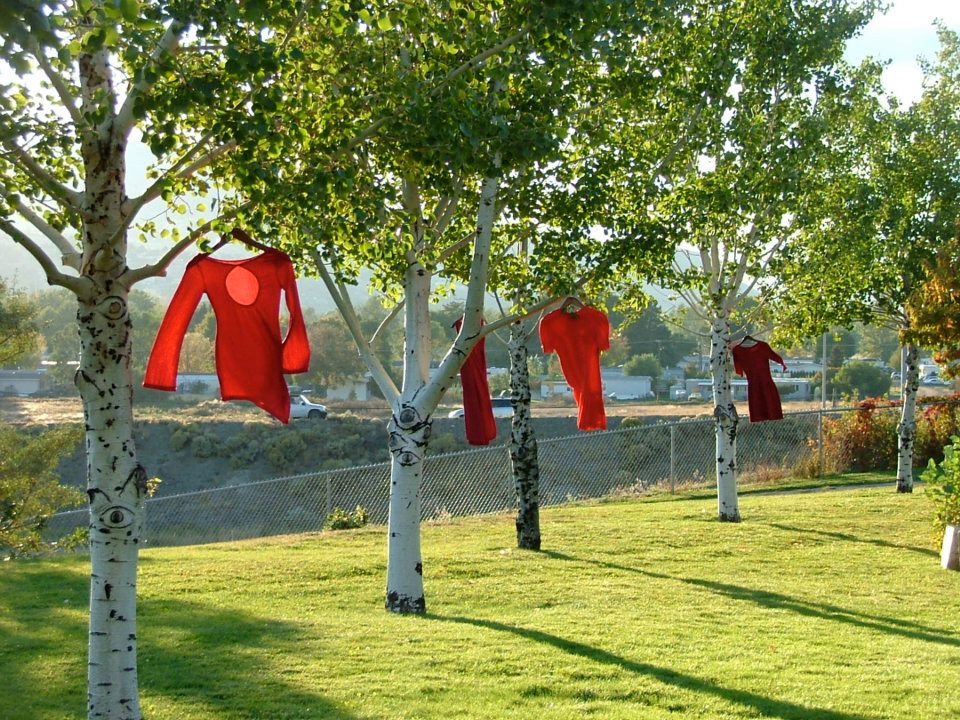
For the duration of the weekend, a collection of red dresses will be hanging on the grounds of St. John’s Lutheran Church as part of an installation set up to remind passersby of the thousands of Indigenous women and girls who are missing or have been murdered in Canada.
Jennifer Mielke, a member of the St. John’s Lutheran Church congregation, said she wanted to put up this display to spur people to consider their own relationship with Canada’s history of colonization and its ongoing impacts on Indigenous communities.
“It’s a small thing, and maybe it will do nothing for people, [ . . . ] but my hope is that maybe that will make people reflect upon that, or if they’re Christian, for example, maybe they’ll start to include these missing women and girls in their prayers, or maybe they’re going to go home and have a discussion with their family and friends, or maybe they’re going to take stronger action and put more pressure on the government,” Mielke said.
The display is being organized as a local iteration of the REDress Project, an installation first created by Métis artist Jaime Black in 2010 in which she hung hundreds of red dresses around the University of Winnipeg campus “to invoke a presence through the marking of absence,” Black wrote, explaining the project.
Since the project’s first installation, hundreds of red dresses have been hung in communities across Canada and the United States, each one a visual reminder of the disproportionate number of Indigenous women who have not returned home.
Indigenous women represent 10 per cent of missing women in Canada, while only five per cent of Canada’s total population self-identified as Indigenous on Canada’s 2021 census.
Estimates suggest that around 4,000 Indigenous women and girls and 600 Indigenous men and boys have gone missing or been murdered between over the past 50 years. In 2016, the Canadian government launched an inquiry into this endemic of violence against Indigenous women.
The inquiry’s final report called the systemic violence perpetrated against these women a “Canadian genocide.”
“But I don’t want to make it a political thing. I just want to make it this sort of individual, how do you feel as a person, what can you do, and what do you want to do?”
Mielke will be setting up a basket filled with red ribbons at the Oktoberfest breakfast on Saturday morning, inviting people to take one to the church around the corner from the festival’s headquarters at the Ladysmith community centre and tie it on a tree there.
Inside the church, she will have set up a series of four artworks by Indigenous artists that together are meant to guide viewers through reflection on the ongoing colonial violence against Indigenous women. These artworks were made available to Mielke through the Eastern Synod of the Evangelical Lutheran Church In Canada, which has a special committee dedicated to encouraging conversations about reconciliation across its congregations.
Mielke, who sits on that committee and is also on the Oktoberfest board of directors, decided to organize her red dress display to coincide with the festival weekend because of the greater visibility it would get.
“It’s actually probably a great time because we’re not celebrating any sort of colonial conquest, we’re just celebrating our heritage and where we came from,” she said.
“And it’s a great opportunity to educate people about, ‘Yeah okay, we’re here and we’re proud, but we also acknowledge that others have been displaced on the land that we celebrate.’”
Jim Goos has been a pastor at the church for four years. He said he read portions of the 2015 Truth and Reconciliation Report that details the history and legacy of the Indian Residential School System, and believes the act of hosting opportunities for reflection on this history is a small but important step in reconciling with Indigenous communities.
“I was shocked at how we have mistreated our people. So we should be doing . . . I mean I don’t know what the answers are, 100, 200 years later, how do you fix this? That’s beyond my area of expertise, but I think conversations need to happen, and this is one way we can have some conversations,” he said.
“I think we can be part of the solution, rather than assuming the government is going to do it all for us. I think the grassroots conversations, and the working together, will also go a long way. But just showing we recognize our Indigenous neighbours, care about them, want to talk with them and work with them, is a big step forward.”
Les personnes qui se rendront à Ladysmith ce week-end pour célébrer le patrimoine allemand de la région lors de l’Oktoberfest seront également invitées à se souvenir et à réfléchir à un autre aspect de l’histoire canadienne.
Pendant tout le week-end, une collection de robes rouges sera suspendue sur le terrain de l’église luthérienne St. John’s dans le cadre d’une installation visant à rappeler aux passants les milliers de femmes et de filles autochtones disparues ou assassinées au Canada.
Jennifer Mielke, membre de la congrégation de l’église luthérienne St. John’s, a déclaré qu’elle souhaitait mettre en place cette exposition pour inciter les gens à réfléchir à leur propre relation avec l’histoire de la colonisation au Canada et à ses répercussions continues sur les communautés autochtones.
« C’est une petite chose, et peut-être que ça ne fera rien pour les gens [ . . . ], mais mon espoir est que ça les fera peut-être réfléchir, ou si ce sont des chrétiens, par exemple, peut-être qu’ils commenceront à inclure ces femmes et ces filles disparues dans leurs prières, ou peut-être qu’ils rentreront chez eux et discuteront avec leur famille et leurs amis, ou peut-être qu’ils prendront des mesures plus énergiques et mettront plus de pression sur le gouvernement », a déclaré Mme Mielke.
L’exposition est organisée comme une version locale du REDress Project, une installation créée pour la première fois en 2010 par l’artiste métisse Jaime Black, qui a suspendu des centaines de robes rouges autour du campus de l’Université de Winnipeg « pour invoquer une présence par le marquage de l’absence », a écrit Mme Black, expliquant le projet.
Depuis la première installation du projet, des centaines de robes rouges ont été suspendues dans des communautés à travers le Canada et les États-Unis, chacune étant un rappel visuel du nombre disproportionné de femmes autochtones qui ne sont pas rentrées chez elles.
Les femmes autochtones représentent 10 % des femmes disparues au Canada, alors que seulement 5 % de la population totale du Canada s’est auto-identifiée comme autochtone lors du recensement de 2021.
Les estimations suggèrent qu’environ 4 000 femmes et filles autochtones et 600 hommes et garçons autochtones ont disparu ou ont été assassinés au cours des 50 dernières années. En 2016, le gouvernement canadien a lancé une enquête sur cette violence endémique à l’égard des femmes autochtones.
Le rapport final de l’enquête a qualifié la violence systémique perpétrée contre ces femmes de « génocide canadien ».
« Mais je ne veux pas en faire une affaire politique. Je veux juste en faire une question individuelle, comment vous sentez-vous en tant que personne, que pouvez-vous faire et que voulez-vous faire? »
Mme Mielke installera un panier rempli de rubans rouges au petit-déjeuner de l’Oktoberfest samedi matin, invitant les gens à en apporter un à l’église, au coin de la rue du quartier général du festival, au centre communautaire de Ladysmith, et à l’attacher à un arbre.
À l’intérieur de l’église, elle aura installé une série de quatre œuvres d’artistes autochtones qui, ensemble, sont censées guider les spectateurs dans une réflexion sur la violence coloniale continue à l’égard des femmes autochtones. Ces œuvres ont été mises à la disposition de Mme Mielke par le Synode de l’Est de l’Église évangélique luthérienne au Canada, qui dispose d’un comité spécial dédié à l’encouragement des conversations sur la réconciliation dans ses congrégations.
Mme Mielke, qui siège à ce comité et fait également partie du conseil d’administration de l’Oktoberfest, a décidé d’organiser son exposition de robes rouges pour qu’elle coïncide avec le week-end du festival en raison de la plus grande visibilité qu’elle obtiendrait.
« C’est en fait probablement un bon moment parce que nous ne célébrons aucune sorte de conquête coloniale, nous célébrons simplement notre héritage et d’où nous venons », a-t-elle déclaré.
« Et c’est une excellente occasion d’informer les gens en leur disant : “Oui, nous sommes ici et nous sommes fiers, mais nous reconnaissons aussi que d’autres ont été déplacés sur la terre que nous célébrons.” »
Jim Goos est pasteur de l’église depuis quatre ans. Il a déclaré avoir lu des extraits du Rapport de la Commission de vérité et réconciliation de 2015 qui détaille l’histoire et l’héritage du système des pensionnats indiens, et estime que le fait d’offrir des occasions de réflexion sur cette histoire est un petit pas, mais important, vers la réconciliation avec les communautés autochtones.
« J’ai été choqué de la façon dont nous avons maltraité notre peuple. Alors, nous devrions faire… Je veux dire, je ne sais pas quelles sont les réponses, 100, 200 ans plus tard, comment réparer ça? C’est au-delà de mon domaine d’expertise, mais je pense que des conversations doivent avoir lieu, et c’est une façon d’en avoir », a-t-il déclaré.
« Je pense que nous pouvons faire partie de la solution, plutôt que de supposer que le gouvernement va tout faire pour nous. Je pense que les conversations de base et la collaboration feront également beaucoup. Mais le simple fait de montrer que nous reconnaissons nos voisins autochtones, que nous nous soucions d’eux, que nous voulons discuter avec eux et travailler avec eux, est un grand pas en avant. »