


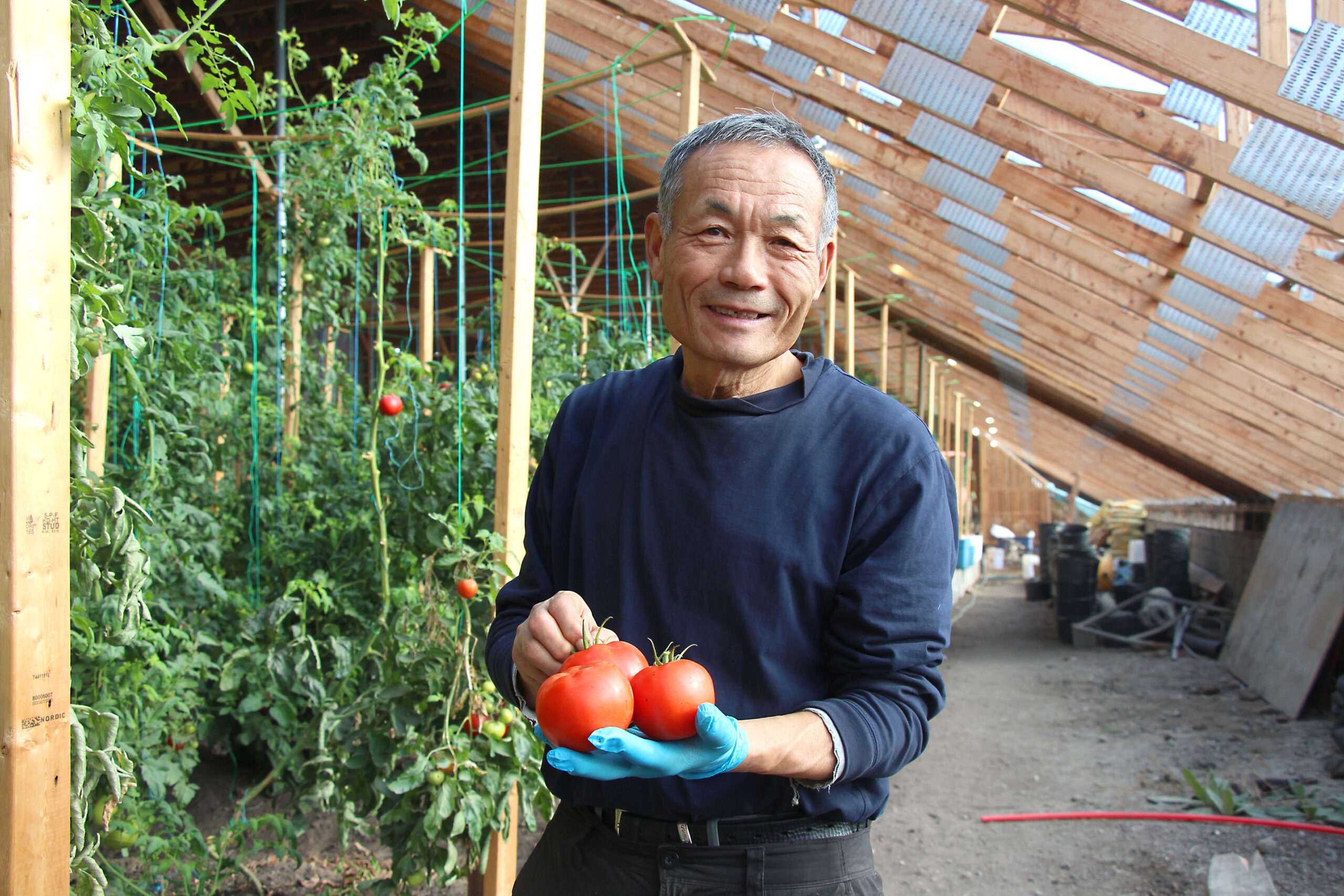



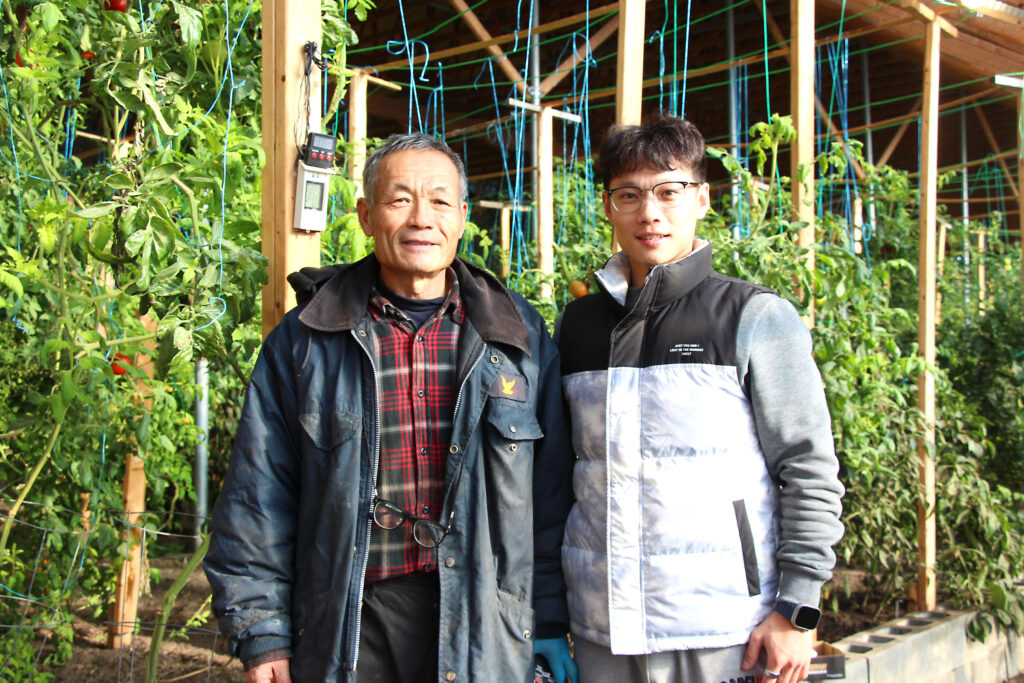
Over the past few years, Jian Zhang and nephew Ryan Zhang have been working to open a greenhouse out back of their Ultramar gas station in Litchfield.
Slowly but surely, the Zhangs have been building what they see as the future of agriculture – a greenhouse powered by renewable energy, smack-dab in the middle of chilly rural Canada.
Starting with little experience in agriculture, the past few years haven’t come without challenges. Now, after years of work, they are finally ready to offer fresh produce in their store for the first time.
Jian, a native of China, gave THE EQUITY a tour of the greenhouse last week. Fresh tomatoes and crispy cucumbers were perched in a box in the front window of their gas station store, some of the first vegetables they have had for sale.
Jian explained that the greenhouse is powered by sustainable energy sources – namely passive solar energy and energy generated from composting organic matter. This allows the greenhouse to be used year-round, heated during the colder winter months with no active energy input.
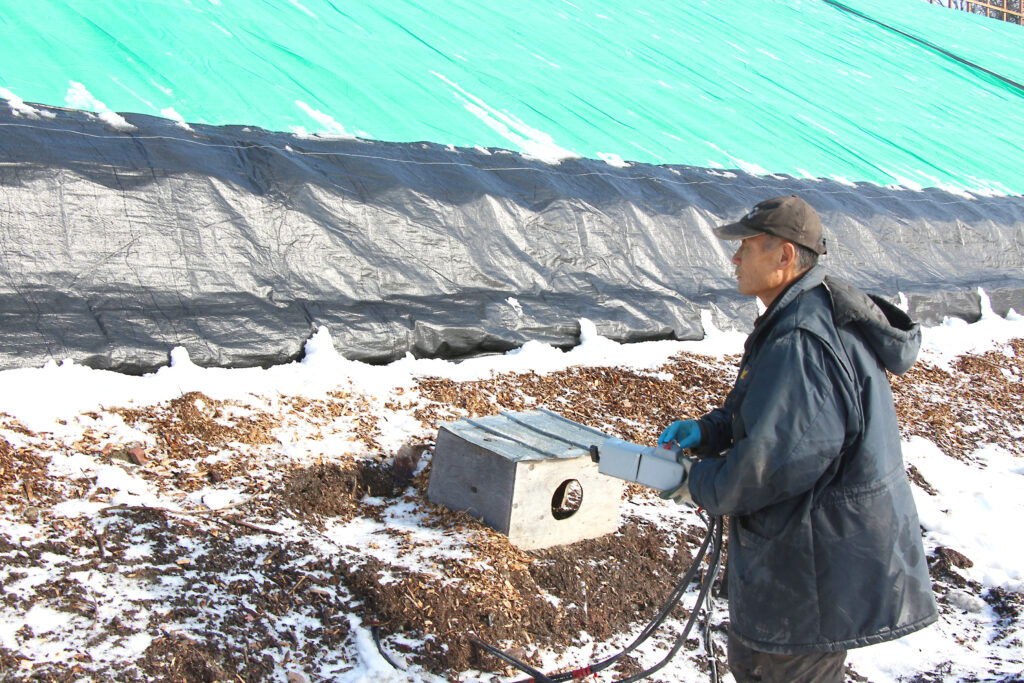
During the winter, the tarp on the outside of the greenhouse is rolled up to let in the limited sunlight, while extra light will come from grow lights he is planning to install. Piles of compost on the outside and inside of the greenhouse create additional heat as they decompose, while insulation all around the sides of the greenhouse keeps the heat inside.
Jian, who has a PhD in energy economics, said the idea is to create a more sustainable way of growing food while also minimizing transportation costs and energy consumption of transporting food products long distances in the winter.
“It’s very ecological, very sustainable. In the winter, in Canada nothing can grow, so everything comes from the south. And when they come from the south, they [have to] transport it, so there’s lots of energy consumption,” he said.
Jian said there have been a few hurdles along the way – starting with the very design of the greenhouse itself. The technology, common in China, is often built using metal, but wooden structures are few and far between.
“It costs more money. You order this truss, that rafter, they don’t have it in stock, they have to make it special for you. It’s more challenging,” he said.
Then, there was the issue of snow piling up on the greenhouse’s roof and at the bottom of the greenhouse. Last winter, after heavy snowfalls, Ryan Zhang said it would take the pair almost two days to shovel snow off the roof. The snow would pile up, weighing down the tarp on the roof and preventing them from being able to roll it up to let in sunlight.
“It’s very hard because the snow is thick on the tarp. So we had to climb up there and come down, and do it [again and again],” he said.
The pair installed a second tarp with a smoother surface over top of the first, allowing accumulated snow to slide right off instead of getting stuck. Ryan said even with the limited snowfall so far this year, the new addition has been a huge help.
“We only spent a half-hour [shovelling] because the snow slides right off,” he said.
Right now, the greenhouse only produces tomatoes, cucumbers and various cabbages, along with eggs from the few dozen chickens that live in the greenhouse as well.
But going forward, Jian would like to grow an assortment of vegetables on the north wall of the greenhouse, which has 200 feet of staircase-style planters for growing so-called “vertical plants.”
“We might do lettuce or other cold-tolerant vegetables,” Jian said.
He also plans to install boxes along the east wall of the greenhouse to house compost heaps.
“This way, all the heat goes directly inside,” he said, adding that by placing the compost along the walls it helps them make use of space they wouldn’t otherwise be using.
Ryan, who moved from Vancouver to help his uncle run the businesses, said it has been a learning experience, but he also believes they are working toward something big for the region.
“This is the future, if we can get some support from the local government, we can promote our business model for the whole Pontiac area,” he said.
While the concept is popular in certain parts of China, it has not taken on as quickly in Canada. Ryan said he hopes that his greenhouse can serve as a model for others in Canada and other cold-climate regions.
Jian, who recently pivoted to running a greenhouse as a way to support the local economy, said sustainable agriculture projects like these should be a priority for local governments, especially in the Pontiac where all industries need to be considered.
He said his diverse background never included agriculture before these past few years, but he is using those experiences to help him with the greenhouse
“I’m still learning. I find it really challenging, really exciting [ . . . ] but if I don’t do this project, there’s no one else here to do it.”
Au cours des dernières années, Jian Zhang et son neveu Ryan Zhang ont travaillé à l’ouverture d’une serre à l’arrière de leur station-service Ultramar à Litchfield.
Lentement, mais sûrement, les Zhangs ont construit ce qu’ils considèrent comme l’avenir de l’agriculture – une serre alimentée par des énergies renouvelables, en plein cœur d’une région rurale et froide du Canada.
Ayant peu d’expérience en agriculture au départ, les dernières années n’ont pas été sans défis. Maintenant, après des années de travail, ils sont enfin prêts à offrir des produits frais dans leur magasin pour la première fois.
Jian, originaire de Chine, a fait visiter la serre à THE EQUITY la semaine dernière. Des tomates fraîches et des concombres croquants étaient placés dans une boîte à la vitrine de leur dépanneur, parmi les premiers légumes qu’ils ont eu à vendre.
Jian a expliqué que la serre est alimentée par des sources d’énergie durables – notamment l’énergie solaire passive et l’énergie générée par le compostage de matières organiques. Cela permet d’utiliser la serre toute l’année, chauffée pendant les mois d’hiver les plus froids sans apport énergétique actif.
Pendant l’hiver, la bâche à l’extérieur de la serre est roulée pour laisser entrer la lumière du soleil limitée, tandis qu’un éclairage supplémentaire proviendra de lampes de culture qu’il prévoit d’installer. Des tas de compost à l’extérieur et à l’intérieur de la serre créent de la chaleur supplémentaire en se décomposant, tandis que l’isolation sur tous les côtés de la serre maintient la chaleur à l’intérieur.
Jian, titulaire d’un doctorat en économie de l’énergie, a déclaré que l’idée est de créer un moyen plus durable de cultiver des aliments tout en minimisant les coûts de transport et la consommation d’énergie liés au transport de produits alimentaires sur de longues distances en hiver.
« C’est très écologique, très durable. En hiver, au Canada, rien ne peut pousser, donc tout vient du sud. Et quand ça vient du sud, il faut le transporter, donc il y a beaucoup de consommation d’énergie », a-t-il dit.
Jian a mentionné qu’il y a eu quelques obstacles en cours de route – à commencer par la conception même de la serre. La technologie, courante en Chine, est souvent construite en métal, mais les structures en bois sont rares.
« Ça coûte plus cher. Vous commandez cette ferme de toit, ce chevron, ils ne l’ont pas en stock, ils doivent le fabriquer spécialement pour vous. C’est plus difficile », a-t-il dit.
Ensuite, il y a eu le problème de l’accumulation de neige sur le toit et au bas de la serre. L’hiver dernier, après de fortes chutes de neige, Ryan Zhang a déclaré qu’il fallait presque deux jours au duo pour déneiger le toit. La neige s’accumulait, alourdissant la bâche sur le toit et les empêchant de la remonter pour laisser entrer la lumière du soleil.
« C’est très difficile parce que la neige est épaisse sur la bâche. Nous devions donc monter et descendre, et le faire [encore et encore] », a-t-il dit.
Le duo a installé une deuxième bâche avec une surface plus lisse par-dessus la première, permettant à la neige accumulée de glisser directement au lieu de rester coincée. Ryan a déclaré que même avec les faibles chutes de neige de cette année jusqu’à présent, le nouvel ajout a été d’une aide précieuse.
« Nous n’avons passé qu’une demi-heure [à pelleter] parce que la neige glisse tout droit », a-t-il dit.
Actuellement, la serre ne produit que des tomates, des concombres et diverses variétés de choux, ainsi que des œufs des quelques douzaines de poulets qui y vivent également.
Mais à l’avenir, Jian aimerait cultiver un assortiment de légumes sur le mur nord de la serre, qui dispose de 200 pieds de jardinières en escalier pour la culture de ce qu’il appelle des « plantes verticales ».
« Nous pourrions faire de la laitue ou d’autres légumes tolérants au froid », a dit Jian.
Il prévoit également d’installer des boîtes le long du mur est de la serre pour y abriter des tas de compost.
« De cette façon, toute la chaleur va directement à l’intérieur », a-t-il dit, ajoutant qu’en plaçant le compost le long des murs, cela leur permet d’utiliser de l’espace qu’ils n’utiliseraient pas autrement.
Ryan, qui a déménagé de Vancouver pour aider son oncle à gérer les entreprises, a déclaré que cela a été une expérience d’apprentissage, mais il croit également qu’ils travaillent à quelque chose de grand pour la région.
« C’est l’avenir, si nous pouvons obtenir un soutien du gouvernement local, nous pourrons promouvoir notre modèle d’affaires pour toute la région du Pontiac », a-t-il dit.
Bien que le concept soit populaire dans certaines régions de Chine, il n’a pas été adopté aussi rapidement au Canada. Ryan a déclaré qu’il espère que sa serre pourra servir de modèle pour d’autres au Canada et dans d’autres régions à climat froid.
Jian, qui s’est récemment tourné vers la gestion d’une serre comme moyen de soutenir l’économie locale, a déclaré que des projets d’agriculture durable comme ceux-ci devraient être une priorité pour les gouvernements locaux, en particulier dans le Pontiac où toutes les industries doivent être prises en considération.
Il a déclaré que son parcours diversifié n’incluait jamais l’agriculture avant ces dernières années, mais il utilise ces expériences pour l’aider avec la serre.
« J’apprends encore. Je trouve ça vraiment stimulant, vraiment excitant [ . . . ] mais si je ne fais pas ce projet, il n’y a personne d’autre ici pour le faire. »