


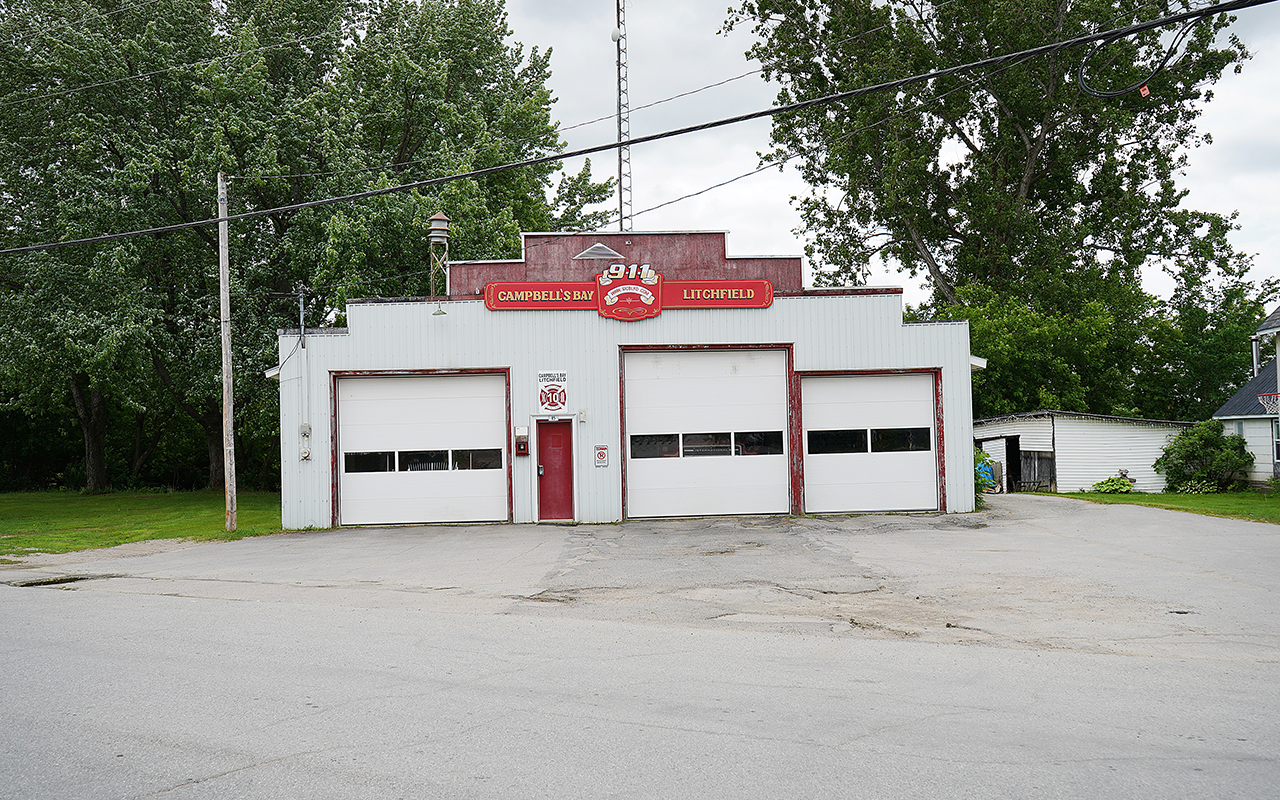



Bryson, Calumet Island, Campbell’s Bay and Litchfield municipalities will benefit from a shared fire service agreement as of July 1, the four municipalities announced in a joint press release on June 11.
With the new agreement, firefighters from all four municipalities will operate as a single department, administered by the Municipality of Campbell’s Bay.
“All firefighters from the four municipalities will be dispatched at the same time,” said Campbell’s Bay director general Sarah Bertrand. “It’s like one big fire department now.”
The Campbell’s Bay-Litchfield Fire Department has been responding to structure fires in Bryson and Calumet Island in an unofficial manner since 2011, when local fire departments were subjected to new minimum requirements that the Bryson and Calumet Island departments were not able to meet.
A 2012 merger between the Bryson and Calumet Island departments was not enough to help those municipalities meet the required number of firefighters to achieve a strike force, so Campbell’s Bay-Litchfield has remained responsible for structure fires on the territory ever since.
Under this lastest agreement, the Campbell’s Bay-Litchfield department will still be responsible for structure fires on the territory but can now benefit from the resources of the Bryson and Calumet departments, including fire trucks, firefighters and equipment, in responding to those fires.
Campbell’s Bay mayor Raymond Pilon said a shared budget will make it easier to pool resources, like the fire truck, as well as make new purchases for the department.
“When it comes to the decision to replace a truck, the money will be there [ . . . ] sharing this between four municipalities makes it a lot more affordable,” he said as an example.
While fire halls in Bryson and Calumet Island will continue to be used, those two municipalities will continue to respond to non-structural calls in their territory. “Power line down, bonfire in somebody’s backyard, we’ll each do our own,” said Kluke.
Additionally, firefighters from those halls will be dispatched from a single location, meaning response times are not affected.
“What’s happening now is a formalized, pre-planned service agreement, not just mutual assistance,” said Julien Gagnon, MRC Pontiac’s public security coordinator, in an email.
“This creates predictable staffing, ensures dispatch is streamlined, and clarifies financial and legal responsibilities. It’s a shift from, ‘We’ll help if you need us’ to ‘We’re your designated fire service.’”
Campbell’s Bay-Litchfield chief Kevin Kluke, who will act as chief of the shared service, said the agreement will boost firefighter numbers from around 25 to around 45, making it easier to meet service levels.
“Sometimes Bryson has two or three. Sometimes we don’t have our eight here. So by putting it together, we’re going to hit our eight 100 per cent of the time, and that’s the biggest problem,” he said.
Pilon said the agreement will also improve the department’s consistency, making sure all firefighters have the right training and that all equipment is inspected and up to snuff.
“Now, everybody’s working under their own municipality, but this will be one big team that is working and training together,” he said. “We will make sure all the equipment is up to par, and that the firefighters are up to par in their training also.”
The budget for the agreement will be shared between the four municipalities, with Campbell’s Bay-Litchfield and Bryson-Calumet Island departments splitting the cost down the middle.
Bryson mayor Alain Gagnon said although his municipality will contribute 20 per cent of the overall budget, he believes the service will be better for his residents because it will be able to meet provincial requirements.
“If there was a house fire, we were calling Campbell’s Bay-Litchfield automatically. During the weekdays, [when] people working are out of town, we don’t have the minimum eight, so you’re always calling your neighbours to help out. So this time with the four of us it will be a lot easier.”
Gagnon confirmed that Bryson has purchased a “new-to-them” fire truck, which will be ready for service within a few weeks.
Litchfield mayor Colleen Larivière said while her municipality pays slightly more than Campbell’s Bay into the agreement due in part to the larger size of its territory, it is still a good deal because it makes for a better service.
“It benefits us as much as them because it gives us the manpower we need, and the equipment, and vice-versa,” she said.
“I’m very pleased that we finally came to a consensus and we’re all on the same page, and I think it’s going to provide a better service for our residents.”
Public security coordinator Gagnon said shared fire service agreements like these are becoming more common due to more stringent requirements from the province, but also because they help municipalities to pool resources.
“No single municipality could afford a full-time fire chief on staff to ensure this management, but together this becomes possible and affordable,” he wrote.
“From a public security standpoint, [these agreements] simplify coordination, reduce liability, and improve training consistency across departments. They also promote better equipment sharing and long-term sustainability for the fire services involved, all the while not actually changing the service to the population.”
Les municipalités de Bryson, L’Isle-aux-Allumettes, Campbell’s Bay et Litchfield bénéficieront d’une entente de services d’incendie partagés à compter du 1er juillet, ont annoncé les quatre municipalités dans un communiqué de presse conjoint le 11 juin.
Grâce à la nouvelle entente, les pompiers des quatre municipalités fonctionneront comme un seul service, administré par la Municipalité de Campbell’s Bay.
« Tous les pompiers des quatre municipalités seront dépêchés en même temps », a déclaré Sarah Bertrand, directrice générale de Campbell’s Bay. « C’est comme un grand service d’incendie maintenant. »
Le Service d’incendie de Campbell’s Bay-Litchfield répondait aux incendies de structure à Bryson et à L’Isle-aux-Allumettes de manière officieuse depuis 2011, lorsque les services d’incendie locaux ont été soumis à de nouvelles exigences minimales que les services de Bryson et de L’Isle-aux-Allumettes n’étaient pas en mesure de respecter.
Une fusion en 2012 entre les services de Bryson et de L’Isle-aux-Allumettes n’a pas suffi à aider ces municipalités à atteindre le nombre requis de pompiers pour constituer une force de frappe, c’est pourquoi Campbell’s Bay-Litchfield est resté responsable des incendies de structure sur le territoire depuis lors.
En vertu de cette dernière entente, le service de Campbell’s Bay-Litchfield restera responsable des incendies de structure sur le territoire, mais peut désormais bénéficier des ressources des services de Bryson et de L’Isle-aux-Allumettes, y compris les camions de pompiers, les pompiers et l’équipement, pour intervenir sur ces incendies.
Raymond Pilon, maire de Campbell’s Bay, a déclaré qu’un budget partagé facilitera la mise en commun des ressources, comme les camions de pompiers, ainsi que l’achat de nouveaux équipements pour le service.
« Quand vient le temps de décider de remplacer un camion, l’argent sera là [ . . . ] partager cela entre quatre municipalités le rend beaucoup plus abordable », a-t-il donné en exemple.
Bien que les casernes de pompiers de Bryson et de L’Isle-aux-Allumettes continueront d’être utilisées, ces deux municipalités continueront de répondre aux appels non structurels sur leur territoire. « Ligne électrique tombée, feu de joie dans l’arrière-cour de quelqu’un, nous ferons chacun le nôtre », a déclaré Kluke.
De plus, les pompiers de ces casernes seront dépêchés à partir d’un seul endroit, ce qui signifie que les temps de réponse ne sont pas affectés.
« Ce qui se passe maintenant est une entente de services formalisée et planifiée à l’avance, et non seulement une assistance mutuelle », a déclaré Julien Gagnon, coordonnateur en sécurité civile de la MRC de Pontiac, dans un courriel.
« Cela crée un effectif prévisible, assure une répartition simplifiée et clarifie les responsabilités financières et juridiques. C’est un passage de « Nous vous aiderons si vous avez besoin de nous » à « Nous sommes votre service d’incendie désigné ». »
Kevin Kluke, chef du service de Campbell’s Bay-Litchfield, qui agira à titre de chef du service partagé, a déclaré que l’entente fera passer le nombre de pompiers d’environ 25 à environ 45, ce qui facilitera le respect des niveaux de service.
« Parfois, Bryson en a deux ou trois. Parfois, nous n’avons pas nos huit ici. Donc, en le combinant, nous atteindrons nos huit 100 % du temps, et c’est le plus grand problème », a-t-il déclaré.
Pilon a déclaré que l’entente améliorera également la cohérence du service, en veillant à ce que tous les pompiers aient la bonne formation et à ce que tout l’équipement soit inspecté et conforme.
« Actuellement, tout le monde travaille sous sa propre municipalité, mais ce sera une grande équipe qui travaillera et s’entraînera ensemble », a-t-il dit. « Nous nous assurerons que tout l’équipement est à la hauteur, et que les pompiers sont également à la hauteur dans leur formation. »
Le budget de l’entente sera partagé entre les quatre municipalités, les services de Campbell’s Bay-Litchfield et de Bryson-L’Isle-aux-Allumettes se partageant le coût à parts égales.
Alain Gagnon, maire de Bryson, a déclaré que bien que sa municipalité contribuera à 20 % du budget global, il croit que le service sera meilleur pour ses résidents car il pourra répondre aux exigences provinciales.
« S’il y avait un incendie de maison, nous appelions automatiquement Campbell’s Bay-Litchfield. Pendant les jours de semaine, [quand] les gens qui travaillent sont hors de la ville, nous n’avons pas le minimum de huit, alors vous appelez toujours vos voisins à l’aide. Alors cette fois-ci, à nous quatre, ce sera beaucoup plus facile. »
Gagnon a confirmé que Bryson a acheté un camion de pompiers « nouveau pour eux », qui sera prêt à être mis en service d’ici quelques semaines.
Colleen Larivière, mairesse de Litchfield, a déclaré que si sa municipalité paie un peu plus que Campbell’s Bay dans l’entente, en partie en raison de la plus grande taille de son territoire, cela reste une bonne affaire car cela permet un meilleur service.
« Cela nous avantage autant qu’eux parce que cela nous donne les effectifs dont nous avons besoin, et l’équipement, et vice-versa », a-t-elle déclaré.
« Je suis très heureuse que nous soyons enfin parvenus à un consensus et que nous soyons tous sur la même longueur d’onde, et je pense que cela fournira un meilleur service à nos résidents. »
Gagnon, coordonnateur en sécurité civile, a déclaré que les ententes de services d’incendie partagés comme celles-ci deviennent plus courantes en raison des exigences plus strictes de la province, mais aussi parce qu’elles aident les municipalités à mettre en commun leurs ressources.
« Aucune municipalité seule ne pourrait se permettre d’avoir un chef pompier à temps plein pour assurer cette gestion, mais ensemble, cela devient possible et abordable », a-t-il écrit.
« Du point de vue de la sécurité civile, [ces ententes] simplifient la coordination, réduisent la responsabilité et améliorent la cohérence de la formation entre les services. Elles favorisent également un meilleur partage de l’équipement et la durabilité à long terme des services d’incendie concernés, tout en ne modifiant pas réellement le service à la population. »