


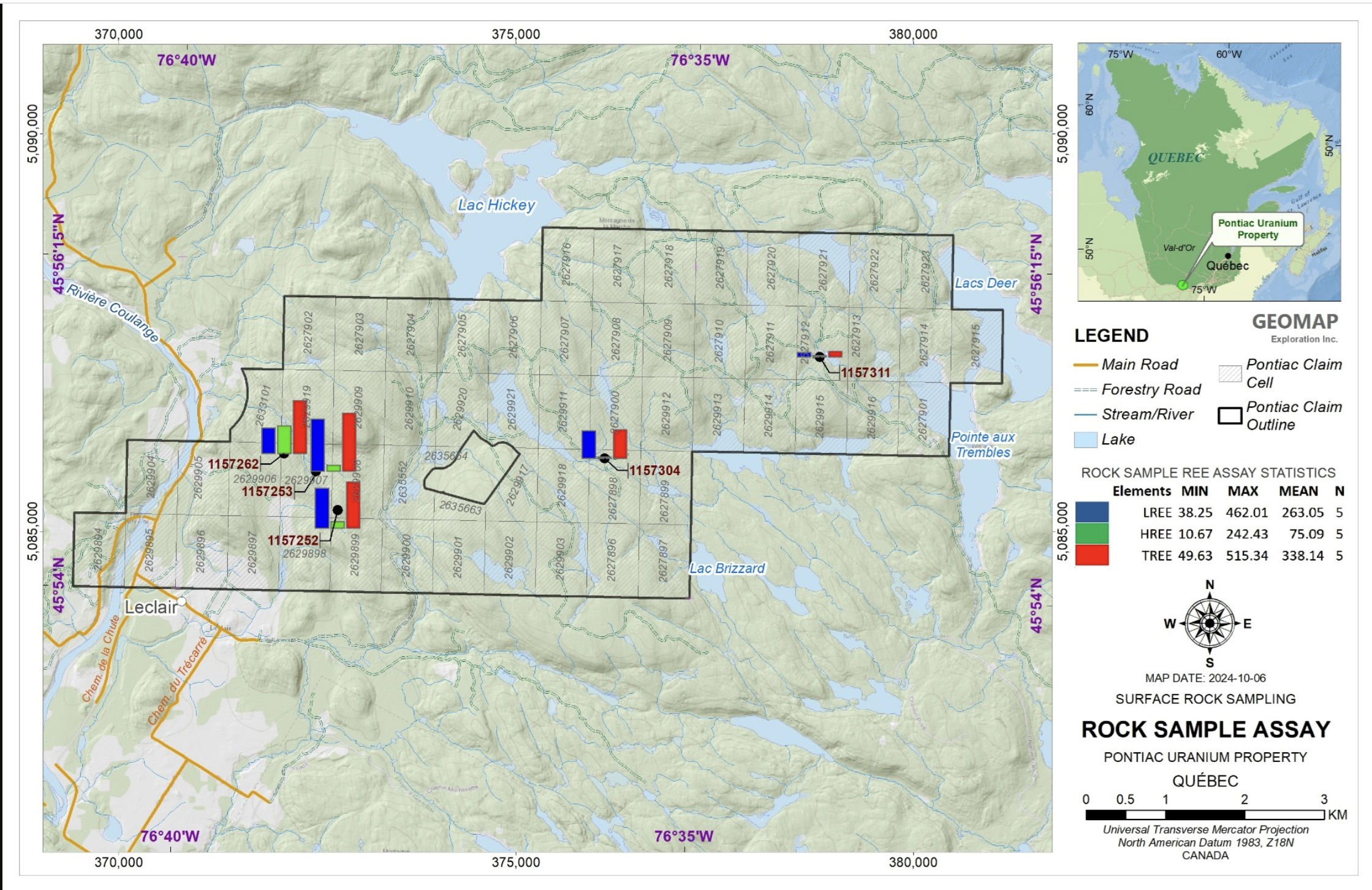



A British Columbia-based company that has finished the first phase of exploration activities on an area of land spanning several Pontiac municipalities indicated in a January press release it will continue toward a second phase of exploration.
Showcase Minerals Inc. owns about 60 mining claims in the area, spanning about 3,461 hectares across the municipalities of Litchfield, Mansfield and Pontefract, and Otter Lake.
In the release, the company said it had completed the first phase of surveying activities on the land, including geological mapping, rock sampling and ground prospecting, finding rare earth elements (REEs), uranium and other minerals.
“We are excited by the results [ . . . ] These findings highlight the property’s significant rare earth element potential,” Kirk Reed, CEO of Showcase Minerals was quoted as saying in the release.
“As global demand for clean energy technologies and strategic materials continues to grow, the Pontiac Project’s potential as a multi-commodity exploration target aligns with our commitment to advancing projects that support a sustainable future. We look forward to building on these results in Phase II.”
A previous release from September indicated phase two of exploration would involve “trenching and stripping operations” and “further prospecting, geological mapping, and sampling work throughout the property.”
The company did not respond to repeated interview requests, but THE EQUITY was able to determine the company is headquartered in Salmon Arm, B.C., was incorporated in 2020 and listed on the Canadian Securities Exchange in 2023.
In the independent auditor’s report of the company’s most recent annual financial statement, auditor K.R. Margetson Ltd. wrote the company “does not currently have the financial resources to sustain operations in the long-term.”
“The company has incurred net losses of $718,176 since inception, has a working capital deficit of $42,208 and has never made any sales of its products,” the audit continued.
As of Monday, none of the three mayors whose municipalities touch Showcase Mining’s claims had heard about the surveying activity, and neither had MRC Pontiac warden Jane Toller.
“At this point there has been no communication with the MRC or municipalities,” confirmed Toller in a message, adding that companies often purchase claims but do not necessarily proceed to the extraction phase.
Mining claims, which are each typically about 10 hectares in size, can be purchased from the province’s natural resources ministry.
“Often, companies speculate or have claims which they announce to draw attention and it could increase stock activity,” Toller said, noting that in her experience as warden, very few claims have amounted to mining activity.
“In the seven and a half years that I’ve been warden, I am only aware of Sphinx [on Calumet Island], and that didn’t work out,” she said. “There could be a lot of claims that are just speculation and interest that will never be followed up on, so I don’t think there’s cause for alarm.”
Region’s mining claims doubled since 2019
According to the online mining claims database available on Quebec’s natural resources ministry’s website, there are currently between 200 and 300 active mining claims in the area Showcase Minerals has surveyed, roughly located between Highway 148 and Highway 301, south of Squaw Lake.
A coalition of mining industry watchdogs found that in 2023 there were over 330,000 active mining claims in Quebec. Per the province’s natural resources ministry, in 2022 only 14 per cent of claims proceeded to the exploration stage.
There were 112,447 mining claims approved in 2023 province-wide, an increase of nearly 40,000 from the year prior. In the Outaouais, the number of active mining claims has more than doubled since 2019.
Carolyn Raab, a co-founder of anti-mining activism group Action Low, said mining claims can be purchased cheaply by companies for less than $80 each.
Raab, who helped form the group to fight a recent increase in mining claims in her home municipality of Low, noted the process happens in several phases. Once the surface-level exam has been done, companies can move to the exploration phase, breaking ground to see if there is enough mineral there to justify mining on a large scale.
She said mining claims can be held on a property without the knowledge of the property owner, but if a company gets government authorization to proceed with exploration, landowners have little-to-no say in the process.
“If it’s private property, you’re going to get expropriated. That typically doesn’t work out well for the landowner, and the landowner has no say in the matter. You don’t own it to begin with, so your negotiating power is pretty minimal.”
Raab explained municipalities can request that certain lands gain a designation called TIAM, or territory incompatible with mining activity, which would exempt land from mineral exploration, and can apply for this exemption if the land falls within an urban perimeter, if the mining activity would interfere with agricultural or touristic areas or with places of historical or cultural importance.
In 2020 the city of Sherbrooke successfully designated all but 77 hectares of its territory as incompatible with mining activity, in response to an increase in mining claims.
Toller said the MRC has already designated areas along the banks of the Coulonge and Black rivers as incompatible with mining activities.
“In our land management plan, we do have incompatible areas, and those would be two of them,” she said.
“No mining can take place there.”
Toller also said that while there hasn’t historically been much mining activity, she believes it could bring jobs to local workers who travel elsewhere to work in mines.
“It would be great someday if we had some form of mining operation, because we have people who are experienced who could work here.”
Une entreprise établie en Colombie-Britannique, qui a achevé la première phase de ses activités d’exploration sur un secteur s’étendant sur plusieurs municipalités du Pontiac, a indiqué dans un communiqué de presse de janvier qu’elle passera à une deuxième phase d’exploration.
Showcase Minerals Inc. détient environ 60 claims miniers dans la région, s’étendant sur environ 3 461 hectares sur les municipalités de Litchfield, Mansfield et Pontefract, et Otter Lake.
Dans le communiqué, l’entreprise a déclaré avoir terminé la première phase des activités de levés sur le territoire, y compris la cartographie géologique, l’échantillonnage de roches et la prospection au sol, en y trouvant des éléments des terres rares (ETR), de l’uranium et d’autres minéraux.
« Nous sommes enthousiasmés par les résultats [ . . . ] Ces découvertes mettent en évidence le potentiel significatif de la propriété en éléments des terres rares », a déclaré Kirk Reed, PDG de Showcase Minerals, dans le communiqué.
« Alors que la demande mondiale pour les technologies d’énergie propre et les matériaux stratégiques continue de croître, le potentiel du projet Pontiac en tant que cible d’exploration multi-matières premières s’aligne sur notre engagement à faire progresser les projets qui soutiennent un avenir durable. Nous sommes impatients de nous appuyer sur ces résultats lors de la phase II. »
Un communiqué précédent de septembre indiquait que la phase deux de l’exploration comprendrait des « opérations de creusement de tranchées et de décapage » ainsi que « d’autres travaux de prospection, de cartographie géologique et d’échantillonnage sur l’ensemble de la propriété. »
L’entreprise n’a pas répondu à nos demandes d’entrevue répétées, mais The Equity a pu déterminer que l’entreprise a son siège social à Salmon Arm, en C.-B., a été incorporée en 2020 et inscrite à la Bourse des valeurs canadiennes en 2023.
Dans le rapport de l’auditeur indépendant sur les plus récents états financiers annuels de l’entreprise, l’auditeur K.R. Margetson Ltd. a écrit que l’entreprise « ne dispose pas actuellement des ressources financières nécessaires pour soutenir ses opérations à long terme. »
« L’entreprise a subi des pertes nettes de 718 176 $ depuis sa création, présente un déficit de fonds de roulement de 42 208 $ et n’a jamais réalisé de ventes de ses produits », a poursuivi l’audit.
Lundi, aucun des trois maires dont les municipalités touchent aux claims miniers de Showcase Mining n’avait eu connaissance des activités de levés, pas plus que la préfète de la MRC de Pontiac, Jane Toller.
« À ce stade, il n’y a eu aucune communication avec la MRC ou les municipalités », a confirmé Mme Toller dans un message, ajoutant que les entreprises achètent souvent des claims, mais ne procèdent pas nécessairement à la phase d’extraction.
Les claims miniers, qui mesurent généralement environ 10 hectares chacun, peuvent être achetés auprès du ministère des Ressources naturelles de la province.
« Souvent, les entreprises spéculent ou ont des claims qu’elles annoncent pour attirer l’attention, ce qui pourrait augmenter l’activité boursière », a déclaré Mme Toller, faisant remarquer que, selon son expérience en tant que préfète, très peu de claims ont donné lieu à des activités minières.
« En sept ans et demi que je suis préfète, je n’ai connaissance que de Sphinx [sur l’île de Calumet], et cela n’a pas fonctionné », a-t-elle déclaré. « Il pourrait y avoir beaucoup de claims qui ne sont que de la spéculation et de l’intérêt qui ne seront jamais suivis, donc je ne pense pas qu’il y ait lieu de s’alarmer. »
Les claims miniers de la région ont doublé depuis 2019
Selon la base de données en ligne des claims miniers disponible sur le site web du ministère des Ressources naturelles du Québec, il y a actuellement entre 200 et 300 claims miniers actifs dans la zone qu’a étudiée Showcase Minerals, approximativement située entre l’autoroute 148 et l’autoroute 301, au sud du lac Squaw.
Une coalition de groupes de surveillance de l’industrie minière a constaté qu’en 2023, il y avait plus de 330 000 claims miniers actifs au Québec. Selon le ministère des Ressources naturelles de la province, en 2022, seulement 14 % des claims ont atteint la phase d’exploration.
112 447 claims miniers ont été approuvés à l’échelle de la province en 2023, soit une augmentation de près de 40 000 par rapport à l’année précédente. Dans l’Outaouais, le nombre de claims miniers actifs a plus que doublé depuis 2019.
Carolyn Raab, cofondatrice du groupe d’activisme anti-minier Action Low, a déclaré que les entreprises peuvent acheter des claims miniers à bas prix, pour moins de 80 $ chacun.
Mme Raab, qui a contribué à former le groupe pour lutter contre une récente augmentation des claims miniers dans sa municipalité d’origine de Low, a noté que le processus se déroule en plusieurs phases. Une fois l’examen de surface effectué, les entreprises peuvent passer à la phase d’exploration, en creusant le sol pour voir s’il y a suffisamment de minéraux pour justifier une exploitation minière à grande échelle.
Elle a déclaré que des claims miniers peuvent être détenus sur une propriété sans que le propriétaire en ait connaissance, mais si une entreprise obtient l’autorisation gouvernementale de procéder à l’exploration, les propriétaires fonciers n’ont pratiquement pas leur mot à dire dans le processus.
« S’il s’agit d’une propriété privée, vous allez être exproprié. Cela ne se passe généralement pas bien pour le propriétaire foncier, et celui-ci n’a pas son mot à dire en la matière. Vous n’en êtes pas propriétaire au départ, donc votre pouvoir de négociation est assez minime. »
Mme Raab a expliqué que les municipalités peuvent demander que certaines terres obtiennent une désignation appelée TIAM, ou territoire incompatible avec l’activité minière, ce qui exempterait la terre de l’exploration minière, et peuvent demander cette exemption si la terre se trouve à l’intérieur d’un périmètre urbain, si l’activité minière interférerait avec des zones agricoles ou touristiques ou avec des lieux d’importance historique ou culturelle.
En 2020, la Ville de Sherbrooke a réussi à désigner tout son territoire, à l’exception de 77 hectares, comme incompatible avec l’activité minière, en réponse à une augmentation des claims miniers.
Mme Toller a déclaré que la MRC a déjà désigné des zones le long des rives des rivières Coulonge et Noire comme incompatibles avec les activités minières.
« Dans notre plan d’aménagement du territoire, nous avons des zones incompatibles, et celles-ci en seraient deux », a-t-elle déclaré.
« Aucune activité minière ne peut avoir lieu là. »
Mme Toller a également déclaré que, bien qu’il n’y ait pas eu historiquement beaucoup d’activité minière, elle pense que cela pourrait créer des emplois pour les travailleurs locaux qui se déplacent ailleurs pour travailler dans les mines.
« Ce serait formidable un jour si nous avions une forme d’exploitation minière, car nous avons des gens expérimentés qui pourraient travailler ici. »