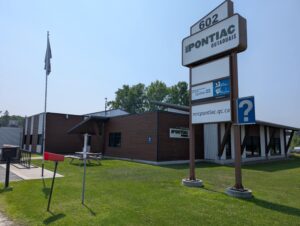



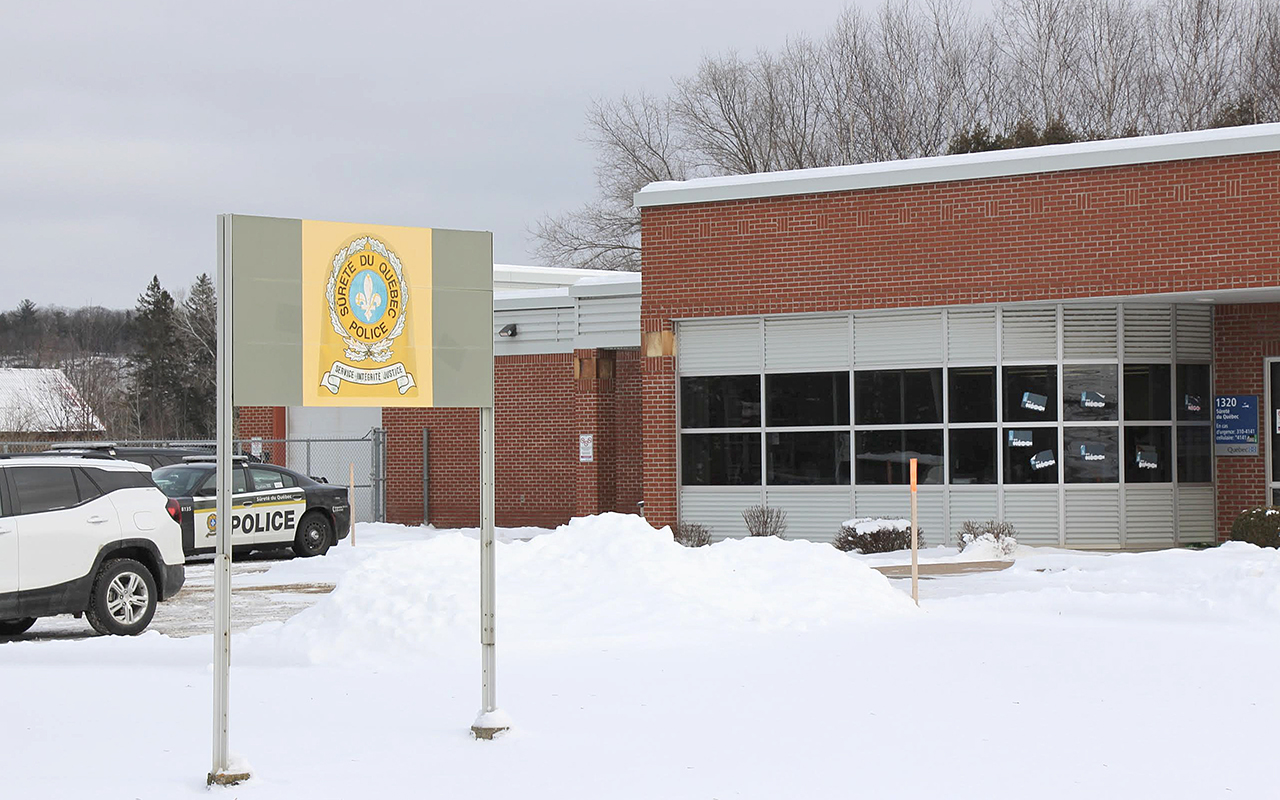



A Quebec coroner is recommending the Sûreté du Québec review its policy for the surveillance of people under its care following an incident in which a woman who collapsed in an interrogation room at the police station in Campbell’s Bay in 2024 later died in hospital.
The recommendations were first reported by Le Droit.
In her Jan. 9 report, coroner Francine Danais lays out the details of the case. A woman from Clarendon was arrested by police and brought to the Campbell’s Bay police station on Mar. 1, 2024. Her name is redacted in the report. She suffered a medical emergency while in the station’s interrogation room, and collapsed in convulsions. An ambulance was called and she was taken initially to Pontiac Hospital, and then transferred to Hull the following day. The woman died there on Mar. 4, 2024. An autopsy was performed on Mar. 11 in Montreal.
Analysis
Danais’ report states that the woman had several conditions – chronic obstructive pulmonary disease, chronic anemia, depression, and substance use disorder (alcohol and cocaine) – and was prescribed medications for them. It notes that based on the last time the prescriptions had been filled, and the quantities remaining, she may have been in “non-compliance” with her treatment schedule.
According to the provided timeline, determined with the surveillance footage as well as testimonies from witnesses, she was taken to the interrogation room at around 9 a.m. and at around 9:30 a.m. she requested her medication, which police said they were retrieving. Her condition appeared to deteriorate as she was left alone in the room, and she loses her balance, while continuing to knock on the door and ask for her medication. She fell to the floor at one point around 10:15 a.m., but returned to her chair with difficulty and was breathing heavily.
Though she received some medication containers from an officer around 10:30 a.m., she did not mention feeling unwell or the fall, Danais notes.
At around 10:50 a.m. she became more agitated and asked to see a doctor, and at 11:08 a.m. she collapsed again and began to convulse. The convulsions end three minutes later, but she laid on the ground breathing heavily. An officer entered the room at 11:15 a.m. and found her, helping her into a chair. Emergency services were called, and she convulsed again at 11:29 a.m. A civilian employee who was also a first responder attended to her. The paramedics arrived at 11:39 a.m., began CPR and she was subsequently transported to hospital.
The report concluded that the death was accidental, caused by a “prolonged cardiorespiratory arrest, likely induced by recent use of illicit drugs (cocaine and methamphetamine).”
“It should also be noted that the medications requested by Ms. [redacted] did not counteract the cardiotoxic effects of methamphetamine and cocaine, and their administration, or the delay in taking them, did not contribute to her death,” she said. “In summary, based on my investigation, it appears that Ms. [redacted] had consumed methamphetamine and cocaine prior to her arrest and that she suffered from the harmful effects of these substances, which would have occurred regardless of where she was,” she wrote.
Danais notes that coroners do not have the authority to rule on civil or criminal liability, or determine whether officers operated according to best practices, as there are other authorities for these determinations.
“Thus, one can question what appears to be the lack of supervision of Ms. [redacted] while she was experiencing discomfort in the interrogation room,” Danais wrote. “In light of my investigation, there appears to be a lack of precision in the ‘Sûreté du Québec’s Management Policy’ as well as in the ‘Guide to Police Practices of the Ministry of Public Security’ regarding the definition of a detained person and their supervision.”
Coroner’s recommendations
Danais made two recommendations each to the Department of Public Security and the Sûreté du Québec.
She recommended the DPS revise their guide on people detained in a police station to include detention and custody in an interview room, as well as revise their policies to clarify what constitutes a detained person and to add a section on people “detained at the police station in all premises other than a cell, including an interview room, interrogation room, or even a police vehicle.”
For the SQ, she recommended they update their guidelines on the use of an interrogation room, specifying in particular the definition of a person in custody. She also recommended that a designated supervisor “exercises close, regular, and constant supervision, which must be adapted to the condition of the person in custody, in order to guarantee their well-being, as soon as they are in custody, regardless of where they are located.”
Prosecutor found no grounds to lay charges following BEI investigation
Back in July 2025, Quebec’s police watchdog, the Bureau des enquêtes indépendantes (BEI), announced that they had closed their investigation into the case, after the director of criminal and penal prosecutions (DPCP) had reviewed the file and found no grounds to lay any charges.
“The surveillance camera footage shows that it was difficult to assess the woman’s condition. Her condition deteriorated when she was alone. It was only upon returning to the interrogation room that the officer became aware of her precarious state of health,” the DPCP’s report notes. “At that point, he provided her with assistance and contacted emergency services. The available evidence does not support a finding of marked departure from the conduct of a reasonable police officer in the same circumstances, nor does it support a finding that they failed to provide the necessities of life to a dependent.”
“In criminal law, the burden of proof that the prosecution must meet is very demanding. Due to the principle of the presumption of innocence, the prosecution must demonstrate the guilt of the accused beyond a reasonable doubt before the court,” the DPCP report adds. “The decision to prosecute or not is a discretionary decision made by the prosecutor in the performance of their professional duties, without fear of judicial or political interference and without yielding to media pressure. Furthermore, it is not the prosecutor’s responsibility to rule on possible civil or ethical misconduct. They only seek evidence that allows them to conclude that a criminal act has been committed and to determine whether they can reasonably prove it. Nor is it their role to make comments or recommendations regarding police intervention methods.”
Un coroner québécois recommande à la Sûreté du Québec de revoir sa politique concernant la surveillance des personnes sous sa garde à la suite d’un incident où une femme s’est effondrée dans une salle d’interrogatoire au poste de police de Campbell’s Bay en 2024 et est décédée plus tard à l’hôpital.
Les recommandations ont d’abord été rapportées par Le Droit.
Dans son rapport du 9 janvier, la coroner Francine Danais expose les détails de l’affaire. Une femme de Clarendon a été arrêtée par la police et conduite au poste de police de Campbell’s Bay le 1er mars 2024. Son nom est caviardé dans le rapport. Elle a subi une urgence médicale alors qu’elle se trouvait dans la salle d’interrogatoire du poste, et s’est effondrée en convulsions. Une ambulance a été appelée et elle a été initialement transportée à l’hôpital de Pontiac, puis transférée à Hull le lendemain. La femme y est décédée le 4 mars 2024. Une autopsie a été pratiquée le 11 mars à Montréal.
Analyse
Le rapport de Mme Danais indique que la femme souffrait de plusieurs affections — maladie pulmonaire obstructive chronique, anémie chronique, dépression et trouble lié à l’usage de substances (alcool et cocaïne) — et des médicaments lui avaient été prescrits pour les traiter. Il est noté que, d’après la dernière fois que les ordonnances avaient été remplies et les quantités restantes, elle aurait pu être en « non-observance » de son horaire de traitement.
Selon la chronologie fournie, établie à partir des images de surveillance ainsi que des témoignages de témoins, elle a été conduite à la salle d’interrogatoire vers 9 h et vers 9 h 30, elle a demandé ses médicaments, que la police a dit être en train de récupérer. Son état a semblé se détériorer alors qu’elle était laissée seule dans la pièce, et elle a perdu l’équilibre, tout en continuant à frapper à la porte et à demander ses médicaments. Elle est tombée au sol à un moment donné vers 10 h 15, mais est revenue à sa chaise avec difficulté et respirait lourdement.
Bien qu’elle ait reçu des contenants de médicaments d’un agent vers 10 h 30, elle n’a pas mentionné se sentir mal ou la chute, note Mme Danais.
Vers 10 h 50, elle est devenue plus agitée et a demandé à voir un médecin, et à 11 h 08, elle s’est à nouveau effondrée et a commencé à convulser. Les convulsions ont cessé trois minutes plus tard, mais elle est restée au sol, respirant lourdement. Un agent est entré dans la pièce à 11 h 15 et l’a trouvée, l’aidant à s’installer sur une chaise. Les services d’urgence ont été appelés, et elle a convulsé de nouveau à 11 h 29. Un employé civil, qui était aussi premier répondant, s’est occupé d’elle. Les ambulanciers sont arrivés à 11 h 39, ont commencé la RCR et elle a ensuite été transportée à l’hôpital.
Le rapport a conclu que le décès était accidentel, causé par un « arrêt cardiorespiratoire prolongé, probablement induit par une consommation récente de drogues illicites (cocaïne et méthamphétamine) ».
« Il faut aussi mentionner que les médicaments demandés par Mme [texte caviardé] n’ont pas contrecarré les effets cardiotoxiques de la méthamphétamine et de la cocaïne, et que leur administration, ou le délai de leur prise, n’a pas contribué à son décès », a-t-elle déclaré. « En résumé, d’après mon enquête, il semble que Mme [texte caviardé] ait consommé de la méthamphétamine et de la cocaïne avant son arrestation et qu’elle ait souffert des effets néfastes de ces substances, ce qui se serait produit indépendamment de l’endroit où elle se trouvait », a-elle écrit.
Mme Danais note que les coroners n’ont pas l’autorité de statuer sur la responsabilité civile ou criminelle, ni de déterminer si les agents ont agi selon les meilleures pratiques, car d’autres autorités sont chargées de ces déterminations.
« Ainsi, on peut s’interroger sur ce qui semble être le manque de surveillance de Mme [texte caviardé] alors qu’elle éprouvait un malaise dans la salle d’interrogatoire », a écrit Mme Danais. « À la lumière de mon enquête, il semble y avoir un manque de précision dans la « Politique de gestion de la Sûreté du Québec » ainsi que dans le « Guide des pratiques policières du ministère de la Sécurité publique » concernant la définition d’une personne détenue et sa surveillance. »
Recommandations du coroner
Mme Danais a fait deux recommandations à l’attention du ministère de la Sécurité publique et deux autres à l’attention de la Sûreté du Québec.
Elle a recommandé au MSP de réviser son guide sur les personnes détenues dans un poste de police afin d’y inclure la détention et la garde dans une salle d’entrevue, ainsi que de réviser ses politiques pour clarifier ce qui constitue une personne détenue et d’ajouter une section sur les personnes « détenues au poste de police dans tous les locaux autres qu’une cellule, y compris une salle d’entrevue, une salle d’interrogatoire, ou même un véhicule de police. »
Pour la SQ, elle a recommandé de mettre à jour leurs directives sur l’utilisation d’une salle d’interrogatoire, en précisant notamment la définition d’une personne en garde à vue. Elle a également recommandé qu’un superviseur désigné « exerce une surveillance étroite, régulière et constante, laquelle doit être adaptée à l’état de la personne en garde à vue, afin de garantir son bien-être, dès qu’elle est en garde à vue, quel que soit l’endroit où elle se trouve. »
Le procureur n’a trouvé aucun motif de porter des accusations à la suite de l’enquête du BEI
En juillet 2025, l’organisme de surveillance policière du Québec, le Bureau des enquêtes indépendantes (BEI), a annoncé qu’il avait clos son enquête sur l’affaire, après que le directeur des poursuites criminelles et pénales (DPCP) eut examiné le dossier et n’eut trouvé aucun motif de porter des accusations.
« Les images des caméras de surveillance montrent qu’il était difficile d’évaluer l’état de la femme. Son état s’est détérioré lorsqu’elle était seule. Ce n’est qu’en retournant dans la salle d’interrogatoire que l’agent a pris conscience de son état de santé précaire », note le rapport du DPCP. « À ce moment-là, il lui a fourni de l’aide et a contacté les services d’urgence. Les preuves disponibles ne permettent pas de conclure à un écart marqué par rapport à la conduite d’un policier raisonnable dans les mêmes circonstances, ni de conclure qu’ils n’ont pas fourni les nécessités de la vie à une personne dépendante. »
« En droit pénal, le fardeau de la preuve que doit satisfaire la poursuite est très exigeant. En raison du principe de la présomption d’innocence, la poursuite doit démontrer la culpabilité de l’accusé au-delà de tout doute raisonnable devant le tribunal », ajoute le rapport du DPCP. « La décision de poursuivre ou non est une décision discrétionnaire prise par le procureur dans l’exercice de ses fonctions professionnelles, sans crainte d’ingérence judiciaire ou politique et sans céder à la pression médiatique. En outre, il n’appartient pas au procureur de se prononcer sur d’éventuelles fautes civiles ou éthiques. Il ne recherche que les preuves lui permettant de conclure qu’un acte criminel a été commis et de déterminer s’il peut raisonnablement le prouver. Ce n’est pas non plus son rôle de faire des commentaires ou des recommandations concernant les méthodes d’intervention policière. »