






With only two games left in the 2019-20 regular season, the Pontiac Senior Comets sit in first place in the Outaouais Senior AA Hockey League (OSAAHL) and look poised for a . . .
run at the Hull Volant Cup during the playoffs.
Scoring an unprecedented 10 goals in each of their last three games – including a 14-2 trouncing of the second place Mont-Laurier Montagnards in January – the Comets’ offense has been its catalyst all season long.
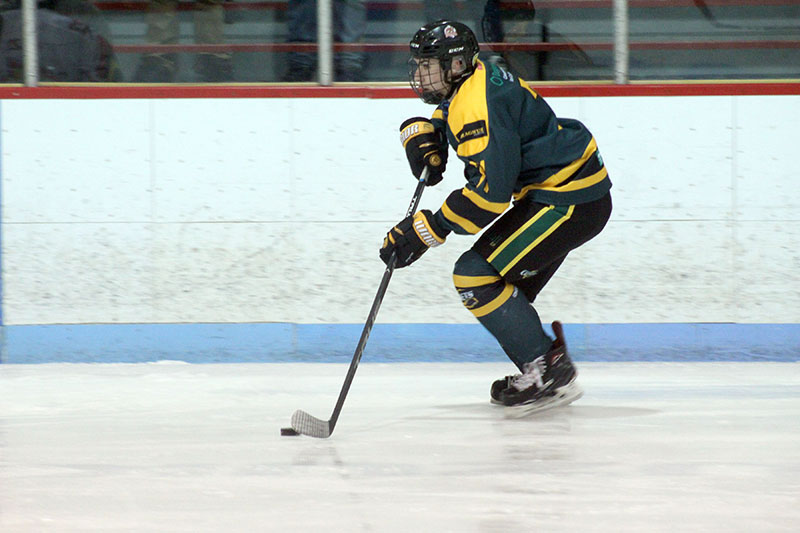
For 21-year-old forward Ryan Peck, joining the Comets earlier this season has been an absolute joy and being part of a winning team has made the experience even better.
“It’s been awesome,” he said. “I couldn’t ask for any better. The boys are super good.”
Contributing 17 points (nine goals, eight assists) in his first 16 OSAAHL games, while serving mostly in a depth role, Peck has been a reliable asset on both sides of the puck ever since joining the team in November of 2019.
Growing up in Wakefield, Que., Peck started playing hockey at age three on a backyard rink that his father Randy constructed every winter until the most recent, meaning that he didn’t need to go far to work on his skills and develop a love for the game.
“I guess that’s kind of how I started playing hockey,” he said. “I started when I was pretty young and it just kind of continued.”
The oldest in a family of five children, Peck has two brothers – Luke and Carter – who both play hockey competitively for the Embrun Panthers in the Central Canadian Hockey League 2 and two sisters – Kyley and Madison – who play collegiate soccer for Heritage College.
A natural athlete, Peck played a number of sports besides hockey growing including soccer and fastball, which he still plays in the Shawville Men’s Fastball League.
But hockey was always his number one passion and throughout his minor hockey years, he played competitively for the Loups des Collines, where he took on teams from all across the Outaouais.
As a small player growing up, Peck recalled needing some adjustment in his early years. But with countless hours of practice, especially in his backyard, Peck developed into a perennial competitive player.
“I always played double letters growing up,” he said.
Peck’s finest minor hockey memory came in his first year of Midget AA with the Loups des Collines (2013-14).
After finishing in second place in the regular season, behind a Gatineau team that gave his squad fits all year long, Peck’s team defeated their rival in a five-game series, took home the championship and advanced to the Dodge Cup.
“Come playoffs, we just kind of came together as a team,” he said. “That was a great team to be a part of. It had the same feeling as the Comets this year. We had a great year that year.”
After finishing minor hockey at 17-years-old, Peck was determined to keep rising in the hockey ranks. Not completely sure about his chances of playing junior hockey at such a young age, Peck chose a different route.
Interested in the academic opportunity it offered while playing hockey with highly talented players every day, Peck enrolled at St. Paul’s School – a small boarding institution in Concord, NH, known for its hockey culture.
“You never know if you’re going to earn a spot on a Junior A team,” he said. So, it kind of seemed like a good stepping stone for me to continue my hockey career and my education at the same time.”
As part of the United States High School Preparatory (USHS-Prep) league, Peck suited up for the Pelicans for the next two years, where he played against schools from all across the Northeastern American seaboard.
Transitioning from minor hockey to prep-school, Peck said the biggest change was the time spent on the ice, which augmented significantly, and the style of play, which was more focused on puck possession and systemic structure.
“In minor hockey, you kind of played a game or two per week and a practice,” he said. “Whereas, the transition to prep school was all of sudden every single day and they play a different style of hockey than we do here in Canada I find. It’s not that different. It’s just that I find they play a bit more of a skill game, more systems and stuff like that. Whereas, here it’s as bit more kind of rugged and physical.”
In his first season at St. Paul’s (2016-17) as an 18-year-old, Peck finished second on the team with 20 points (nine goals, 11 assists) in 25 regular season games.
During his second year with the Pelicans, he put up 25 points (seven goals, 18 assists) in 24 games, good for second on the team again.
Looking back on his experience at St. Paul’s, Peck has nothing but fond memories. Living on campus with his friends and being part of the hockey culture on campus, he feels grateful for all the good times he had in New Hampshire.
“I wouldn’t have traded it for anything,” he said. “It was awesome.”
Peck explained that graduating from St. Paul’s earned him a degree that was valued similarly to a diploma from CEGEP, which allowed him to enroll in a wider range of universities when he desired.
Plus, contributing to the resurgence of a once well-reputed program, Peck felt very proud about what his team accomplished on the ice over his two years there.
“Going in the first season we were kind of rebuilding and the second year for the first time in a long time we were a 500-team and almost made playoffs,” he said. “We turned the program around pretty well.”
Learning all sorts of valuable skills on and off the ice at St. Paul’s, Peck said his experience in prep-school was very beneficial for his transition to high levels of hockey.
“It was a great stepping stone to prepare me for Junior A the next year,” he said.
After graduating from St. Paul’s, the 20-year-old Peck was hungry for an opportunity to play junior hockey during what was his final year of eligibility.
Interested in playing Junior A, he attended the Central Canadian Hockey League’s (CCHL) Navan Grads’ pre-selection camp and landed a spot on the team.
Having played fairly high-level hockey down in the states for the previous two years, Peck explained that his experience helped smooth the transition to the CCHL. But the size, speed and skill of his teammates and counterparts required some getting used to.
“Playing in the CCHL was tough at first,” he said. “There was definitely a big speed increase in the CC. For the first couple of games, you’re like ‘Woah, this is pretty fast.’ But once you get used to it and kind of get your feet under you, it’s not as bad after you give it some time.”
Peck played 10 regular season games with the Grads, notching two points, before he got traded to the Blind River Beavers from the Northern Ontario Junior Hockey League (NOJHL).
Having started off the season in the CCHL, Peck said his opportunity with the Grads certainly helped ease the move to Blind River.
Plus, with his cousin – Cole Peck – having already played for the Beavers a couple of years before, it was easy for Peck to engrain himself as part of the team and the community.
“It was kind of an easy transition for me because I was already familiar with the team,” he said. “The team was kind of familiar with my family. As far as hockey went, the team was really well received. It was just a really good place to play.”
In his lone season with the Beavers, Peck finished sixth on the team in scoring with 35 points (19 goals, 16 assist) in 43 regular season games, helping his team clinch a playoff spot. During the postseason Peck led the charge for Blind River offensively with 16 points (eight goals, eight assists) in eight games.
“I feel like that was kind of my learning curve period, and once I got to Blind River, I was already kind of used to the league,” he said.
Reflecting on his single year in Blind River, Peck said he really enjoyed the experience because it allowed him to explore a different part of the country and to live with a billet family for the first time.
For Peck the best part about the experience in Blind River was being around such qu ality people on a regular basis, whether it was competing on the ice or hanging out in the town.
“We had a great group of guys,” he said. “We did a lot of community stuff as well. Going to the rink every day, it was always a fun atmosphere to be a part of. We just had a lot of fun at the rink.”
After finishing his lone year of junior hockey, Peck knew that getting a proper education was important, so he enrolled in Carleton University’s commerce program.
Having always dreamed of playing university-level hockey, Peck tried out for the Ravens but unfortunately didn’t make the club.
Still hungry to play hockey competitively, Peck believed he was all out of options and that his hockey future was left in a lurch.
Fortunately, he received a call from Comets’ owner Danick Boisvert regarding an opportunity to play senior hockey in Fort Coulonge.
Already familiar with some of the players on the team, including captain Darcy Findlay, Peck decided to give it a shot.
“I didn’t really consider senior hockey an option,” he said. “I was just looking for somewhere to play hockey competitively,” he said. “I knew some of the veterans and it seemed like a good spot to go.”
In his first game in Comets’ colours, Peck picked up his first career OSAAHL goal in a 7-6 home victory against the Maniwaki Forestiers – the first of a record 10-game win streak.
Happy with his team’s success so far this season, Peck isn’t satisfied just yet, noting that he looks forward to the playoffs and the opportunity to help the Comets win their first ever OSAAHL championship.
For Peck, one the best parts about the league is that it gives high-calibre players a chance to keep competing in the game they love, while still having time to dedicate to other aspects of life.
“Going in I didn’t really know what to expect,” he said. “But it’s really good hockey. It’s nice because it’s once per week and you don’t have practices. It’s not like junior hockey where you’re on the ice every day. So, you can kind of live your life and still play hockey competitively. It’s nice to have balance.”
Next year, Peck intends on trying out for the Ravens once again. If that doesn’t work out, Comets’ supporters can expect to see the Wakefield-native suit up in green and gold next year.
Still living in Wakefield, Peck is in his first year of studying commerce at Carleton – after taking a year off school. Settled into the program, he said he’s enjoyed every part of it so far.
Interested in business, entrepreneurship and the flexibility that comes with being one’s own boss, Peck said his long-term goal is to one-day start his own enterprise. In the short term, he’s focused on learning the skills and experience to make his vision a reality.
by J.D. Potié