





When we look back in history, there is a reason why people did things the way that they did. Common sense is often not taught in school but learned the hard way.
The first thing that engineers should be taught is that water runs downhill and it is very expensive to dig through that hill to get it to run the other way. The very first roads built in our Pontiac County were often called “forced roads”, and did not follow either the concessions or the side roads which joined the concessions every mile or so. Those forced roads were not built crooked to add character to the county, they were crooked because they were built on high land with no muddy places. Early roads were either walked by foot or used by the early settler’s saddle horse, in a buggy. Nobody, person or horse, liked walking in mud.
The oldest road in our municipality was the Heath Road, named after Mr. Heath who was an early resident who lived on the Ottawa River. That road went north from the river towards Clarendon centre, later called Shawville after the Shaw family donated land for the fairgrounds. Clarendon center was an early destination for early settlers because there was good land there and it was known for the abundant, clear spring water that came out of the hill just north of Mill Dam creek. The Aylmer Road was just northeast of the Ottawa River and was used by pony express from Aylmer to Portage-du-Fort.
The road from Aylmer to Fort William passed right through Luskville, Beachgrove, Quyon, Wyman, Shawville, Bryson, Campbell’s Bay, Vinton, Fort-Coulonge, Davidson, Waltham, Chapeau, Chichester, Sheenboro, and Fort William. All those first roads went where there was high ground, less wet ground, and where the fewest bridges were needed. Two-hundred years later, those three early forced roads are still in use in most areas. The road from Aylmer to Fort William later was called the Route 8 highway. After millions of dollars was spent taking out some curves, building more expensive bridges, blasting over some mountains, and building roads over previously wet and muddy ground, the new improved and paved, but still crooked road was renamed Highway 148.
The new 148 highway bypassed several towns and took away local businesses. Some towns began seeing more businesses move to the new highway. This caused speed reductions on the highway and moved the main street out of town! The old Route 8 road cut many farms in two and farmers that lived on those farms and their families, children, and cows (that walked that highway to pasture) were happy to see the road move. Farmers who live on the old Route 8, (now Calumet East, Main Street, John Dale Road, and Calumet West in Shawville) know why the road was originally built where it was. Just southwest of that high and dry road are a series of springs that come out of the ground causing wet land in the spring. That same springy land runs beside that old road from Radford, five miles to the creek beside the springs where Shawville gets its water.
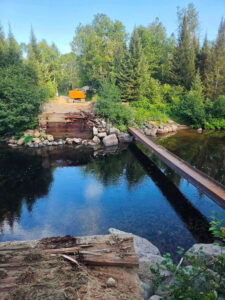
There are other forced roads like the road to Portage-du-Fort from Shawville that cut many farms in two, diagonally, which leaves farms not only cut in two, but also with many three-cornered fields which are less efficient to farm! When there was mostly horse traffic and before snowplows, there were winter roads across farmland. These winter roads were only used in winter and never snow plowed. Winter roads were built where there were no hills and gulleys where drifting made it very hard for teams and sleighs or cutters to drive on. Some roads across wet ground were only used in dry times in summer. It was easier to avoid those roads in wet times than get your clothes or the horse and buggy all dirty. That’s why most of the higher, drier farms were snatched up first by early pioneers. Sawmills, grist mills, and later hydro stations were built on creeks or rivers where water ran downhill to drive water wheels and turbines for cheap power. You have probably noticed that the first churches and settlers’ homes were built on high ground close to good clean water that never flooded. Back when people were responsible for their own mistakes, they were more careful.
Chris Judd is a farmer in Clarendon on land that has been in his family for generations. gladcrest@gmail.com