





As we go for a leisurely drive down some back roads in this beautiful part of our country, we come upon some charming little country churches in some quite remote areas.
Many of these little churches are close to a graveyard where some of our ancestors were given their last resting place. Although many of these little churches no longer have regular weekly services, both they and their graveyards are often meticulously maintained. A few are abandoned and the graveyard is growing with wildflowers and hay.
If you stop a few minutes and take a walk through the graveyard, you may notice that on some of the headstones is engraved the word “pioneer,” and some of these pioneers were born in another country like Ireland or Scotland, or maybe somewhere in the now United States such as Massachusetts or Vermont. You may also notice that too many women died too young and were buried with an infant child.
Some of these little churches were constructed of round logs with a scoop roof. A scoop roof was constructed by first collecting straight logs of similar diameter and the correct length to reach from the bottom to the ridge of one side of the roof. Then the logs were split in two and the centres of the logs were gouged out to make the split logs look like troughs. The first layer of those split and hollowed out logs were placed trough side up, side by side along the roof so that rain would run down the hollowed logs. Then the second layer of scooped out logs were placed round side up over the first layer so that the rain would drain down into the troughs of the under layer of scooped out logs. This type of roof was quite . . .
heavy and required a lot of logs but remember that back then most of the country was covered with trees.
Some of the early houses were also built this way. It required a lot of manpower to build any building 200 years ago but neighbours learned very early to work together for all construction, land clearing, harvesting, quilting, and butchering.
So, why were those little churches built in the middle of nowhere?
When our country was settled, the land was surveyed into hundred acre lots and pioneers were allotted one lot on the promise that they would clear a number of acres each year, plant some crops and garden, and construct a dwelling and a shed or barn. If the pioneer fulfilled his promise, he could receive another hundred acre lot.
The first preachers or ministers were called circuit riders and traveled on horseback from community to community and held small gatherings of settlers in someone’s home. These early preachers could belong to any of many different denominations.
When a community decided to construct a church, neighbours worked together and sometimes the horseback preacher visited the lumber camps where groups of men cut down the trees for the timber and lumber trade. This was the only time that men in the lumber camps had a chance to pray as a group.
Those hard-working men who started our logging industry were very grateful and often helped out the clergy to pay for part of the early church construction. There were no means of transportation 200 years ago except by horse or walking. That’s the reason that those little churches were only a few miles apart.
It was a strong faith, neighbours who worked together, and a family to feed that kept our ancestors working very hard in a land where there were few luxuries.
A midwife 200 years ago was one of the most important members in a community as doctors were not only very few, but often hours away by horse and buggy.
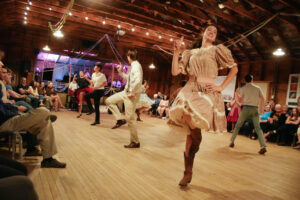
I was too young to have participated in some of the many house parties where neighbours celebrated every chance they got, a place where young people learned to sing, dance, and maybe meet their future, forever partner. Anyone who could play music, sing, call square dances, or even step dance was invited to many, many parties.
Those were the days when your heritage, your original language, your skin color, or your choice of religion took a back seat to honesty and how hard you worked.
Many of those little country churches are now almost by themselves because the farmers close by have moved away and the little farms have regrown in bush with the stone fences once built with sweat and hard work now hidden in the woods. There are some neighbours close by who have built in the quiet countryside where our pioneers once toiled to raise a family and appreciate the still beautiful countryside.
I often think that in this fast moving modern age, we have not maintained some of the basic values that our ancestors took for granted.
On your next leisurely drive through this beautiful country that we call home, regardless of your religion or heritage, you will be welcome to visit any of those little churches, graveyards, or yearly memorial services, and talk to some of the people whose ancestors toiled to build this country. You might even get in on a “pot luck” lunch after the service.
Chris Judd is a farmer in Clarendon on land that has been in his family for generations.
gladcrest@gmail.com