





Brett Thoms
Chapeau November 10, 2022
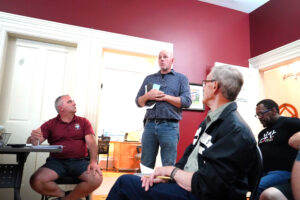
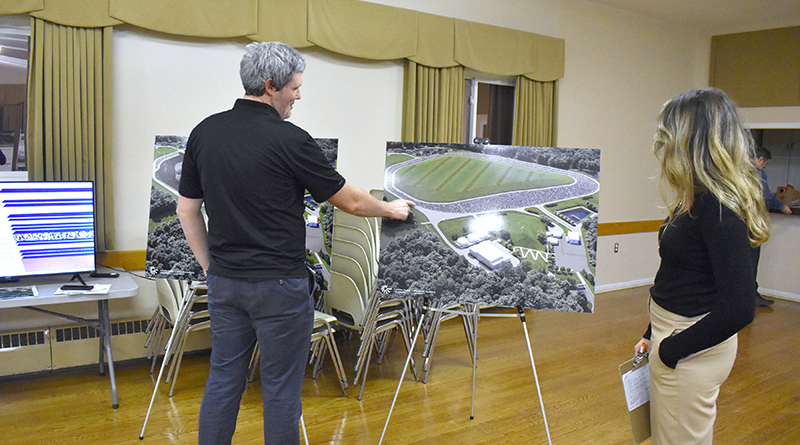
Canadian Nuclear laboratories (CNL)held a series of public information sessions last week in three Pontiac municipalities on its environmental remediation projects. The first was held at Rapides-des-Joachims on Nov. 8, the second was held at Sheenboro on Nov. 9 and the third was held in Chapeau on Nov. 10.
The sessions featured presentations on CNL’s overarching waste strategy program, the Near Surface Disposal Facility (NSDF), Nuclear Power Demonstration Closure Project and the Cleanup Function and the CRL Overview Decommissioning and Cleanup Plan.
“The Chalk River site is over 60 years old. So, there’s a lot of what we call legacy liabilities there. It’s the birthplace of the Canadian nuclear program to apply the atom to peaceful applications like to the medical field and power generation. So, that is a lot of liabilities. There’s a really active program to clean up and take care of those liabilities, we recognize that we can’t leave buildings 40, 50, 60 years old that are contaminated standing. You have to start to take them apart, take them down, clean them up, and then eventually find a way to manage the waste,” explained Mitch Mackay, manager of stakeholder relations environmental remediation management at CNL, at the Chapeau public information session.
Steven Innes, deputy vice president of capital projects CNL, presented information about the NSDF, which is now on hold until CNL participates in further engagement and consultation with Kebaowek First Nation and the Kitigan Zibi Anishinabeg, which will be concluded in January 2023.
“[The current timeline] is just based on an assumption that we’ll be successful and get a license to construct. You know, really from the time that we’ll be closing this period, which would then have the final written submissions, the first possible time we will hear a decision is in the summertime,” said Innes.
Innes and Mackay covered the proposed purpose and construction of the NSDF, which will be built on . . .
the top of a ridge at the Chalk River Facility approximately 163 metres above sea level, approximately 50 metres above the current water levels of the Ottawa River. Upon its completion it would hold up to 1,000,000 cubic metres of low-level radioactive waste.
Special attention was paid to the water treatment facilities built at the site during the presentation, which both Innes and Mackay said would ensure that any water coming from the site going into the nearby Ottawa River or Perch Lake would be monitored and filtered of any contaminants.
“One of the good things about the site is we’ve gotten hydrology studies in wells throughout this site, we know exactly what the water does. And so, by locating the facility here, we know the time it would take any water to get out to the river, and it’s literally years but the way that groundwater flows through there. But it’s also close enough to let us clean it all up,” said Innes.
The decommissioning of buildings at Chalk River and how that relates to the NSDF was also discussed.
“Depending on where the building is and what it did, when we take a building apart in our decommissioning. Buildings literally come apart piece by piece, two-by-four by two-by-four, they do all kinds of tests in advance, and then they test the pieces. If it’s clean, and we can put it through clearable waste, that’s going to be sent off to be recycled, or to local landfills. There will be portions of the buildings and different labs in areas where there might have been an experiment that spilled on the floor at one point in time, and then there’s contamination within that floor. So that’s the type of stuff that will end up coming to the NSDF,” said Innes.
Innes also discussed how the facility would handle an earthquake, which frequently has been brought up by community groups opposing the site.
“So that’s one of the improvements and upgrades we actually made through the whole engagement process,” said Innes. “Previously, in the structure we weren’t excavating right to bedrock, there were different, basically aggregate columns going down to bedrock for the seismic protection. The design has changed now. And one of the big things for construction is we’re actually excavating the entire area down to bedrock. And basically using engineered fill to bring it up. So, we know exactly what the materials are. We know how it handles different earthquakes within this area and it’s, you know, from the whole perimeter to the mound, and the materials used are designed for seismology.”
Innes also explained that the construction also accounted for serious rainfall scenarios, flooding and tornados, all of which wouldn’t threaten the facility, according to him.
Another concern expressed by activist groups opposing the site were fears that nuclear waste from other facilities would be transported to the NSDF and therefore introduce risks surrounding the waste’s transportation.
“The commitment from the near surface disposal facility is to take on the Government of Canada’s low level waste liabilities. And so those liabilities exist in a place called Whiteshell Laboratories in Manitoba. There’s a tiny bit in a place called Douglas Point, it’s on Bruce power site. And there’s a tiny bit on a site called Gentilly-1 in Bécancour, Quebec. And those are the Government of Canada’s low level waste liabilities. And instead of having to build them out in multiple spots, the decision is that 10 per cent of the near surface disposal facility will be earmarked for Canada’s other low level waste liabilities. There’s no commercial waste that’s coming. There are no other waste streams other than the Government of Canada’s liabilities. The transportation of low-level waste is all done through regulated packages, done through our Emergency Response Program at site that continually exercises, continually updates or plans, in case there would be an accident which there is a very low percentage chance of. We’ve been traveling with nuclear materials in Canada for decades now without incident. The packages are known to work so if there’s an accident it’s safe,” explained Mackay.
Mackay and Innes said that the facility would not host any intermediate waste, which was another concern of activists opposing the site.
“The Government of Canada through the program right now is looking at where intermediate level waste can go. But right now, on site with, we just manage it. So it’s managed in facilities that are regulated and then provide the right protections,” said Mackay about intermediate waste.
The CNL staff also addressed why a NSDF was chosen for the facility as opposed to a deep geological site as proposed by critics.
Both MacKay and Innes said that a deep geological site would be impractical, expensive and overkill for containing low level waste.
“This is actually overkill,” said Innes about the NSDF. “This is the most stringently designed facility for this type of waste. This is just a practical solution that’s close to the source of the majority of the waste going in. You’ve got to keep in mind, the amount of stuff that’s going in this facility that’s designed to handle this waste, right now is sitting in various forms on the site, whether it’s just contaminated soil. And that’s not really protected. Although we’ve got robust systems in place that we’ve sort of corrected some of those habits from the past, and we’re mitigating impacts, this is still the next solution, to any potential further effect to the environment.”
On the cost of the site, Innes also said the escalating cost of construction materials is causing the price of the project to raise.
The CNL staff also discussed the broader efforts to clear the site which the NSDF is required to complete in full.
“Over 112 buildings have been taken down. These historical buildings that you see here, over 100 of them have been demolished and cleaned up. We’re obviously doing the ones that we can do without the NSDF because we need a place to send the hotter stuff,” said Luc Robitaille, environmental remediation specialist at CNL.
Robitaille also discussed that the clean-up of the Chalk River site would also serve to renew activity at the facility.
“The idea is that by removing these old buildings that don’t serve our purposes, now, we’re able to have a location that if we want to have a new modular reactor, then we have a space for it. And we’re trying to consolidate these areas within this footprint here, which we call brownfields, or lands that have been used before, rather than clearing forests to put in these new facilities. The idea is to try to be more sustainable,” said Robitaille.
Robitaille also said he wants to spread the message of the innovation coming out of CNL which he hopes will convince people on this side of the river why CNL’s mission is so worthwhile, especially regarding medical research related to cancer.
“There’s a product here that the world would need, that has an incredible benefit. Right now. They’re looking at multiple myeloma and prostate cancer, and they’re having incredible results. So that all these leading-edge ideas is the mission of the site. Like all these tools that are being developed to segregate these materials and everything. It’s all stuff that eventually we hope to be able to sell to the rest of the world, just like these isotopes were sold around the world for medical purposes. These technologies benefit the world,” said Robitaille.
The CNL staff finished the presentation with an appeal for Pontiac residents to join a citizens advisory panel, which advises the company what residents would like to see from the environmental remediation around Chalk River.
“We’ve been really successful in getting lots of people interested in participating in the Citizens Advisory Panel, from Pembroke, Renfrew, Deep River, Chalk River and Petawawa but we haven’t had success here, despite trying to get over here and advertise and do different things. We haven’t had a lot of interest from people over here. And we would really like people from this side of the river to participate in that panel,” said Mackay.
They also encouraged citizens to visit engagewithcnl.ca/nsdf where they say any concerned resident could go to have their questions answered.