





Zainab Al-Mehdar
Quyon Dec. 15
About 32 years ago a young Denis Charrette walked into what is now called the Canadian Museum of History and was completely in awe of the giant sculptures. It was soon after that at the age of 16 that he started carving and the passion just grew from there.
As part of a public pilot project . . .
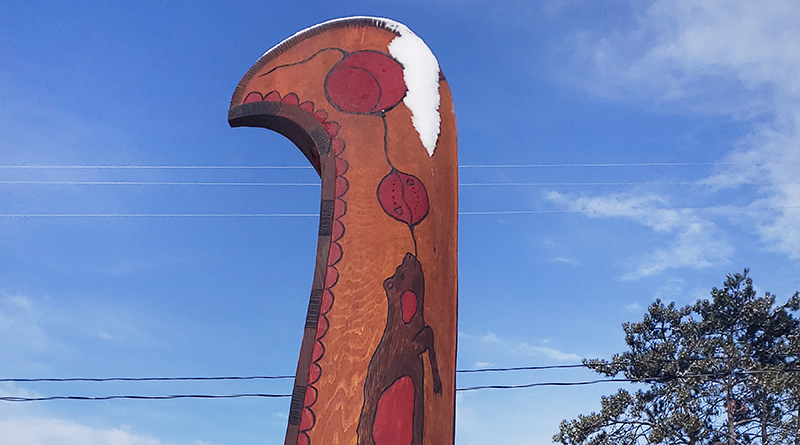
initiated by the MRC des Collines-de-l’Outaouais titled Le parcours de collines et d’eau, Charrette was chosen to create a sculpture which now rests at the Quyon Recreation Park.
The project highlights the historical, cultural and natural heritage of the seven municipalities of the MRC. Charrette, an Indiginous artist living out of Cantley Quebec, said “I did the sculpture [to] honor the river.” The full time artist explained that for him the canoe is a powerful symbol that represents the strength of the river as the canoe was the first vehicle used to travel long distances in the region.
The project consisted of two phases; phase one was completed in 2017 where eight sculptures got installed in the seven municipalities of the territory. The second phase includes installing a second public art piece to represent an important part of the community relating to the theme of water.
The sculpture, which is the size of half a canoe, about 7 feet tall, is made of red cedar which was brought over from British Columbia. Meticulously carved is an otter on each side with the sun representing the day and moon representing the night. It took him about three months to finish this art piece.
Charrette, who has been a sculptor for over 30 years, first started off like many people in a full time job. Not really finding his footing in other jobs he started sculpting again at the age of 25 and then at the age of 29 it became his full time job.
“I noticed that when I start carving a piece of wood, the energy [is] so strong and I was so happy,” he said as he explained that for him it was an easy choice to make, because he was so passionate about it.
Creating this current sculpture, Charrette said he creates something for people to enjoy but also one that represents the territory. The choice to sculpt a canoe was also in regards to the location and how close it is to the river.
When asked why it was important for him to be a part of this project he said, “I was born here, this is my territory,” he added he has fond memories in this region growing up in Pontiac. He highlighted the current sculpture as one of five others in the territory, “I’m proud to be part of this,” he said.
Listening to the stories from the elders, Charrette said, helps him draw inspiration and connect to the territory. For him, simply being out in nature is what inspires him and it reflects in his work he said.
Anyone wishing to see the first art piece to be installed in the series is encouraged to head over to the Luskville Community Centre. For more information on the project, visit: www.decollinesetdeau.com.