





CHRIS LOWREY
AYLMER Sept. 19, 2018
Nearly 70 people filed into the Knights of Columbus hall in Aylmer for one of the Pontiac riding’s English language debates ahead of the upcoming provincial election.
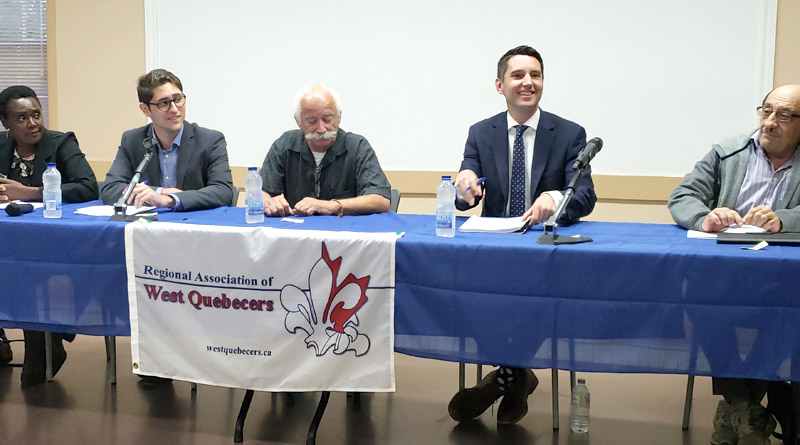
In attendance were Coalition Avenir Quebec (CAQ) candidate Olive Kamanyana, New Democratic Party of Quebec (NDPQ) representative Samuel Gendron, Marxist-Leninist candidate Louis Lang, Green Party candidate Roger Fleury as well as Quebec Liberal Party (PLQ) candidate and outgoing Pontiac MNA André Fortin.
The debate was orchestrated by the Regional Association of Western Quebecers (RAWQ), a not-for-profit group dedicated to supporting the English language community of the Outaouais.
Each candidate kicked off the night by giving a short introductory speech.
Kamanyana started by telling the mostly English crowd that she knows what it’s like living as a minority in Quebec, and how important organizations like RAWQ are to those communities. She reiterated her campaign promise that the CAQ would build a new hospital in the region and improve cell and internet coverage.
Next up was the NDPQ’s Samuel Gendron. He highlighted the struggles of the Outaouais health network and said the NDPQ would make the hiring process easier for nurses and healthcare professionals. He also said that, when it comes to education, his party would stop funding private schools.
Lang said that the main issue facing voters is their lack of policy input in between elections. He said that too many politicians are beholden to their party instead of their constituents – something he promised to change if elected.
Fleury then made the case for more direct participation by citizens in their democracy. He also said that the Liberal party’s claim of a balanced budget came on the backs of “the little guy.”
Fortin opened his remarks by saying what an honour and privilege it’s been to represent his friends and family. He then highlighted his commitment to protecting the rights of English speakers in the province.
The first question asked candidates their thoughts about the creation of the Secretariat for the relations with English-speaking Quebecers and what their party would do to protect and enhance it. Each candidate had one minute to respond.
Lang answered first and said that politics are divided because people don’t have enough of a say in how government functions.
Fortin said that his party implemented the secretariat because of feedback from constituents. He also committed to “proper funding” for the office going forward.
Fleury recounted his fight in the provincial courts over an archaeological site in Gatineau. He said several people involved in the lawsuit were unable to get information on the proceedings in English and that this indicated there was something wrong with the system.
Gendron said that the NDPQ would pass a law that would protect the secretariat should another party try and abolish it.
Kamanyana said her party would support it and wondered why it took so long for the Liberals to implement it.
The next question asked candidates to outline their party’s plans for the province’s school boards.
Fortin said that he believes the current system works well. He also highlighted the fact that his government tasked Elections Quebec with finding ways of increasing voter turnout for school board elections.
Fleury said he also agrees with the status quo for the province’s school boards. He also said that doing away with the language police would help.
Gendron also wants to maintain school boards and said one way to improve language accessibility for both French and English speakers is to have more English courses in French schools and vice versa.
Kamanyana, whose party has advocated for the abolishment of school boards, said the CAQ will not abolish school boards, but change their framework. She said parents will retain input, there will still be elections but they will be less expensive.
Lang said that not enough money is being invested in the education system and said one of the best ways to improve education in the region is to improve working conditions for teachers.
The third question asked candidates how they would ensure that Quebec residents could access healthcare services in their preferred language.
Fleury said that the Outaouais is underfunded. He also said that the province needs to do a better job attracting Anglophone workers to improve healthcare access for English speakers.
Gendron said that once a population reaches 10 per cent English speakers, it should be mandatory that English services be offered to the population.
Kamanyana said this should not be a controversial issue. She said that it was “obvious” that people should be able to access healthcare in their native tongue.
Lang argued that more equitable language rights need to be part of a wider societal shift that gives more power to citizens.
Fortin pointed to the Pontiac Community Hospital and the Wakefield hospital as bilingual institutions. He also said that there needs to be better integration between the healthcare sector in the Outaouais with the education system in order to train more healthcare workers.
The next question highlighted the fact that less than one per cent of the province’s civil service is staffed by English speakers. Candidates were then asked what they would do to increase access to provincial civil service jobs for English speakers.
Gendron started off by saying his party would grant a higher wage for bilingual staff members in order to attract a higher number of them.
Kamanyana said that she believes in positive discrimination where giving opportunities to minority populations can help. She argued that more French immersion would be a good first step.
Lang said that it is important to protect the fact that the working language in Quebec is French. He said he would push to prioritize bilingual education.
Fortin pointed to a study which found that English youth are more bilingual than French youth in the province. He said that it’s important to make the provinces civil servant jobs more attractive to English speakers and that more Anglos need to be considered for appointment to government boards.
Fleury said that one of the main issues is the fact that government is too centralized in Quebec City. He said he wants to see more localized decision-making.
The fifth question asked how the candidates will ensure that residents can access municipal services in their preferred language.
Kamanyana started by saying that the CAQ would comply with the fact that communications must be done in the resident’s preferred language.
Lang said that, while language is one small part of municipal services, people should have more of a say in how those services are distributed.
Fortin pointed to the Parti Quebecois Bill 14 – which would have impacted Anglo rights – that was backed by the CAQ. He then questioned Kamanyana’s commitment to be “compliant” with the province’s rule that residents can access municipal services in the language they choose.
Fleury said that these decisions need to be made on the local level instead of by bureaucrats in Quebec City who “make weird decisions.”
Gendron said that too many young Anglos are leaving Quebec because their French isn’t good enough. He said municipalities need to be given resources to stem this flow.
The final question asked about the lower employment rate among minorities in the province and asked how each candidate would remedy that.
Lang said people need to be clear on the difference between a refugee and an immigrant. He said that refugees need to be taken care of.
Fortin highlighted the economic need for immigrants in the province.
“Party leaders have a responsibility to talk positively about immigration instead of preying on fears,” Fortin said.
Fleury said that, as chief of the Algonquins Off-Reserve, his people welcomed Europeans hundreds of years ago. He also said that one of the main factors driving people out of Quebec are the restrictive language laws.
Gendron said that the NDPQ would not lower the immigration rate and that his party would work to recognize diplomas from other countries.
Kamanyana said that integration is the key to minority success. She said that a lack of tools for immigrants makes life tougher for them, and in many cases, forces them to leave the province.
After some specific audience questions, each candidate was given three minutes for their closing remarks.