










CHARLES DICKSON
OTTAWA Aug. 21-22, 2018
“The plan to entomb and abandon radioactive carcasses of nuclear reactors next to major rivers is an abomination,” says Dr. Gordon Edwards, President of the Canadian Coalition for Nuclear Responsibility.
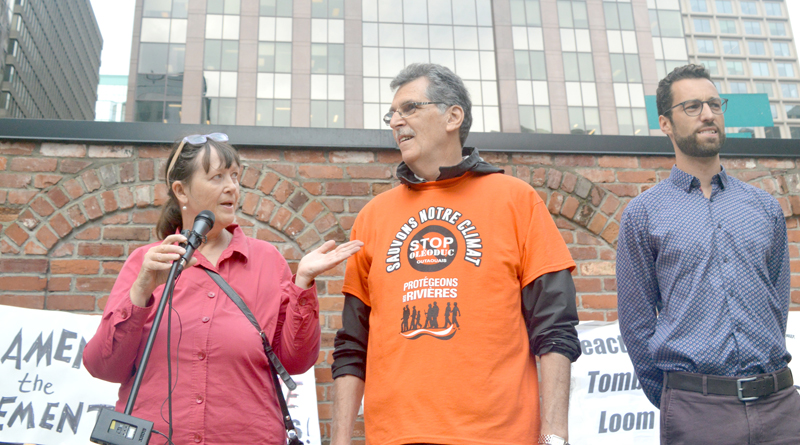
Speaking at a press conference in Ottawa last Tuesday, Edwards laid out concerns about plans for the disposal of radioactive wastes at four Canadian nuclear facilities, all near major rivers.
One is at Rolphton, across the Ottawa River from the Pontiac community of Rapides-des-Joachims, where the plan is to entomb the NPD (Nuclear Power Demonstration) reactor “by dumping all the radioactive garbage into the sub-basement (of the reactor), filling it with cement and leaving it there for eternity,” as Edwards described it.
Theresa McClenaghan, Executive Director of the Canadian Law Association (CELA), who also participated in the Tuesday briefing, said this approach would not meet International Atomic Energy Agency (IAEA) guidelines.
As explained in the briefing, the IAEA recommends the ‘entombment’ approach be used only in extreme cases where there is no alternative, such as where there has been a meltdown, and not where an orderly process of dismantling and removal of radioactive components can be achieved, as would be possible with the facility at Rolphton.
The proposal to construct a disposal facility at the Canada Nuclear Laboratories (CNL) site at Chalk River, also on the shore of the Ottawa River, across from the Pontiac community of Sheenboro, was also discussed at the briefing.
Ole Hendrickson, of Concerned Citizens of Renfrew County and Area, said the near surface facility would, in fact, be ‘a giant mound’ that rises 20 to 25 metres above ground, and cover an area of 11 hectares within a kilometre of the Ottawa River. He said the facility would be loaded with up to a million cubic metres of what are described as ‘low level’ radioactive wastes but which Hendrickson believes will include significant quantities of long-lived alpha and beta/gamma emitters. According to IAEA guidelines, he said, above-ground disposal is unsuitable for such long-lived radionuclides that should instead be isolated from the biosphere below ground for the duration of their radiological hazard.
The fact that CNL has, until very recently, proposed to include even more toxic intermediate-level wastes in that same above-ground disposal facility should raise concern about CNL’s judgement in these matters, said Edwards.
He added that the Chalk River facility could be located further inland, twenty kilometres from the river, and still be on crown land, but that the current site less than a kilometre from the Ottawa River is preferred by CNL.
While sites for nuclear facilities were originally chosen decades ago because of their proximity to water that was needed for cooling, they are now being slated for disposal at the same near-water locations simply because that is where the wastes happen to be and so is the cheapest and most expedient option, explained Edwards.
According to Edwards, the fact that such options are being given serious consideration is, in part, because the responsibility for cleaning up Canada’s nuclear wastes was contracted out by the Harper government in 2015 to Canadian Nuclear Laboratories (CNL), a consortium of international private companies, including Canada’s SNC Lavalin, with a mandate to do it ‘quickly and cheaply’. And, explained Edwards, CNL is operating in a ‘near-perfect policy vacuum’, citing a letter from Jim Carr in July when he was the federal minister of natural resources, stating that, “Canada does not yet have a federal policy for the long-term management of non-fuel radioactive waste.”
“The Feds are asleep at the switch,” said Edwards.
“Through inaction and lack of any adequate public consultation mechanism, the Canadian government is complicit in allowing unacceptable approaches to radioactive waste to be pursued. The Canadian government, we feel, is shirking its responsibility to establish clear policies governing the long-term management of the bulky human-made radioactive waste materials that have been created by nuclear fission in nuclear reactors,” he said.
Of the role that the Canadian Nuclear Safety Commission (CNSC) can play in deciding the outcome, Edwards said, “In its 18 years of existence, the CNSC Commissioners have never refused to grant a licence to anyone who has applied. When it attempted to suspend the operation of a major nuclear facility (the NRU reactor) over safety concerns, the head of the CNSC, Linda Keen, was fired.”
The Canadian Coalition for Nuclear Responsibility, of which Edwards is president, is among 40 First Nations, citizen groups and NGOs that are calling on the federal government to step up and shoulder its responsibility for the safe and socially acceptable long-term management of nuclear waste, beginning with the development of federal policy on the matter that has had the benefit of public consultation. They are also asking the Auditor General to investigate whether the federal government is handling nuclear waste and reactor decommissioning in ways that are compatible with sustainable development principles.
Asked for comment, Pontiac MP Will Amos provided a letter to the editor (see page 4), including the following: “It is up to the CNSC to conduct an environmental assessment of the CNL proposal and to determine the risks associated with long-term storage of radioactive waste materials. The CNSC is a public body whose independent and expert public servants are mandated by federal law to analyze every public safety and environmental concern related to the nuclear industry . . . I will continue to follow the CNSC process closely, to help ensure that Pontiac constituents can effectively participate in the CNSC’s transparent public process that allows citizens to voice their opinions and preoccupations.”