





by Carole St-Aubin
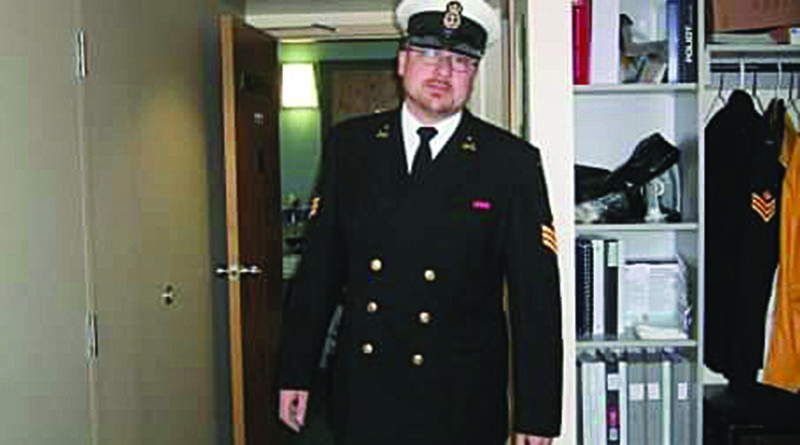
Bryson native Mark Lance’s interest in the armed forces began at a young age.
He was a cadet in Renfrew for four years before he decided to join the Royal Canadian Navy (RCN) in 1988 at the age of 20.
“I went for my basic training in Cornwallis, Nova Scotia, and from there I went to . . .
the CFB (Canadian Forces Base) in Borden Ontario for trade training. I was a steward by trade,” said Lance.
Stewards are basically short-order cooks, they specialize in running the “Mess hall”, the bars and the clubs and taking care of the officers.
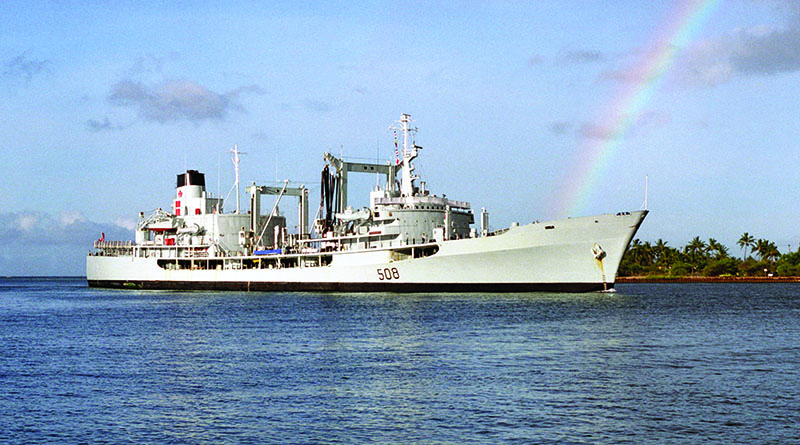
After his training, Lance went aboard his first ship, the HMSC Margaree. He also served on the HMSC Provider, the HMSC Iroquois, and the HMSC Algonquin, which are all currently decommissioned.
“I was part of the decommissioning crew for both the Margaree and the Provider,” said Lance.
“And the bow of the Iroquois, I just found out a couple of days ago, is now a monument in Ottawa in an area around Carleton University,” he added, still quite interested in keeping up with the history of these ships.
Lance spoke of some of his most memorable moments.
“During the Cold War, I had the honour of seeing part of the Berlin wall fall. When we were there, it was after the big party, the soldiers were just letting the people come and go. So a few of us did go over to East Berlin and we traded t-shirts from our ships for East Berlin soldier uniform pieces.”
When Lance was on the Margaree, they were supposed to be going on a standard NATO tour (a military training exercise), but then the Gulf War broke out.
“So we ended up going from a standard training exercise to prepare for all warfare,” said Lance, “Being in my early 20s at the time, that pretty well woke me up and I said, ‘Okay, this is not a game.’
Originally on the way to the Caribbean, the Margaree was redirected to the Mediterranean, to provide aircraft carrier escort.
When asked about his role at that point, Lance replied, “You’re a sailor first, so on the ship I was also responsible for manning a 50-calibur gun. I was also part of the ship’s boarding team; the boarding team is responsible for being on the lookout for ships that look suspicious. We would board them, check their records, check for contraband drugs, illegal aliens, things along those lines.”
“I was also involved in a rescue of refugees in the Mediterranean [I believe they were from Libya]. It was very heartbreaking to witness, men, women and children, there were probably 50-60 of them in a boat made for maybe a dozen people. They were stacked on top of each other,” he said.
The boat, he believes, had been at sea for approximately 20 days.
“Such a state of desperation. It’s unbelievable. It’s unbelievable,” he said, shaking his head.
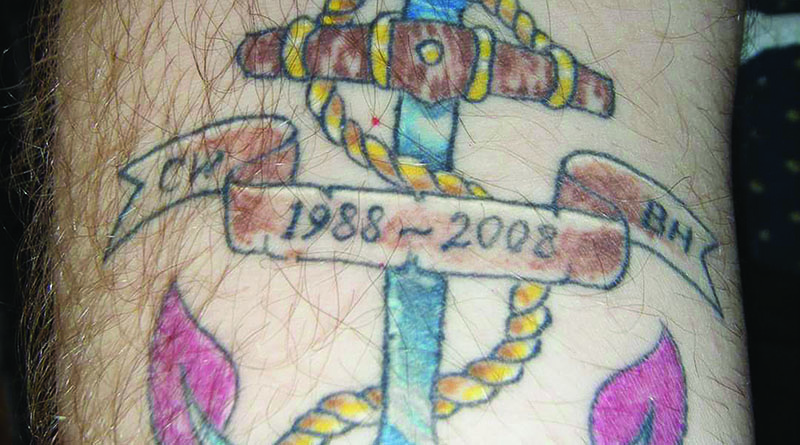
Between that experience and having lost two shipmates, Cory Wells and Billy Heinz, during that same trip, Lance now suffers from PTSD.
“You can’t unsee what you have seen,” Lance told THE EQUITY.
Lance, whose ship duties also included doing CPR, lowered his eyes and said, “I remember, every day I remember.
He also recalled having seen mothers crossing the Mexico border breaking the caps off of hairspray cans, pouring the liquid in the cap and giving it to their children to drink in order to stay warm.
These are all experiences that haunt him to this day.
Lance has also served with the Special Service Force in Petawawa, alongside the Airborne Regiment. He also worked in the service battalion in Petawawa.
Lance, who met his wife Evelyn in Halifax, celebrated his 30th wedding anniversary on Oct. 12. Together they have two boys, Nathaniel, 27 (who is an engineer in the Armed Forces) and Jared, 22. Both his sons went to school in Shawville.
“People don’t give military spouses enough credit,” said Lance, speaking of his wife.
“They are by far the strongest people in the Canadian Armed Forces.”
Lance also served in Winnipeg, then was an instructor in Borden, Ontario. He had the privilege of meeting the Queen and the Queen Mother, who were on their yacht, the HMS Britannia.
“It was an honour, the Queen Mum was an absolute sweetheart,” he quickly chimed in.
Lance retired in 2008 when he was injured.
“I broke my hand and almost lost three fingers. That happened on the ship during rough seas when a man went overboard. I also ended up damaging my back pretty badly.”
Despite the bad memories, which include losing half a dozen shipmates, some in the Afghan war and some to suicide, Lance carries with him many good ones.
“If I could start over. Yeah, without hesitation, I’d jump on a plane right now,” he said.
“If it wouldn’t have been for my injury, I would actually be in my last year of service, I wouldn’t have gotten out,” he said.
Aside from seeking help and counselling, Lance claims one of the best things that helped him deal with PTSD has been his dog Dixie, who never leaves his side.
“She is definitely an emotional seatbelt, she’s a little red healer,” he concluded.
Though he hasn’t had the opportunity to do so in the last year, Lance also enjoys going to speak to school children and answer their questions about his service in the RCN.