



Over the past two weeks volunteer birders pulled out their binoculars and notepads for the 125th annual Christmas Bird Count.
The event, which is held by the National Audubon Society and was facilitated locally by volunteers and members of the Club des ornithologues de l’Outaouais, saw dozens of amateur birders go out into the field to count birds for this citizen science project.
Volunteers in the Pontiac were mobilized between Breckenridge and Fort Coulonge, in four different circles.
Some of them, called “road teams”, went out into the field to spot their flying friends, while others, called “feeder-watchers”, stayed at home to count birds from their backyards.
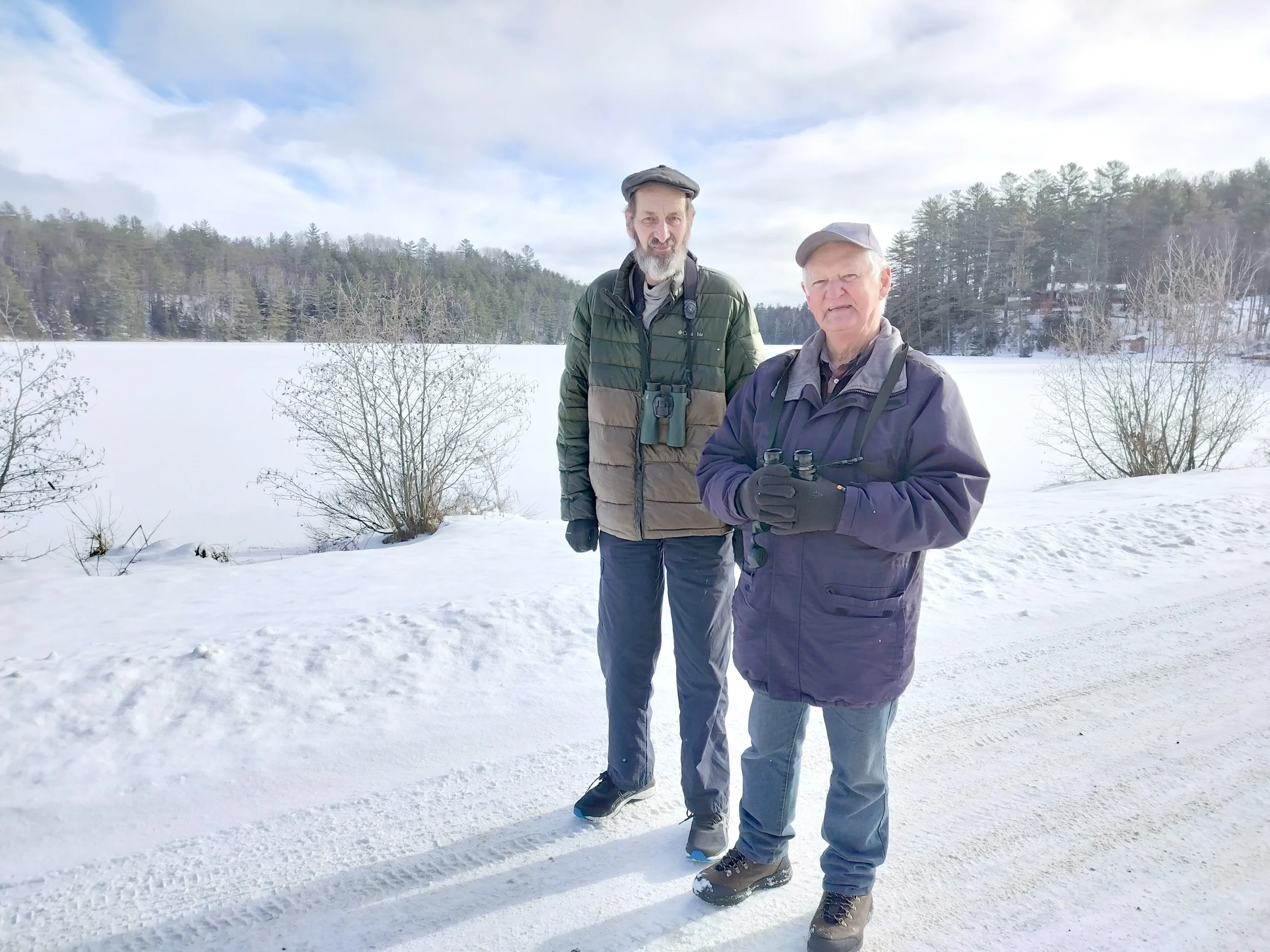
Amateur birders Vincent Agnesi and Ron Bertrand formed one of the road teams that helped to complete the Fort Coulonge area’s count on Jan. 3, covering a territory spanning from Davidson to Mansfield’s Trout Lake Road and Chemin de Bois-Franc. The pair drove the length of their assigned roads, stopping if they saw any birds or if they spotted a bird-feeder installed outside a house.
This year, Agnesi said pine siskins and crossbills, birds that are relatively common in the area, were nowhere to be found, possibly because of the lack of food.
“It’s all about the feed. Either they’ve got plenty where they are, or there’s not the feed they want down here so they keep going,” he said, theorizing about why they weren’t able to spot those species.
In the winter, Agnesi said, there isn’t always abundant feed for many species, so a well-stocked bird-feeder is usually one of the best spots to count birds.
In Davidson the pair spotted ravens, blue jays, chickadees and juncos, species Agnesi said are some of the most common species in the area.
Agnesi, who also did the count on Allumette Island, said there were also some surprises this year. He spotted a white-throated sparrow, a bird that usually shows up in the warmer months. “It’s not common at this time of the year,” he said.

Deb Powell has been the coordinator for the Shawville-Quyon bird count for 12 years, and she said this year the team spotted 33 different species, slightly lower than the average of 35 since the Shawville-Quyon count began in 2011.
“That’s not a bad number,” she said, adding that the amateur birders can’t always spot every single species that reside in the region.
“Sometimes it’s a matter of being in the right place at the right time to make the observation, but it is also a matter of what species are in the area at the time.”
She said this year her team spotted some avian oddities. “Sweet winter observations this year include a Barred Owl (they are around but not often seen), a Cooper’s Hawk (rarely seen), a White-throated Sparrow (not often seen) and 4 American Robins,” she wrote in an email.
Powell said some of their feeder-watchers weren’t available this year, nor were two people who normally form a road team, but she was nonetheless happy with the participation from local birders this year in her zone.
“We do the best we can,” she said, adding the flu season and unavoidable commitments sometimes mean her team isn’t always at full strength.
125 years of citizen science
Birds Canada outreach coordinator Yousif Attia has been coordinating the Christmas Bird Count for the past five years, and he said the program started in the year 1900 at a time when sport hunters and nature conservationists were starting to diverge from each other.
“We had already lost a couple of birds by then,” he said of certain species that had already gone extinct, in part due to the ever-popular pastime of hunting.
He explained one conservationist named Frank Chapman decided to take action against this phenomenon.
“[He] proposed to count birds on Christmas, as opposed to hunting birds, which was a well-established tradition,” Attia said.
“He’s saying, ‘Let’s do this, let’s count birds. We’ll get the same value out of it, hanging out with friends, a little bit of a competitive aspect,’ and it took off.”
In 1900, there were 27 local counts, including two in Canada. Last year, there were 41 count circles in Quebec alone, and 475 across the country. The data collected by community bird counters every year is used in peer-reviewed studies and is even used by federal governments and conservation groups to make decisions.
“Over time [the count] has become incredibly valuable,” he said. “The data is telling us what the trends are
[ . . . ] And when you know what’s increasing and what’s decreasing you can put your conservation attention in the right place.”
Attia said on the 125th anniversary of the count volunteer numbers are still growing steadily, including a spike during the pandemic, especially among the 25-35 age demographic.
“Many people found an interest in birding, and that translated into finding out about these citizen science opportunities,” he said, adding that there are many aspects that people enjoy about the bird count.
“The data are important, but that aside, the community aspect, the social aspect of it, bringing more people into the hobby, and leaving it saying ‘that was a lot of fun, and I’m coming back next year.”
On the 125th anniversary of the annual count, Powell, who ran the Shawville-Quyon bird count, said the feeling of contributing to something larger is one of the reasons she does it every year.
“It’s a super cool citizen science project, as long as the weather is not really bad and you end up in a snowbank,” she said. “It’s a feeling of being involved in something that has a history.”
As for Agnesi and Bertrand, they participate not so much to take part in the historical tradition, but because they just enjoy going out into the field together.
“I just look forward to doing it,” said Agnesi. Bertrand agreed. “There’s always something new to see.”