





The agriculture industry has gone through a host of
changes in recent decades.
According to StatsCan’s most recent figures, the overall number of farmers in Canada decreased by nearly 25 per cent between 1991 and 2011, while their typical acreage increased steadily. Farms are becoming bigger and more industrialized than the small, mom and pop operations of the past, while ownership is gradually becoming more concentrated among an older cohort.
None of this is surprising, since advanced technology and automation have brought about rapid changes in plenty of other sectors. In the Pontiac and many other rural communities like it, this has led to young people and families fleeing to urban centres en masse, in search of employment.
Which makes it all the more novel to hear about the success of a young couple who founded their dairy farm in Clarendon three-and-a-half years ago.
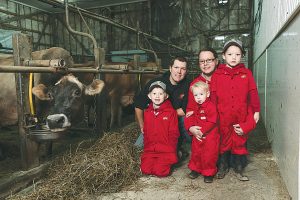
Husband and wife team David Ingalls and Eline Van der Veen operate Eli-Da Jerseys on the Fifth Line just outside Shawville, along with their three children: Kaleb, Keagan and Elly.
They were recently recognized with a Young Achievers Award by Jersey Canada for their dedication to the breed.
“We knew that we were nominated,” said Van der Veen, who explained that an old family friend had submitted their name. “As far as I know, everyone that’s nominated actually gets it, but it’s still really nice that someone saw something in us and appreciates what we’re doing.”
Van der Veen grew up on a sheep farm in Grand Valley, Ont., and met Ingalls while she was studying animal biology at the University of Guelph. He grew up on a small beef farm in the Eastern Townships and studied farm management at MacDonald College. Before setting their sights on the Pontiac, they had built up a flock of 300 sheep near Ingalls’ parents in Brigham, Qc.
“We were living in a rented house and we rented his parent’s farm,” Van der Veen explained. “It snowballed, we ended up renting a field here, another barn there … Next thing you know, the rent we were paying was more than a mortgage.”
They might have put down stakes in another area of Quebec, or even another province, had it not been for a man named Will Armitage.
“The long and the short of it is, he was my roommate in college,” Ingalls explained. “In the spring of ’06 we put our Monday night beer league team into the Flying Elbows tournament. That was my first glimpse of the Pontiac. Fast-forward a few years … summer of ’09 we’re up here visiting Will and we toured around a little bit.”
By 2012 they had enough equity to purchase their current plot in Clarendon.
“We wanted to be in a predominately English community, somewhere in Quebec because there’s a lot more support for young farmers in Quebec than there is in any province that I’m aware of,” Ingalls said.
In the spring of 2014, they applied for the Producteurs de lait du Quebec (PLQ)’s New Entrant Quota program, which helps new farmers get a foothold in the dairy business and were eventually approved in May.
“It’s not very easy to get into, it comes with an extensive business plan and you need a lot of community support,” Van der Veen explained.
“They only approve 12 [farms] in the province each year,” Ingalls added. “It was a pretty nerve-wracking couple of months.”
In addition to the rigorous qualifications, farms in certain outlying regions like like Abitibi-Témiscamingue, Gaspé or Lac St-Jean get priority, further stacking the odds against their Pontiac dream.
“It was just lucky for us that year,” Ingalls said.
Over the course of that summer, they renovated the barn and purchased a herd of short, stout Jersey cows, mostly from Belleville, Ont. They started milking on Sept. 11, 2014 and eventually ended up selling their flock of wooly beasts in Februrary 2017, to focus on dairy full-time.
“There was a bunch of variables that changed along the way,” Ingalls said. “Cow prices changed between doing the business plan and starting … The sheep market had changed as well. It was less interesting to raise the lambs.”
With Canada’s supply management system, dairy farming provides a much more stable cash flow than most other livestock, though it involves significant overhead costs.
“There’s so many more opportunities to trim a penny with the cows,” Ingalls said. “Everybody’s trying to save a penny, but with the dairy versus the sheep it’s the simple fact that you’re working with dollars or dimes. It’s a lot easier to trim a penny off a dollar than it is off a dime.”
The choice of breed mainly had to do with the province’s environmental regulations, which limit the amount of phosphorus that a farm can produce annually.
“Basically, we can keep two Jerseys or one Holstein and it’s the same amount of phosphorus produced, or very close,” Ingalls said. “A good farmer can easily fill one kilo of quota per cow, per day, irrelevant of what breed it is. But we’re just able to grow our business that much more with the Jerseys before we get into thresholds that incur costs, such as manure pits.”
“A manure pit would have doubled our start-up costs,” Van der Veen added.
Jerseys are also far more heat tolerant and have fewer hoof problems as a result of their smaller stature. Though they produce a smaller volume of milk than their black and white relatives, the milk of a Jersey cow contains more protein, fat and other solids, which makes it quite valuable.
“The way it works is, you get paid based on components and especially right now you get paid a lot for fat,” Van der Veen said.
Eli-Da Jerseys currently boasts just over 70 head, with 36 milking cows as well as thirty-odd heifers and dry cows. Since the fall of 2014, they have increased their quota from 24.9 kilos to 39.7.
A recent uptick in the demand for Jerseys has allowed them to diversify their income by selling breeding stock.
“We have some very good genetics in our barn that people are willing to pay for, but also there’s more and more people getting into that ‘danger zone’ with the environmental thresholds, and it’s as simple as moving out some black and white cows and moving in some little brown ones,” Ingalls said.
The couple plan on doubling the size of their barn this summer, with a goal of milking 50 cows by October. Both were proud of the support they received during their short time in the area.
“We have amazing neighbours, a great community,” Van der Veen said.
The couple extended their thanks to everyone in the area that helped them along the way.
“We said that Pontiac county is where we want to be and looking back five years now, I’d say we made the right choice,” Ingalls concluded.