





The age of artificial intelligence – AI, to its friends – is upon us. And with it has come a worldwide discussion about its benefits and dangers.
There is little doubt that there are many benefits to be gained from a machine that can learn and think faster than humans. It can search the internet, drive a car and even write a story in your local newspaper.
In case you are wondering, AI was not used in writing this editorial or any part of this newspaper. Not today, not ever. One reason is that AI cannot drive itself around the county witnessing events, interviewing people, confirming facts, and taking pictures. So far, only humans can do that. And, so far, it seems that human readers of newspapers are much more interested in what their fellow humans have to say than they are in what a smart machine might come up with.
But we do need to be wary of some of the pitfalls of AI. Recall HAL in Kubrick’s 2001: A Space Odyssey, not to mention a growing number of examples much closer to home where AI is being used for nefarious purposes.
One example is the ability of AI to generate fake videos. Early attempts were a bit glitchy. A tell-tale sign was the voice of the speaker not syncing up perfectly with the movement of the mouth. But the technology is improving daily by leaps and bounds. It may even be smart enough to improve itself, for all we know. But the result is a quality of fakery that is getting very difficult to detect.
An example came last year in a fake video of Florida governor Ron DeSantis announcing his regrets in seeking nomination as the Republican Party’s presidential candidate, which undoubtedly did damage to his campaign. Another came just a couple of weeks ago in the form of a video featuring journalist Rosemary Barton interviewing Mark Carney pitching a particular investment opportunity as foolproof. All fake.
Whether the work of political competitors, foreign entities seeking to influence an election, or someone trying to promote sales of their products, it is getting very difficult to tell what’s real and what isn’t these days.
Of course, it doesn’t take AI to misrepresent reality and mislead people. It can be done very easily with relatively low-tech tools readily at hand.
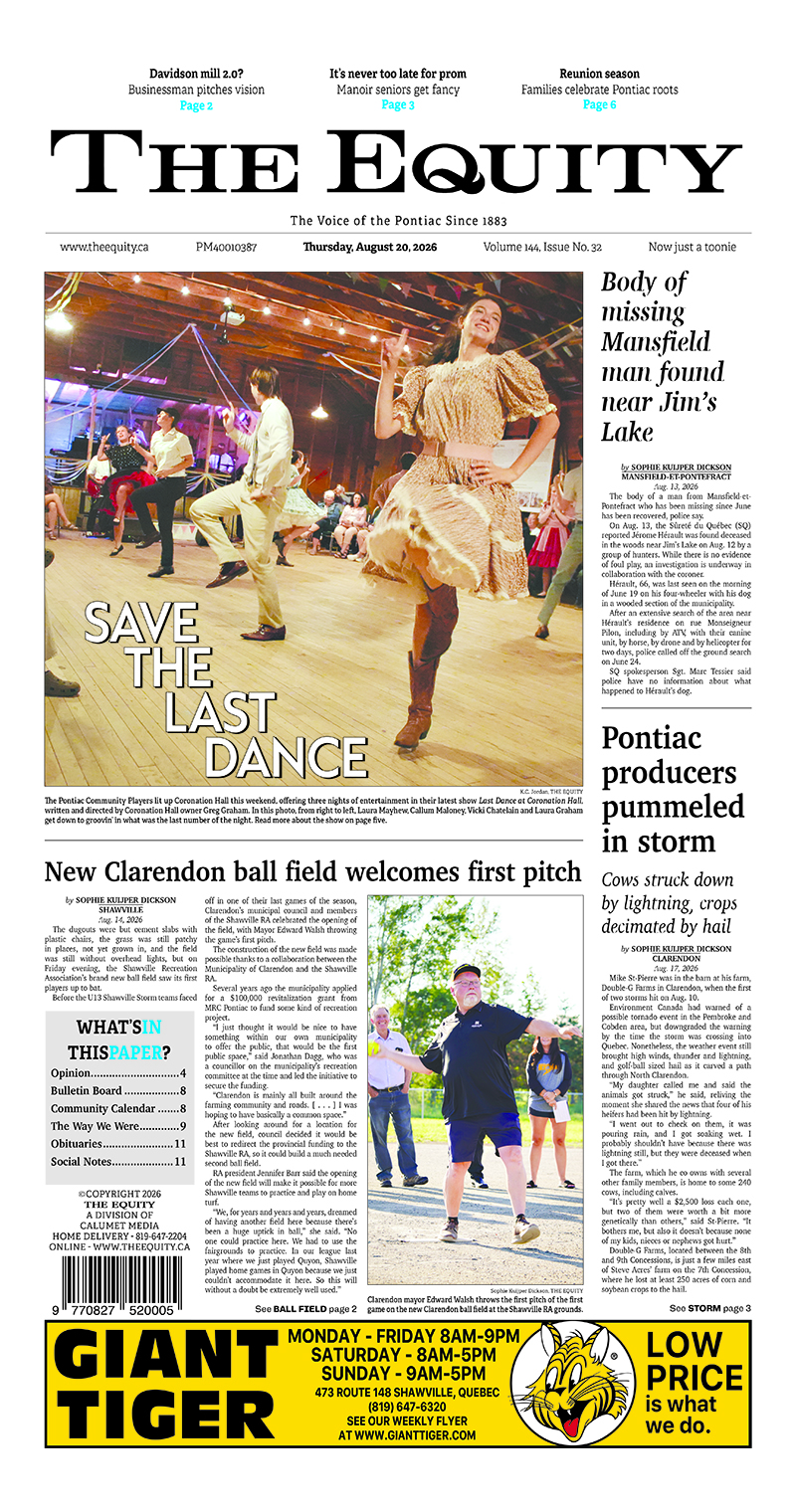
A case in point was how the front page of last week’s issue of THE EQUITY was appropriated by the campaign of one of the five candidates running for election, all of whom were featured in our front-page story. The article was copied, the headline changed and the image manipulated to flatter their candidate, and the result was posted on their social media site. All in good fun, no doubt, but nevertheless inappropriate on several levels.
For starters, reproducing any part of a newspaper without permission is every bit as wrong as walking out of the grocery store without paying for the food in your bag. Distorting a newspaper’s content to make it look as though it said something it did not say can damage its reputation and undermine public confidence in reputable news media, which is already under assault at the hands of some political figures.
We see this sort of thing quite often. One or another local social media site will routinely copy and paste an article from THE EQUITY without permission and without credit. Sometimes, they will rewrite it, probably with the help of a little AI, to cover their tracks and disguise their theft of content for which we have paid money to hire professional reporters to produce and for which we hold the copyright. In many cases, the impulse to share news stories across our communities comes from a good place. But if we are to see the survival of our local newspapers, and maintain the livelihoods of the reporters and others who work day in and day out to support the enterprise of journalism, we must purchase the news from its source. You could say it is our form of ‘buy local’.
In the case of the recent incident with our front page, we checked in to see if the candidate in question had approved the posted image, or was even aware of it. The answer we received was an unqualified ‘no’ on both counts, plus an unsolicited offer to have the message taken down immediately, which it was. Altogether an excellent response, in our estimation.
It has always been the job of newspapers to discern fact from fiction, expose the difference between evidence and unsubstantiated claims, and challenge self-serving conspiracy theories. This is the stock and trade of professional journalists, one of the most important yet undervalued professions these days.
In a world where there are clearly big stakes connected to how readily we, the public, can be fooled, and as the tools and tricks available to misrepresent, mislead and outright lie become highly refined and widely available, we need to be especially discriminating in our consumption of news. We need to identify the credible news sources and the reporters we feel do a scrupulous job in reflecting reality to their readers. And we must neither tolerate nor patronize the imitators that rip off and present as their own the work of bona fide journalists.