


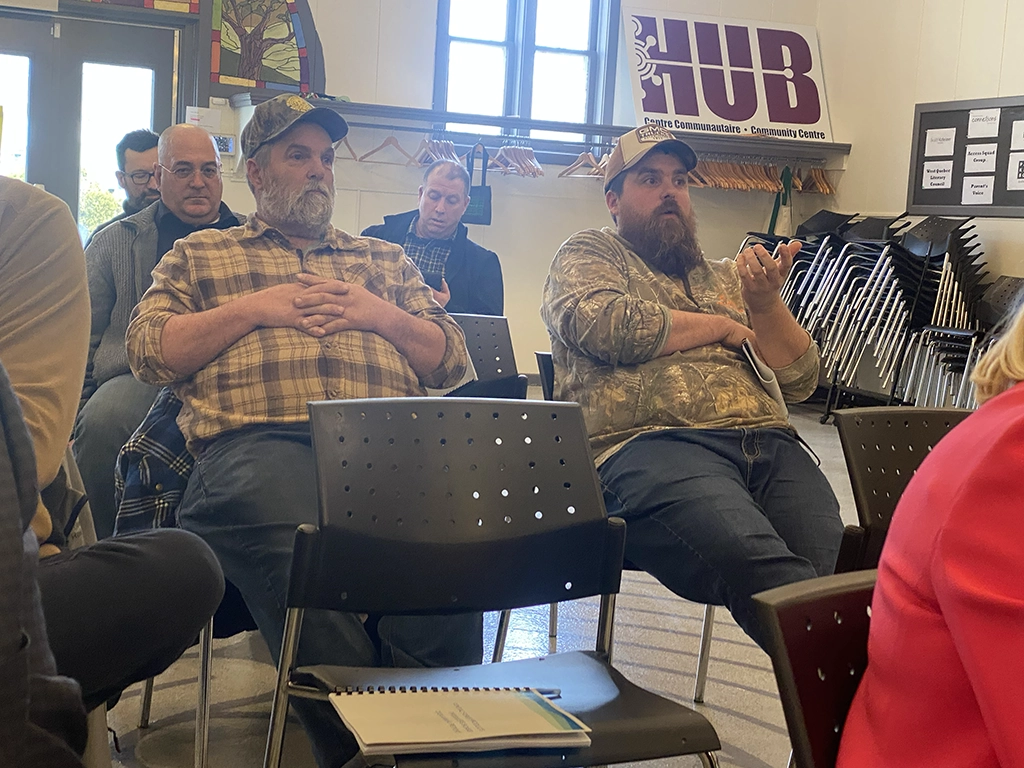

The Pontiac Forest Products Producers Board is on a lifeline, its management shared at its most recent AGM, pointing to the dwindling numbers of local producers paying levies to the organization and the decrease in wood being pulled out of the bush as factors making it impossible for the marketing board to break even year over year.
“We are kind of in a financial pickle,” said the board’s general manager Cash Allard at the annual gathering at St. Paul’s Anglican Church hall in Shawville on Apr. 16.
“This year we may be okay, we might make a few dollars, but we do anticipate going negatively each year, until we get a mill in the area.”
The board, which currently has 77 members, helps local loggers harvesting private lots in the Pontiac get their wood to market at the best price possible.
In exchange, members pay the board a levy on the wood they sell, which helps the board keep its lights on and pay the salaries of the general manager and office manager Stephanie Mayhew working to support the producers.
While membership is up by 10 people since 2023, it’s down from 91 in 2021, and according to Allard, still far from the membership levels the board needs to break even.
“To break even at the marketing board, without getting any assistance from anyone else, we would need to sell 45,000 tonnes more, and that’s a lot,” Allard said, describing a more than 50 per cent increase in production from the 80,000 tonnes produced this year.
“Five years ago we were only 25,000 tonnes away from that mar. When Smurfit-Stone was here, we were way over.”
He said at a bare minimum, the board needs to increase its membership by 10 producers in the next year which, at an average of 1,000 tonnes of wood per producer, would bring in additional $20,000 in levy fees for the board.
This, according to local producer Matt Dagg, is no easy feat. The precarious nature of the local industry means lenders are less inclined to finance large equipment purchases, which makes it challenging for new producers to get into logging.
As you mention forestry in this area, any financial assistance you could get, they don’t touch it [ . . . ] because of the fact that it’s a risky business,” Dagg said.
Allard said on top of this, to qualify as a producer, loggers need to own at least four hectares of bush, which makes it difficult to bring in producers from elsewhere.
To make ends meet for the time being, the board passed a resolution to put a pause on collecting the rolling fund contribution from producers, which is 25 cents per cubic meter sold, and putting that fee instead towards financing its own operation.
“So we’re not increasing the levy but instead we’re going to redistribute it from the rolling fund and put it towards our budget,” Allard explained, noting the board’s rolling fund, which currently sits at about $200,000, can’t be touched. “It will equate to about $20,000 and that will help cover costs.”
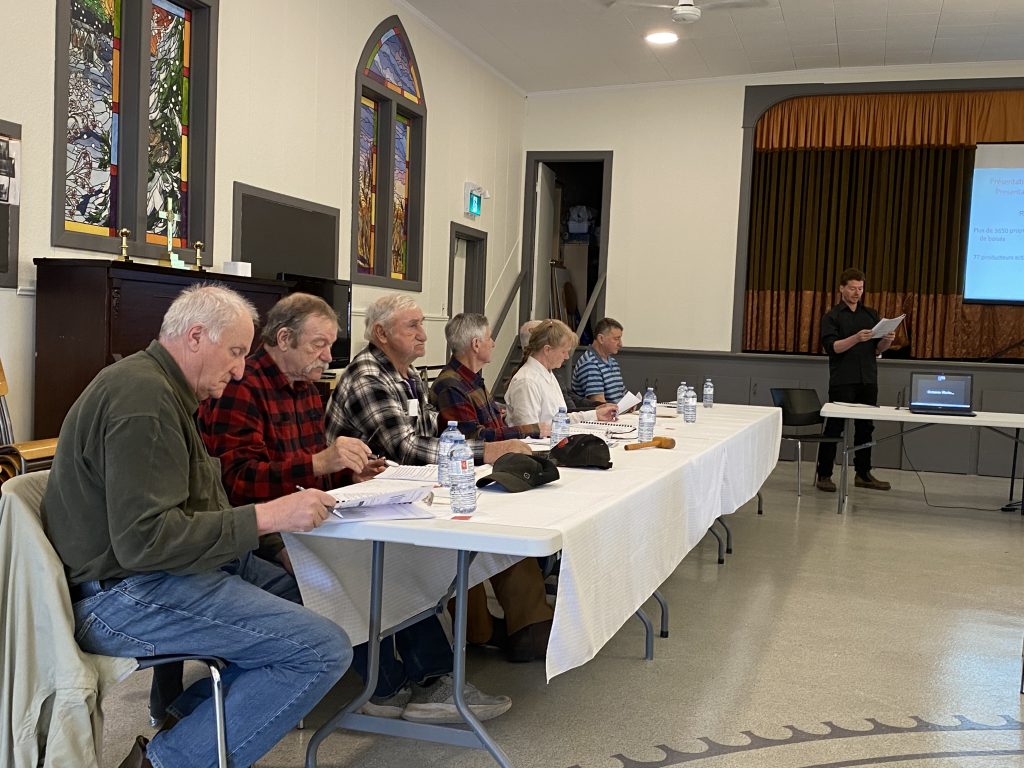
Allard was clear that this is a band-aid solution, and does not mean the board is in the clear.
Allard said producers rely on the temporarily closed Resolute Mill in Maniwaki, which he said is now owned by Domtar, for softwood sales; on Louisiana-Pacific (LP) where producers sell panel wood; and on Domtar’s mill in Windsor, Que. where producers sell hardwood pulp thanks to a subsidy program from Quebec’s Ministry of Natural Resources and Forests which helps pay for costs of getting the wood to Windsor.
“If we lose Domtar, for example, the MRNF trucking subsidy program, that would put a lot of pressure on us,” Allard said. “And then of course, if LP and Domtar were to disappear, we would have to make a hard decision.”
Considering a merger
Also at last week’s AGM the board passed a resolution committing itself to begin exploring what a partnership or collaboration might look like with other local forestry organizations, including other Outaouais wood marketing boards and the Groupement forestier du Pontiac.
This came after a conversation about the potential future necessity to merge with other boards, to consolidate resources and ensure the Pontiac board isn’t simply absorbed into its neighbours’ boards in the case that it goes bankrupt.
“In the interest of all the Pontiac producers we want the marketing board to stay in the Pontiac, but right now, without a mill, and some kind of investor coming into the area, there’s a good chance within five years we’ll really have to consider shutting our doors,” Allard said.
“[Merging] doesn’t necessarily mean we would lose representation in the Pontiac, but if we wait until we’re bankrupt, we have no power.”
Pontiac warden Jane Toller, also in attendance at the meeting, urged the board to not move too hastily.
“Just from what I’ve heard, if you could work with the Groupement, and just have your own board here in the Pontiac . . . I just think that the whole circumstances of this whole MRC are so different from everything else. Forestry built the Pontiac and we hope for some good news fairly soon,” she said, alluding to progress she said she has made on bringing a solution to the pulp and biomass hole in the local market.
Dagg, one of the youngest loggers at the meeting, said he supports looking into some form of collaboration.
“Basically if we don’t do something, by the time my kid is ready to work, there’s going to be no board to work with,” he said. “I think doing what you’re saying and talking to the other boards, it can’t be a bad thing.”
Mayhew, office manager and board secretary, emphasized passing this motion was a critical step in showing the province that the board was doing what it could to survive.
“We have to show the régie this time that we are trying to stay here, or stay afloat,” she said. “Whatever that ‘afloat’ is going to be.”
L’Office des producteurs de produits forestiers du Pontiac est en sursis, a fait savoir sa direction lors de sa plus récente AGA, mettant en cause la diminution du nombre de producteurs locaux qui versent des cotisations à l’organisation et la baisse de l’extraction de bois de la forêt comme facteurs rendant impossible pour l’office de commercialisation d’atteindre l’équilibre budgétaire année après année.
« Nous sommes un peu dans le pétrin financier », a déclaré le directeur général de l’Office, Cash Allard, lors du rassemblement annuel à la salle de l’église anglicane St. Paul de Shawville, le 16 avril.
« Cette année, nous pourrions nous en sortir, nous pourrions faire quelques dollars, mais nous prévoyons être déficitaires chaque année, tant que nous n’aurons pas d’usine dans la région. »
L’Office, qui compte actuellement 77 membres, aide les bûcherons locaux qui récoltent sur des lots privés du Pontiac à commercialiser leur bois au meilleur prix possible.
En échange, les membres versent à l’Office une cotisation sur le bois qu’ils vendent, ce qui aide l’Office à maintenir ses activités et à payer les salaires du directeur général et de la directrice de bureau, Stephanie Mayhew, qui travaillent à soutenir les producteurs.
Bien que le nombre de membres ait augmenté de 10 personnes depuis 2023, il est en baisse par rapport aux 91 membres en 2021, et selon M. Allard, il est encore loin des niveaux d’adhésion dont l’Office a besoin pour atteindre l’équilibre.
« Pour atteindre l’équilibre budgétaire à l’Office de commercialisation, sans obtenir d’aide de quiconque, nous devrions vendre 45 000 tonnes de plus, et c’est beaucoup », a déclaré M. Allard, décrivant une augmentation de plus de 50 % de la production par rapport aux 80 000 tonnes produites cette année.
« Il y a cinq ans, il ne nous manquait que 25 000 tonnes pour atteindre ce seuil. Lorsque Smurfit-Stone était ici, nous le dépassions largement. »
Il a dit qu’au strict minimum, l’Office doit augmenter son nombre de membres de 10 producteurs au cours de la prochaine année, ce qui, à raison d’une moyenne de 1 000 tonnes de bois par producteur, rapporterait 20 000 $ supplémentaires en cotisations à l’Office.
Ceci, selon le producteur local Matt Dagg, n’est pas une tâche facile. La nature précaire de l’industrie locale signifie que les prêteurs sont moins enclins à financer l’achat de gros équipements, ce qui rend difficile pour les nouveaux producteurs de se lancer dans l’exploitation forestière.
« Comme vous l’avez mentionné, en ce qui concerne la foresterie dans cette région, toute aide financière que vous pourriez obtenir, ils n’y touchent pas [ . . . ] en raison du fait que c’est une entreprise risquée », a déclaré M. Dagg.
M. Allard a ajouté qu’en plus de cela, pour être admissible en tant que producteur, les bûcherons doivent posséder au moins quatre hectares de forêt, ce qui rend difficile d’attirer des producteurs d’ailleurs.
Pour joindre les deux bouts pour le moment, l’Office a adopté une résolution visant à suspendre la collecte de la contribution au fonds de roulement des producteurs, qui est de 25 cents par mètre cube vendu, et d’affecter plutôt cette somme au financement de ses propres opérations.
« Nous n’augmentons donc pas la cotisation, mais nous allons plutôt la redistribuer à partir du fonds de roulement et l’affecter à notre budget », a expliqué M. Allard, précisant que le fonds de roulement de l’Office, qui s’élève actuellement à environ 200 000 $, ne peut pas être touché. « Cela représentera environ 20 000 $ et cela aidera à couvrir les coûts. »
M. Allard a clairement indiqué qu’il s’agissait d’une solution pansement, et que cela ne signifie pas que l’Office est tiré d’affaire.
M. Allard a déclaré que les producteurs dépendent de l’usine Résolu de Maniwaki, temporairement fermée, qui, selon lui, appartient maintenant à Domtar, pour les ventes de bois mou; de Louisiana-Pacific (LP) où les producteurs vendent du bois de panneaux; et de l’usine de Domtar à Windsor, au Québec, où les producteurs vendent de la pâte de bois dur grâce à un programme de subvention du ministère des Ressources naturelles et des Forêts du Québec qui aide à couvrir les coûts d’acheminement du bois à Windsor.
« Si nous perdons Domtar, par exemple, le programme de subvention au transport du MRNF, cela nous mettrait beaucoup de pression », a déclaré M. Allard. « Et puis bien sûr, si LP et Domtar venaient à disparaître, nous devrions prendre une décision difficile. »
Envisager une fusion
Également lors de l’AGA de la semaine dernière, l’Office a adopté une résolution s’engageant à commencer à explorer ce à quoi pourrait ressembler un partenariat ou une collaboration avec d’autres organisations forestières locales, y compris d’autres offices de commercialisation du bois de l’Outaouais et le Groupement forestier du Pontiac.
Ceci est survenu après une conversation sur la nécessité potentielle de fusionner avec d’autres offices à l’avenir, afin de consolider les ressources et de s’assurer que l’Office du Pontiac ne soit pas simplement absorbé par les offices voisins en cas de faillite.
« Dans l’intérêt de tous les producteurs du Pontiac, nous voulons que l’office de commercialisation reste dans le Pontiac, mais à l’heure actuelle, sans usine et sans un investisseur quelconque dans la région, il y a de bonnes chances qu’au cours des cinq prochaines années, nous devions vraiment envisager de fermer nos portes », a déclaré M. Allard.
« [Fusionner] ne signifie pas nécessairement que nous perdrions notre représentation dans le Pontiac, mais si nous attendons d’être en faillite, nous n’aurons aucun pouvoir. »
La préfète du Pontiac, Jane Toller, également présente à la réunion, a exhorté l’Office à ne pas agir trop hâtivement.
« D’après ce que j’ai entendu, si vous pouviez travailler avec le Groupement et simplement avoir votre propre office ici dans le Pontiac… Je pense simplement que les circonstances de toute cette MRC sont tellement différentes de tout le reste. La foresterie a bâti le Pontiac et nous espérons de bonnes nouvelles assez tôt », a-t-elle déclaré, faisant allusion aux progrès qu’elle dit avoir réalisés pour apporter une solution au vide laissé par la pâte et la biomasse sur le marché local.
M. Dagg, l’un des plus jeunes bûcherons présents à la réunion, a déclaré qu’il appuyait l’idée d’étudier une forme de collaboration.
« En gros, si nous ne faisons rien, quand mon enfant sera prêt à travailler, il n’y aura plus d’office avec lequel travailler », a-t-il dit. « Je pense que faire ce que vous dites et parler aux autres offices, ça ne peut pas être une mauvaise chose. »
Mme Mayhew, directrice de bureau et secrétaire de l’Office, a souligné que l’adoption de cette motion était une étape cruciale pour montrer à la province que l’Office faisait tout ce qu’il pouvait pour survivre.
« Nous devons montrer à la régie cette fois que nous essayons de rester ici, ou de nous maintenir à flot », a-t-elle dit. « Quelle que soit la forme que prendra ce « à flot ». »