





Brett Thoms
Shawville March 22, 2023
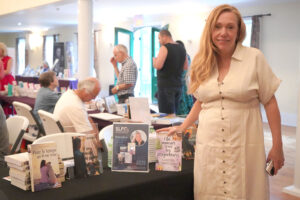
A presentation on the history of Shawville hosted by author Nancy Dale Conroy was held recently at the Pontiac Archives. The presentation, part of a series of presentations on the history of Shawville hosted this year, detailed the families, culture, economy and politics of what was to become the town of Shawville before it was officially created as its own municipality in 1873.
Originally a subsection of the Municipality of Clarendon, then known as Clarendon Centre, Shawville was settled mostly, but not exclusively, by Irish Protestants, mostly of Scottish origin, according to Conroy.
Back then, starting in the 1820s the territories of what was to become Shawville were divided up into lots settled by families who gradually cleared the land and granted the land as property. After the farmers began receiving title to land in the 1830s, lots were further subdivided into businesses as a class of tradespeople and professionals followed the original farmers into the area.
Clarendon Centre was originally settled by John Dale Sr. and Thomas Hodgins in the 1820s but by 1871 several familiar names ranging from Armstrong, Lang, Stark, Armitage, McDowell, Hobbs, Dagg and Shaw, amongst others, appeared in the government’s census.
“If you look at the 1851 census and what the businesses were and who was here and then you look forward to 1861 and 1871 censuses, you see this gradual increase in the number of businesses. Initially, businesses were mainly services to farmers because they would have had to demand various sorts of equipment and whatnot. And then gradually as you move towards 1871, you start to see a few more people doing more of a kind of value-added work.”
Between 1851 and 1871, Clarendon Centre transformed from a collection of farm lots into a true town with several businesses, including store clerks, tanners, seamstresses, a doctor and more, while still remaining a predominantly agricultural community, according to Conroy’s presentation.
Notably in the 1871 census, despite the anti-Catholic sentiment of the original settlers, partially owing the original settlers Ulster roots, a man named Antoine Lalonde, a French Canadian Catholic cooper was living within the boundaries of Shawville. Conroy hasn’t researched why Lalonde’s presence in the town was tolerated, but her theory was since he was a cooper, a trade that was in high demand, people seem to be willing to put aside their prejudices.
“I suggest that by 1873, when Shawville came into being, that civilization had actually arrived here, that compared to what it would have been like 50 years earlier. It was a really well-established little village, with farms being gradually split up into smaller units for both business people and for smaller-scale farmers,” said Conroy.
The businesses and farms of the town formed along roads, which were central to the politics of early Clarendon, according to Conroy. By 1869, councillors from Clarendon Centre began advocating for a separate municipality, largely out of a concern for road construction.
“The councillors who were representing Clarendon Centre felt that people here were being assigned to work on roads that weren’t even part of the town,” said Conroy. “The roads were basically further and further out into the outer areas of the township and they resented that. That was one of the reasons they started to talk about why aren’t we just a separate municipality.”
As discussions on separating Clarendon Centre from Shawville started, the issue of renaming the town was brought up. Conroy said she didn’t find the reason why the representatives of Clarendon Centre wanted to change its name, however, did touch on how it became Shawville.
“Most of the accounts I’ve seen suggest that it was really a choice between naming it after the Dagg family or the Shaws.”
By the 1870s, the Daggs and Shaws were prominent landowners, however it seems that naming the town after the settlement’s true founders were brought up, according to one account.
“There were lots of names tossed around. They could have called it Daleville or Hodginsville, because they were the first here. Not only that, they picked the spot. Why not call it after one of the two men who picked the spot?” Asked Conroy, joking about her relation to the John Dale Sr. “It could have been called, Daleville or go Dale’s Corners or Hodgin’s Village or whatever. But anyway, they ended up picking Shaw.”
In the end, it seems that James Shaw’s money won the day.
“James Shaw didn’t come here until the 1840s. He was a late arrival. He happened to do well, he seemed to become fairly prosperous fairly quickly,” said Conroy. “He had a big general store and he had money. And according to most of the accounts, he basically paid off the town by giving them some land for free so that he could have a town named after him.”
Conroy did concede that Shawville did have a good ring to it.
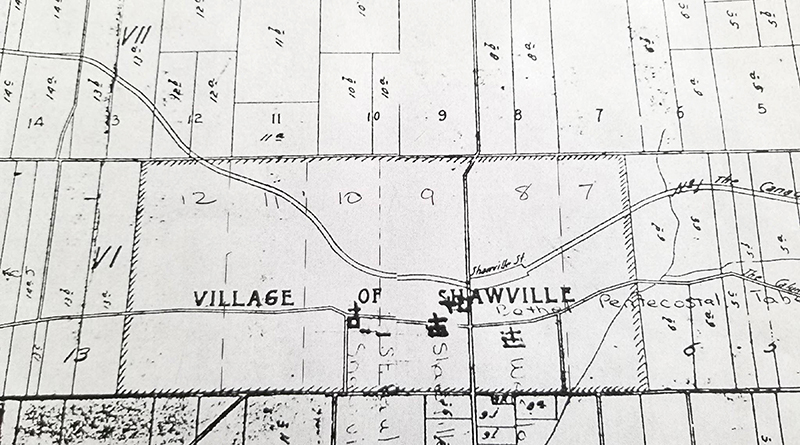
Conroy’s presentation also included an interesting description of the early layout of Shawville by Rev. Nay Taylor from the book the History of the Church in Clarendon.
“I have never forgotten the feeling of dismay which followed my first look at Shawville. One house stood out quite clearly. It was Dr. Lyons house. Beyond it I saw another, not quite so distinctly. It was Mr. James Shaw’s house and store. Then I saw a few dwellings in the foreground. But I could not see that the street ran on beyond Mr. Shaw’s for a full half mile and was fairly well lined with dwellings. What I did see was a background stretching away into the distance toward Adam Brownlee’s Corners and filled apparently with a forest of great dead trees, mostly stark, straight and branchless. I learned later to call them rampikes. I thought I had never seen anything quite so dreary, and it was that which filled me with dismay. The conviction was growing upon me that I and mine were going to have much to do with Shawville, and my mind recoiled whenever I thought of having to face that great forest of dead things.”
Conroy’s presentation also included a lot of information on the early censuses, the nature of Clarendon’s Centre settlement patterns, its economy and more. You can read more about the early history of Shawville and it’s founding families in Conroy’s book: From Derry to the Pontiac: How the Dales Journeyed to the Canadas and Helped to Found the Village of Shawville, Quebec.
Chris Judd will give a presentation on April 5 on the origins of Agriculture in the Pontiac at the Shawville Community Lodge.