






Barry Conway, originally from Barry’s Bay, Ont., is a former journalist, producer and professor, and has spent many years studying the evolution of the English language in the Ottawa Valley. He currently hosts a podcast called The Opeongo Line, a project devoted to investigating and preserving the unique culture of the Ottawa Valley.
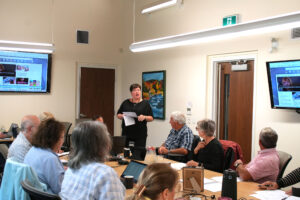
Conway is on mission to preserve the linguistic footprint of the Ottawa Valley. In a public talk last weekend in Osceola, Ont., which he called “How the feckin’ Ottawa Valley Irish Speak English,” he used his intimate knowledge of Renfrew County history to trace the paths of the original Irish settlers and how their ways of speaking shape our language today.
As standardized Canadian English used in mass media threatens to overtake the familiar Ottawa Valley twang, Conway says that how we should preserve our unique culture is not by way of the twang, but by focusing on expressions. It’s by writing down our region’s unique words, sayings and expressions, he says, that local cultures will live on. Here’s an abridged version of THE EQUITY’s chat with Conway.
What’s unique about Ottawa Valley English?
In the 70s there were a couple of linguists from Carleton who studied the Ottawa Valley, and they were all focused on the twang, on the accent. But the accent isn’t even Irish. It’s Medieval English, before what’s called the Great Vowel Shift. When the Irish learned English they learned an English prior to the shift.
For the word “buried,” most people say “berried.” But in the Ottawa Valley we say things like “burried.” Same thing with “yellow” – we tend to say “yalla” up here. And so you can hear in the Ottawa Valley twang the Great Vowel Shift. And so it will shock many people to find out that what they think is Irish is actually Medieval English.
What are you trying to get people interested in with this talk?
There’s a whole bunch of things that I’m trying to get people interested in, and the main thing is: Let’s start looking at some of those fingerprints around here. You’ll find, if you listen closely, instead of worrying about listening to the twang, you listen for the syntax. We will hear things that are very peculiar.
One of my favourites is, somebody from Irish extraction, when they tell you what they think of something, it’s not likely they will go over the top and say “wonderful!” ,“fantastic!” They would say “not bad” or “not half-bad.” And that is part of the Irish DNA of language. The linguists call it negative assertion. For 200-300 years the Irish were under the thumb of the British, and they would learn to speak in a way where they didn’t really have to assert anything. And that’s still very common around here, 500 years later.
It’s things like that that are the fingerprints. It’s not the accent, it’s the way you frame your thoughts using the language. And if you listen carefully enough, and forget about accent, you will discover that they will say things in Shawville in ways that are so obvious that you almost don’t listen for them anymore. But if you start writing down these things, which I’ve been doing for about 50 years now, and you look at them, it will become so obvious.
On the East Coast we have the “inhaled affirmative.” If you ask me a question, and I want to say yes, instead of saying the word ‘yes,’ I inhale as I say the word. Is that the sort of way of expression you’re talking about here?
That’s exactly it. Frequently, people from the Ottawa Valley, or at least in my case, when I was a student, they thought I was a Newfie or from Atlantic Canada. But we don’t sound the same at all – we share the Great Vowel Shift curiosity, but the idiomatic expressions we would have here would be different. There are ways of stating metaphor and similes and analogies that we have here that are different because we have a different industrial structure, where Newfoundland is closer to the sea and the fishing industry. We’re closer to the timber industry, and the way of expression here, the metaphors are drawn from the timber trade.
You alluded to this earlier, but when you went off to university, and professors were pointing out your accent, did you feel pressure to assimilate linguistically?
Oh, yes. And I regret that terribly now, but I thought I was going to be treated as a second-class citizen because I didn’t speak the Queen’s English. In a way I lost it completely, except if I’m really tired I will tend to revert back. If you go to Queen’s or Western [universities], you’re inundated by Torontonians who want to all speak with an Americanized accent. I followed that without thinking much about it.
When did you rediscover that passion for your linguistic heritage?
It didn’t take me very long. There was a split between the accent and the expressions. And the expression I never wanted to lose, because it did have a certain efficacy in dealing with people. It’s those sorts of ways of expressing yourself, the metaphors, the idiomatic expressions. My mother for instance, back in the 50s and 60s, she would never wash the floor, she would “do off” the floor. And if you were going to a wedding or some big event, it was a “big do.” When you use words like “do off the floor,” or “big do,” people will sometimes look at you like, “where in the hell do you come from?” But that’s exactly what I’m trying to do. I’m trying to get people to be conscious of those expressions that you would have in Shawville, in Nova Scotia, and preserve them and recognize them for what they are. They’re the fingerprint of our culture that we should be proud of. I’d love it if people would start collecting them.
Can you tell me about how the mixture of different cultures in the settling of the Ottawa Valley shows up in the English we hear today?
Yes, and it’s a shared culture too. If you go back to the 1850s when the Polish were settling the Ottawa Valley, they didn’t speak English. So they went to the lumber camps, which were full of Irish that were still speaking that English with the twang. When the Irish learned English, if there was more than one they tended to say “yous guys.”
But the Polish picked up certain expressions. And by the time I hear “yous guys” in grade school, the only people who were saying that were Polish. And I’m listening to that thinking that’s a Polish expression. And we thought it was ridiculous that a teacher would be saying that. But what I discovered is that it’s not a Polish expression, it’s an Irish expression. That’s the kind of thing where you start to realize there was a lot of migration of culture.
There’s of lot of things where you will notice how the Irish speak English, or how the Polish speak English. Or even how the Indigenous speak English. And if you peel the onion, you’re often going to find out that it didn’t come directly, it may have come indirectly.
How was such a diversity of language able to flourish here in the Ottawa Valley?
It’s curious, because I thought initially it had a lot to do with modern technology. My grandfather, born in 1880, didn’t have a radio until 1927, and he didn’t get here until the 1960s. And I thought once that happened, it would have a significant effect on pronunciation, but apparently not. The linguists that have done the studies on Canadian English have found there’s a certain stubbornness to Canadian English and the media does not have that significant effect on it. It’s homegrown, and it continues to be homegrown. They do admit that the accent is dying out, like the Ottawa Valley twang, but not the idiomatic, not the metaphors. It’s very much rooted in the culture and the location.
How can people preserve these kinds of expressions?
Two things, fundamentally. One, start listening for an ear to how people speak, and don’t worry about the accent. Listen carefully to metaphor, similes, analogies, and those funny expressions that you hear that give your ear a prick. And those will be culturally significant for the area you’re in. And the second is: start writing them down. I have cue cards that I’ve been collecting for over 50 years. By writing it down, you’re preserving how things are done. Where do you remember hearing them? And which side of your family? It’s very useful to write these things down, make a catalogue, and then share them with people to see if other people have heard them, or they add to them.
We see so much that tells us everything is dying out. Well, it’s not true! The grammar we use, the way we use the language, is in our DNA, the universal syntax that we have, it passes on from one generation to the next.
If you talk to North Americans about Ireland they have this kid of romanticized view of what the Irish are. And there’s a bunch of people who are almost addicted to the twang, that they think that’s somehow the Irishness of who they are, and they want to preserve that. But I tend to think the real future of the Ottawa Valley culture is: if you acknowledge and figure out the syntax of how we express ourselves in the Ottawa Valley, that’s who we are. And it would be wise to preserve that, and not be too bent out of shape because people don’t speak with a twang. It’s not in the alphabet, it’s in the way they see the world.
I hope people are going to take up the challenge that I’m going to make, which is that if you want to preserve your culture, start looking at the language a lot closer. And don’t be at all surprised if you find out that what you think is Irish, is actually Polish.
Ottawa Valley expressions
In the spirit of recording local language and expressions, THE EQUITY set out to discover some examples of unique Ottawa Valley words and phrases. In an excerpt from the Ottawa Journal on Mar. 25, 1966, found in the Pontiac Archives in Shawville, Ruth E. Scharfe published a list of words in a dialect she calls “Ottawa Valley-ese”. Here are a few examples:
Conjurin’ (underhanded plot)
Hotten (heat up)
Pothole (pantry)
Scundered (fed up)
Spoggin’ along (plodding)
Unfriz (thaw out)
Sheenboro expressions
THE EQUITY also reached out to the Sheenboro Archives for this story. While the archives don’t currently house a book of expressions, committee member Lorna Brennan Agnesi has been assembling one herself. Since her father passed away, she has been writing down various “Sheen-isms” that she remembers from his lifetime, and other expressions from the community.
She said many of these sayings are falling out of use because the older generation is slowly passing away, but she hopes that by keeping a record of all the sayings she can keep the traditional culture alive. Here are a few examples:
Arse over teakettle (a bad fall)
Bile the kettle (boil the kettle)
Boarder (a hen that didn’t lay any eggs)
Boom rats (men who worked on the boom; logging camp term)
Bouillon (boiled dinner, usually with chicken vegetables)
Bun in the oven (pregnant)
Brennan Agnesi said anyone who has local Sheen-isms is welcome to reach out and she will add them to her book.
Conway said projects like Agnesi’s are exactly what are needed to keep local cultures alive, and he encourages everyone to do the same. When you hear or are reminded of a unique expression, write it down and keep it someplace safe.
And when you do, share it with us here at THE EQUITY. We would love to hear any words, idioms or turns of phrase that are unique to your family or community. Please send them to me, K.C. Jordan, at kc@theequity.ca .