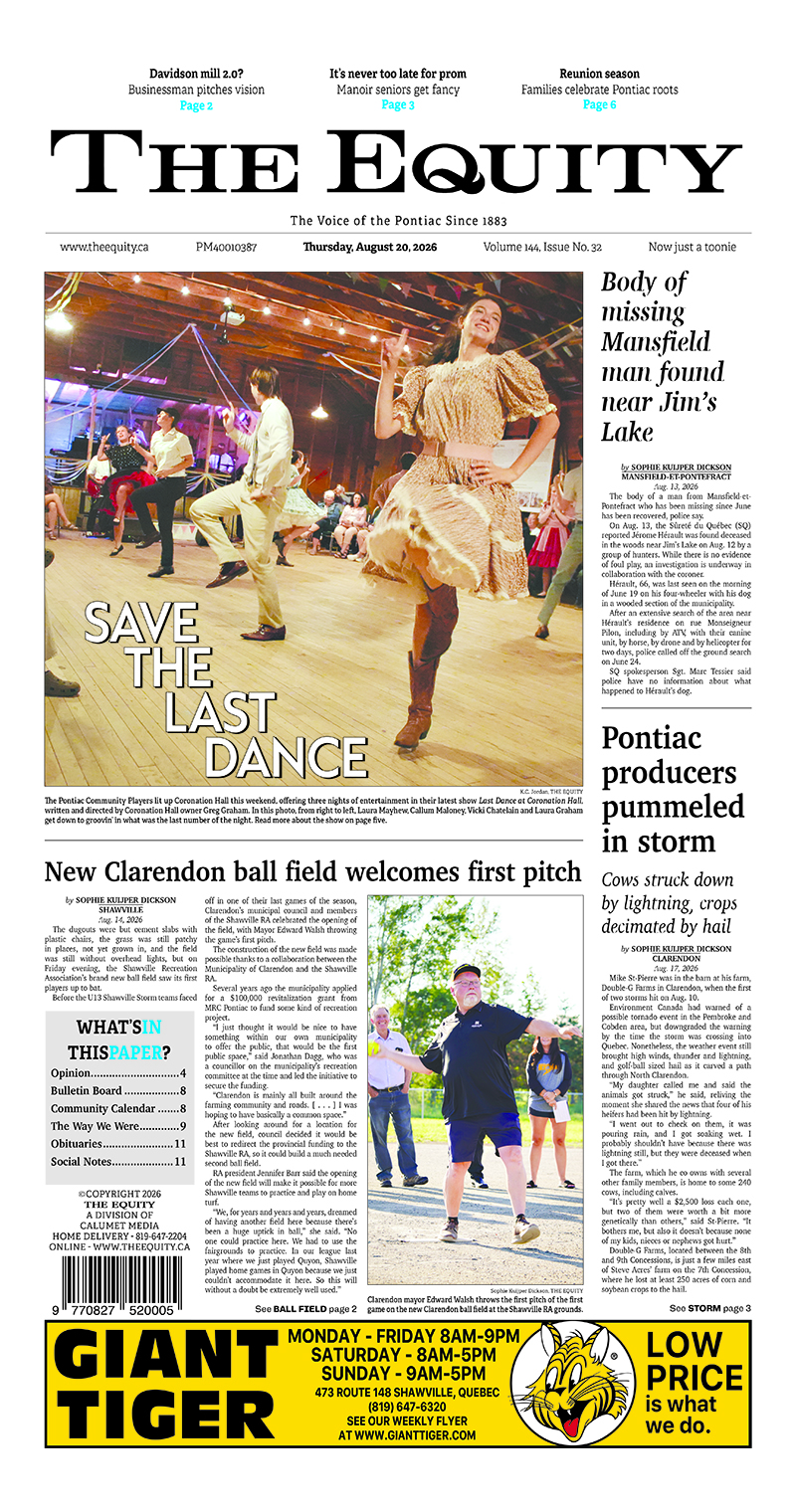






At a time when print media are facing unprecedented challenges across the country and local newspapers are disappearing at an alarming rate, the fact that this year marks the 140th anniversary of THE EQUITY is a remarkable achievement.
The first newspaper to be published in Canada was the Halifax Gazette which printed its debut edition on March 23, 1752. Over the next 150 years, hundreds of papers, large and small, were founded across the country to convey local, national and international news, sway opinion, or represent specific causes. In Quebec alone, by 1900 there were 182 different newspapers, including 17 dailies and over 100 weekly publications. Pontiac’s first newspaper, The Pontiac Advance, was a weekly tabloid published by James Thomas Pattison from 1872 to 1913 in Bryson, the county seat at the time.
It was here that two young friends from Fitzroy Harbour, John Cowan and Henry Thomas Smith, learned their trade as newspapermen.
As was common at the time, newspapers openly reflected their political leanings. The Advance was a Liberal paper which, it turned out, was not
well-suited to Cowan and Smith’s more conservative views. So, in 1883, the two men left the Advance to found their own newspaper, THE EQUITY, with the intention of supporting what was still often referred to as the Liberal Conservative Party, the precursor of today’s Conservative Party of Canada.
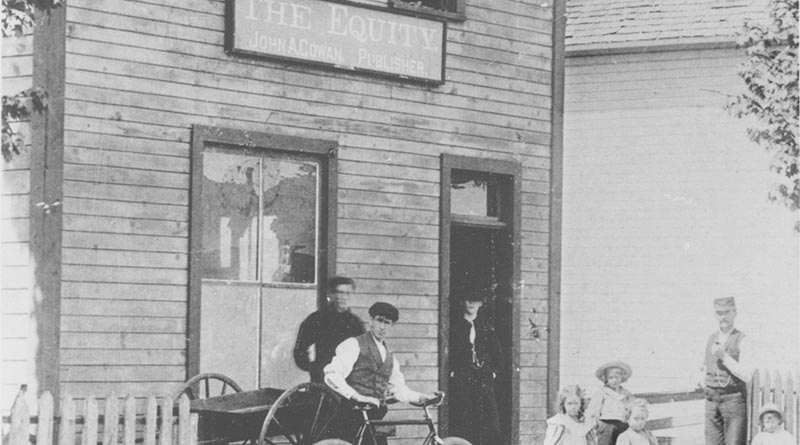
The first issue of THE EQUITY was published on June 7th, 1883, also in Bryson. It was a weekly paper that came out on Thursdays, with subscriptions costing one dollar per year in advance, or $1.50 on account. THE EQUITY set out to be a thoroughly local paper, avoiding the major national issues that occupied larger publications, focusing instead on the interests of the Pontiac. In their inaugural issue, the original editors advised their readers that “Matters which have no immediate connection with our county or provincial affairs, and with which we do not presume to be familiarly acquainted, will receive such consideration as we deem it prudent to give.”
Four years later, in October 1888, THE EQUITY office and printing press were moved to Shawville for reasons the owners “deemed . . .
expedient in the best interests” of the newspaper. The following year, Smith moved to Ottawa to take a job with the federal government. Cowan stayed on as the editor, working tirelessly at this task until his death on October 4, 1931.
After John Cowan’s passing, his son, William George Cowan, managed THE EQUITY for 17 years before dying of a heart attack on November 25, 1948. Over the next two years the paper was run by the trustees of George Cowan’s estate, often under the direction of James Grey. A permanent owner was found in the autumn of 1950 when Bill Kinmond and his wife, Chris Alexander, purchased the paper. They ran the paper until the spring of 1953 when they sold it to David and Rosaleen Dickson, 70 years after the paper was founded. The Dicksons moved THE EQUITY to larger premises on Centre Street in Shawville where they founded Pontiac Printshop, a printing and stationery business. In a lovely letter to the editors in 2008, former co-owner Chris Alexander reminded readers of how often the paper made its way into people’s lives, reminiscing about taking her lunches to school wrapped in old issues of THE EQUITY during the 1920s.
Soon after the Dicksons bought THE EQUITY, the paper gained royal attention following the coronation of Queen Elizabeth II in June 1953. When Mrs. Dickson pblished a poem to mark the occasion, a reader in
New Jersey clipped the verse from the paper and sent it to London. A few weeks later, a warmly-worded reply from Her Majesty’s Lady-in-Waiting expressed the new queen’s gratitude, and a headline in THE EQUITY on August 20 recounted the story in an article under a headline that proudly proclaimed “Equity Goes To Buckingham Palace.”
THE EQUITY has, over the years, maintained its focus on local matters. Not to be distracted by events in Europe, for example, the lead news item on September 14, 1939 noted that Mr. H.W. Hodgins, the secretary of Shawville Fair, would be absent from the office that Friday afternoon. Only further down the page – after an article about a change to the hunting season for partridge, and another discussing the number of lumbermen being sent into the forests of Algonquin Park in the coming winter – was the modest headline, “Canada At War.”
Local, of course, does not mean unimportant. THE EQUITY has always paid close attention to the political and economic matters affecting Pontiac residents. This being Quebec, a fairly constant issue has been the politics of language.
This newspaper has consistently advocated for the rights of the English minority in Quebec, never accepting that the need to protect the language and culture of the French minority within Canada should be at the expense of the anglophone minority within Quebec. In April 1971, hot on the heels of the FLQ crisis and concerned over a proposal to redraw the provincial administrative boundaries in a way that could see the Pontiac disappear, the paper’s then editor, Rosaleen Dickson, conducted an informal poll of local residents to assess their desire to remain a part of Quebec. The results of the poll, published on April 28, showed that an astounding 97 per cent of respondents wanted the Pontiac to leave Quebec, with almost half of the 1,232 respondents wanting the Pontiac to join Ontario.
Almost 400 others supporting the creation of a new federal district, and only 36 people wanting to see the area remain in Quebec. In the late 1970s, Rosaleen and David’s son Ross and his wife Heather joined the business and, with the retirement of Rosaleen and David in the early 1980s, assumed ownership. In 1981, they published a second questionnaire seeking the opinions of local residents on the future of the Pontiac. Again, 96 per cent of respondents wanted a change in the region’s status, with roughly 60 per cent wishing to see the Pontiac join Ontario and another 30 per cent wanting to see it established as part of a new federal district.
Sometimes it seemed as if the world was watching this little corner of Quebec and THE EQUITY’s role in the discussions arising from its complex relationship with the rest of the province. News of the 1971 poll, for example, was reported by newspapers as far away as Edmonton and Victoria. The 1981 poll was covered by American newspapers as far away as Hawaii.
Similarly, in May 1982 major newspapers in both Montreal and Ottawa ran articles about THE EQUITY’s then editor, Ross Dickson, receiving a certificate of appreciation from the Montreal-based Freedom of Choice Movement for his support of English-language rights in Quebec. People were interested. They were reading THE EQUITY, and they were reading about it too, sometimes right across the continent.
In the late 1980s, when the PQ government decided to downgrade Shawville Fair in favour of the Papineau Fair, Ross published a questionnaire asking readers to forward their opinion on the matter to the Quebec agriculture minister. After receiving thousands of letters, reportedly ‘more than he’d ever seen’, the minister helicoptered into Shawville to meet the Fair Board, of which Ross was vice-president, to see for himself what this English town was all about.
Instead of being demoted, Shawville Fair was named the regional fair for all of Quebec from Lachute west.
As the world started to shift online THE EQUITY adapted too, setting up its first website in the spring of 1996.
Today, online subscriptions account for almost 20 per cent of THE EQUITY’s readership, bringing the paper to people anywhere in the world.
In 1989, Ross and business partner Jim Creskey founded The Hill Times, a community weekly newspaper covering goings-on on Parliament Hill. Heather ran Pontiac Printshop and THE EQUITY from the ‘90s through to 2013 when she retired and the business was purchased by Ross’s brother Charles. Now in its 140th year of publication, THE EQUITY has now been owned by members of the Dickson family for 70 of the newspaper’s 140 years. For all of that change, the past several years have been difficult ones for the newspaper industry in Canada, as it has throughout much of the western world.
Declining readership and advertising revenues challenge razor thin profit margins while the proliferation of online content sources – reliable or not – has shifted everyone’s attention to laptops and smartphones.
Between 2020 and 2021 alone, 82 newspapers ceased publication across Canada, almost all of them small community papers. Each closure represents the loss of another voice in the ties that bind us together.
If you want to know what’s going on in your community, and learn how to help make it all a slightly better place, you should read your local weekly newspaper, if you are still lucky enough to have one. In the Pontiac, for the past 140 years, that has been THE EQUITY.
Shawn MacWha, originally from Lachute, spends as much time as possible at his camp “up on the Picanoc” north of Otter Lake. He has a keen interest in Quebec’s past and writes a weekly history column for the Townships Weekend newspaper in Sherbrooke. With contributions by Charles Dickson and Robert Wills.
From Letterpress to Offset
In the earliest days of THE EQUITY, the text that appeared in the paper would have been set by hand, a laborious process that involved selecting individual letters made of wood and metal from a drawer of type, placing them in whatever order was required to form words and sentences, paragraphs and ultimately full pages for printing. After printing, the ink would have to be cleaned off the type before the letters were put back in their proper spots in the type drawers. There were two cases of type drawers, one on top of the other. The upper case housed the capital letters while the lower case housed the rest. This was the world of moveable type, essentially unchanged since Gutenberg’s innovations in the letterpress printing process almost 600 years ago.
The next significant advance was the invention of the Linotype machine, so-named because of its ability to produce a whole line of type at a time. Linotype operators would tap out the words on a qwerty keyboard virtually identical to modern computer keyboards, but with a return key that would send the series of selected type moulds into a chamber where they would be filled with molten lead. The resulting hot type, once cooled, would be assembled into a page of text ready for printing. While the Linotype was invented soon after THE EQUITY was founded, we don’t know when it was first put into use here. It might have been a few years before the new technology found its way to the Pontiac, not least due to the fact that the electrical power required to run the machine wasn’t in place in Shawville until 1925. What we do know is that in 1953, when the business changed hands from the Kinmonds to the Dicksons, a Linotype machine came with it.
From the outset, THE EQUITY was printed on-site on a massive sheet-fed printing press, most recently operated by Neil Sharpe. On a separate machine requiring two operators, different pages of the paper were simultaneously fed in and folded together to make one newspaper. This continued through to the late 1960s when the advent of offset printing changed everything. It enabled the abandonment of the hot type process in favour of the so-called cold type process that involved pasting columns of text, photos and ads onto master sheets of paper from which metal printing plates would be made and strapped onto massive presses. Initially, the text was produced on typewriters, followed in the early 1970s by a machine called a CompuWriter, a four-foot metal cube that had a keyboard on one side and would spit out columns of printed text on the other, and in the 1990s by computers from which text is formatted digitally directly into the final newspaper layout. The shift to offset technology spelled the end of in-house printing of THE EQUITY which has since been printed on multi-million dollar presses owned by larger establishments in Renfrew, Nepean, Smith’s Falls and currently Winchester, Ontario. Rather than scrapping the old printing equipment, the Dicksons donated much of it to Upper Canada Village for use in the antique print shop.
Memories of a former editor
Excerpts from Rosaleen Dickson’s recollections originally published in the 125th anniversary issue in 2008:
Producing a new issue of
THE EQUITY every week for 32 years was not only a livelihood, it was a labour of love in every sense of the word.
When David and I arrived on the scene, the equipment was archaic, even for that time in the history of printing. When it first came into our hands we gazed upon it in wonder, figured out how to use it, and set about keeping THE EQUITY going. Over time we updated the system, donating much of the original machinery to Upper Canada Village where visitors now gaze on it in wonder. Then we indulged in the pleasures of keeping up with the rest of the publishing world, which meant buying an endless line of new machinery, which sometimes became obsolete before it was paid for. Printing is a demanding business.
In line with the needs of the community, we kept enough of the old stuff around to publish books, posters, receipts and ledgers, funeral cards, Christmas cards, maple syrup labels, voters lists, ballots, and other essentials, but even those procedures changed from letter-press, to offset, to computers, and dear knows what comes next.
Memories of a former editor Rosaleen Dickson
I never had a problem finding topics for editorials. Advice was always available from Peden Wilson, Harland Rowat, Jack Argue, Jack Tolhurst, Evans Schwartz, Phoebe McCord, Norma Telford, the Drs. McDowell, Powell, and Horner, Orla Young, Hosmer Turner and his kind, hospitable sisters who ran the ice cream parlour where David and I used to meet everyone in town, slurping old style ice-cream sodas and milk shakes, and generous bowls of home-churned ice cream.
Memories of a former editor Rosaleen Dickson
Dreaming about writing the stories of Pontiac people, and their horses, babies, gardens, celebrations; flying around in the little two-seater airplane with Iverson Harris, taking aerial potos of lakes, farms and forests; helping Wyman MacKechnie sort out the chapters in his great series of books — What Men They Were, Well Remembered, and Weathering the Thirties; solving copyright problems for the Rusty Leach collection of Songs of the Pontiac; and the golden hours that David and I spent together, morphing what was happening all across the County into a weekly newspaper. That was a good life.
Commentary from Robert Wills
At 140 years of age, THE EQUITY is especially long-lived for such a publication. Since its inception, it has been a consistent part of the communications landscape of Pontiac County.
Messrs. Smith and Cowan inaugurated the paper in 1883, with its offices in Bryson. In those times, the River was the highway, and newspapers were the mass media. When Mr. Smith left the partnership and, soon after that, offices were moved to Shawville, it was near the time when the Pontiac Pacific Junction railroad line began construction westward from Ottawa, and commerce shifted from the river towns of Quyon, Portage-du-Fort and Bryson to towns along the new rail line.
THE EQUITY would have been involved as a mainstay of community and regional news, and the forum for discussions, pro and con, of the merits of such a huge socio-economic shift. Imagine, if you will, what an incredible expense the building of a railway line entails. For rural dwellers, it must have required a tremendous leap of faith, imagining a brighter economic future, while enduring a shrinking of bank accounts. The medium of communication throughout that turbulent era was the newspaper.
Over many decades, THE EQUITY was owned and operated by Mr. Cowan, then his children, Bill and Ida, then Jim Gray, then Bill and Chris Kimmond. In 1953, THE EQUITY was bought by David and Rosaleen Dickson and has remained in the Dickson family through the 70 years since.
With the Dicksons taking charge, THE EQUITY entered a new era, and moved to a larger building, its present location on Centre Street. The Dicksons’ commitment to the newspaper as a tool for social improvement ruffled a few feathers, but led to several organizations launched into activity, many awards for journalism, and to Rosaleen being posthumously lauded as one of four Notable Women of the Pontiac in 2020.
Among many community projects spearheaded or encouraged by the Dicksons and THE EQUITY were the Pontiac Anti-Nuclear Action Committee (PANAC), later renamed Pontiac Environment Protection, the Pontiac Historical Society and Museum, which grew out of an Opportunities for Youth workgroup, the establishment of CHIP Radio Pontiac, and later, the development of Ottawa Freenet, one of the first chances for Pontiac residents to connect to the new-fangled internet, among numerous other steps forward in the progress of the Pontiac.
In 1977, Ross and Heather Dickson took over management of THE EQUITY. From the 1980s to the present day, editors have included Richard Wills, Sylvia Bakker, Paul McGee, Wilbur McLean, Kim Thalheimer, Andrea Cranfield, Chris Lowrey, Caleb Nickerson, Carole St. Aubin, Zainab Al-Mehdar and Brett Thoms, among others, with members of the Dickson family taking occasional turns as editor along the way.
For the past ten years, THE EQUITY has been owned by Charles Dickson. Now up to 140 years and counting, THE EQUITY bridges the gap between ink-on-paper and pages-in-cyberspace.
Robert Wills was raised in a family that published a weekly newspaper in a rural Kentucky community in circumstances similar to THE EQUITY’s and is president of the Pontiac Historical Society.
Writing the history of the Pontiac one week at a time for 140 years
From the first issue to the latest, we do our best to capture a week in the life of the Pontiac in the pages of this newspaper, just as many have done before us and, we hope, as many will continue to do after our turn is up. We wish to thank you, the readers, letter writers and advertisers who, for 140 years and counting, have made all this possible and worthwhile.
À l’heure où les médias imprimés sont confrontés à des défis sans précédent partout au pays et où les journaux locaux disparaissent à un rythme alarmant, le fait que cette année marque le 140e anniversaire de THE EQUITY est un exploit remarquable.
Le premier journal à être publié au Canada fut le Halifax Gazette, dont la première édition parut le 23 mars 1752. Au cours des 150 années suivantes, des centaines de journaux, grands et petits, furent fondés à travers le pays pour relayer les nouvelles locales, nationales et internationales, influencer l’opinion ou représenter des causes spécifiques. Rien qu’au Québec, en 1900, il existait 182 journaux différents, dont 17 quotidiens et plus de 100 publications hebdomadaires. Le premier journal du Pontiac, The Pontiac Advance, était un tabloïd hebdomadaire publié par James Thomas Pattison de 1872 à 1913 à Bryson, le chef-lieu du comté à l’époque.
C’est là que deux jeunes amis de Fitzroy Harbour, John Cowan et Henry Thomas Smith, apprirent leur métier de journalistes.
Comme c’était courant à l’époque, les journaux reflétaient ouvertement leurs tendances politiques. Le Advance était un journal libéral qui, il s’avéra, n’était pas
adapté aux vues plus conservatrices de Cowan et Smith. Ainsi, en 1883, les deux hommes quittèrent le Advance pour fonder leur propre journal, THE EQUITY, avec l’intention de soutenir ce que l’on appelait encore souvent le Parti libéral-conservateur, précurseur de l’actuel Parti conservateur du Canada.
Le premier numéro de THE EQUITY fut publié le 7 juin 1883, également à Bryson. C’était un hebdomadaire qui paraissait le jeudi, avec des abonnements coûtant un dollar par an à l’avance, ou 1,50 $ à crédit. THE EQUITY se voulait un journal résolument local, évitant les grandes questions nationales qui occupaient les publications plus importantes, pour se concentrer plutôt sur les intérêts du Pontiac. Dans leur numéro inaugural, les éditeurs originaux informèrent leurs lecteurs que « les questions n’ayant aucun lien immédiat avec les affaires de notre comté ou de notre province, et avec lesquelles nous ne prétendons pas être familièrement familiarisés, recevront l’attention que nous jugerons prudent de leur accorder ».
Quatre ans plus tard, en octobre 1888, les bureaux et la presse de THE EQUITY furent déménagés à Shawville pour des raisons que les propriétaires « jugèrent . . .
expédientes dans les meilleurs intérêts » du journal. L’année suivante, Smith déménagea à Ottawa pour occuper un poste au gouvernement fédéral. Cowan resta rédacteur en chef, travaillant sans relâche à cette tâche jusqu’à sa mort le 4 octobre 1931.
Après le décès de John Cowan, son fils, William George Cowan, géra THE EQUITY pendant 17 ans avant de mourir d’une crise cardiaque le 25 novembre 1948. Au cours des deux années suivantes, le journal fut géré par les fiduciaires de la succession de George Cowan, souvent sous la direction de James Grey. Un propriétaire permanent fut trouvé à l’automne 1950 lorsque Bill Kinmond et son épouse, Chris Alexander, achetèrent le journal. Ils dirigèrent le journal jusqu’au printemps 1953, date à laquelle ils le vendirent à David et Rosaleen Dickson, 70 ans après la fondation du journal. Les Dickson déménagèrent THE EQUITY dans de plus grands locaux sur la rue Centre à Shawville où ils fondèrent Pontiac Printshop, une entreprise d’impression et de papeterie. Dans une charmante lettre aux rédacteurs en 2008, l’ancienne copropriétaire Chris Alexander rappela aux lecteurs à quel point le journal s’immisçait souvent dans la vie des gens, se remémorant qu’elle emballait ses lunchs pour l’école dans de vieux numéros de THE EQUITY durant les années 1920.
Peu après l’achat de THE EQUITY par les Dickson, le journal attira l’attention royale suite au couronnement de la reine Élisabeth II en juin 1953. Lorsque Mme Dickson publia un poème pour marquer l’occasion, un lecteur du
New Jersey découpa le vers du journal et l’envoya à Londres. Quelques semaines plus tard, une réponse chaleureuse de la dame d’honneur de Sa Majesté exprima la gratitude de la nouvelle reine, et un titre dans THE EQUITY du 20 août raconta l’histoire dans un article sous une manchette qui proclamait fièrement « Equity Goes To Buckingham Palace ».
Au fil des ans, THE EQUITY a maintenu son accent sur les questions locales. Pour ne pas être distrait par les événements en Europe, par exemple, la principale nouvelle du 14 septembre 1939 signalait que M. H.W. Hodgins, le secrétaire de la Foire de Shawville, serait absent du bureau ce vendredi après-midi-là. Ce n’est que plus bas sur la page – après un article sur un changement à la saison de chasse à la perdrix, et un autre discutant du nombre de bûcherons envoyés dans les forêts du parc Algonquin pour l’hiver à venir – que se trouvait la modeste manchette « Canada en guerre ».
Local, bien sûr, ne signifie pas sans importance. THE EQUITY a toujours porté une attention particulière aux questions politiques et économiques touchant les résidents du Pontiac. Le Québec oblige, la politique linguistique a été une question assez constante.
Ce journal a constamment défendu les droits de la minorité anglophone au Québec, n’acceptant jamais que la nécessité de protéger la langue et la culture de la minorité francophone au Canada se fasse au détriment de la minorité anglophone au Québec. En avril 1971, juste après la crise du FLQ et préoccupée par une proposition de redessiner les limites administratives provinciales d’une manière qui pourrait faire disparaître le Pontiac, la rédactrice en chef de l’époque du journal, Rosaleen Dickson, mena un sondage informel auprès des résidents locaux pour évaluer leur désir de rester au Québec. Les résultats du sondage, publiés le 28 avril, montrèrent qu’un étonnant 97 % des répondants voulaient que le Pontiac quitte le Québec, près de la moitié des 1 232 répondants voulant que le Pontiac rejoigne l’Ontario.
Près de 400 autres soutenaient la création d’un nouveau district fédéral, et seulement 36 personnes souhaitaient que la région reste au Québec. À la fin des années 1970, Ross, le fils de Rosaleen et David, et son épouse Heather, rejoignirent l’entreprise et, avec la retraite de Rosaleen et David au début des années 1980, en prirent possession. En 1981, ils publièrent un deuxième questionnaire sollicitant l’avis des résidents locaux sur l’avenir du Pontiac. Encore une fois, 96 % des répondants voulaient un changement de statut de la région, environ 60 % souhaitant que le Pontiac rejoigne l’Ontario et 30 % voulant qu’il soit établi dans le cadre d’un nouveau district fédéral.
Parfois, il semblait que le monde entier observait ce petit coin du Québec et le rôle de THE EQUITY dans les discussions découlant de sa relation complexe avec le reste de la province. Les nouvelles du sondage de 1971, par exemple, furent rapportées par des journaux aussi éloignés qu’Edmonton et Victoria. Le sondage de 1981 fut couvert par des journaux américains aussi lointains que Hawaï.
De même, en mai 1982, de grands journaux à Montréal et à Ottawa publièrent des articles sur le rédacteur en chef de l’époque de THE EQUITY, Ross Dickson, qui reçut un certificat d’appréciation du Mouvement pour le libre choix, basé à Montréal, pour son soutien aux droits linguistiques des anglophones au Québec. Les gens étaient intéressés. Ils lisaient THE EQUITY, et ils lisaient aussi à son sujet, parfois à travers tout le continent.
À la fin des années 1980, lorsque le gouvernement du PQ décida de déclasser la Foire de Shawville en faveur de la Foire de Papineau, Ross publia un questionnaire demandant aux lecteurs de transmettre leur opinion sur la question au ministre québécois de l’Agriculture. Après avoir reçu des milliers de lettres, « plus qu’il n’en avait jamais vu », selon les dires, le ministre se rendit en hélicoptère à Shawville pour rencontrer le conseil d’administration de la Foire, dont Ross était vice-président, afin de voir par lui-même ce qu’était cette ville anglophone.
Au lieu d’être rétrogradée, la Foire de Shawville fut nommée foire régionale pour tout le Québec, de Lachute vers l’ouest.
Alors que le monde commençait à se tourner vers le numérique, THE EQUITY s’adapta également, en lançant son premier site web au printemps 1996.
Aujourd’hui, les abonnements en ligne représentent près de 20 % du lectorat de THE EQUITY, rendant le journal accessible aux gens partout dans le monde.
En 1989, Ross et son partenaire commercial Jim Creskey fondèrent The Hill Times, un hebdomadaire communautaire couvrant les activités sur la Colline du Parlement. Heather dirigea Pontiac Printshop et THE EQUITY des années 90 jusqu’en 2013, date à laquelle elle prit sa retraite et l’entreprise fut rachetée par le frère de Ross, Charles. Maintenant dans sa 140e année de publication, THE EQUITY a été détenu par des membres de la famille Dickson pendant 70 des 140 années d’existence du journal. Malgré tous ces changements, les dernières années ont été difficiles pour l’industrie des journaux au Canada, comme dans une grande partie du monde occidental.
La baisse du lectorat et des revenus publicitaires met à l’épreuve des marges bénéficiaires déjà minces, tandis que la prolifération des sources de contenu en ligne – fiables ou non – a détourné l’attention de tous vers les ordinateurs portables et les téléphones intelligents.
Entre 2020 et 2021 seulement, 82 journaux cessèrent de paraître au Canada, presque tous de petits journaux communautaires. Chaque fermeture représente la perte d’une autre voix dans les liens qui nous unissent.
Si vous voulez savoir ce qui se passe dans votre communauté et apprendre comment contribuer à l’améliorer un tant soit peu, vous devriez lire votre hebdomadaire local, si vous avez encore la chance d’en avoir un. Dans le Pontiac, depuis 140 ans, c’est THE EQUITY.
Shawn MacWha, originaire de Lachute, passe le plus de temps possible à son camp « up on the Picanoc » au nord du lac Otter. Il s’intéresse vivement au passé du Québec et rédige une chronique historique hebdomadaire pour le journal Townships Weekend à Sherbrooke. Avec les contributions de Charles Dickson et Robert Wills.
De la typographie à l’offset
Aux tout débuts de THE EQUITY, le texte qui apparaissait dans le journal était composé à la main, un processus laborieux qui impliquait la sélection de lettres individuelles en bois et en métal dans un tiroir de caractères, les plaçant dans l’ordre requis pour former des mots et des phrases, des paragraphes et finalement des pages complètes pour l’impression. Après l’impression, l’encre devait être nettoyée des caractères avant que les lettres ne soient remises à leur place dans les tiroirs de caractères. Il y avait deux casses de tiroirs de caractères, l’une au-dessus de l’autre. La casse supérieure contenait les lettres majuscules, tandis que la casse inférieure contenait le reste. C’était le monde de la typographie mobile, essentiellement inchangé depuis les innovations de Gutenberg dans le processus d’impression typographique il y a près de 600 ans.
L’avancée significative suivante fut l’invention de la machine Linotype, ainsi nommée en raison de sa capacité à produire une ligne entière de caractères à la fois. Les opérateurs Linotype tapaient les mots sur un clavier QWERTY pratiquement identique aux claviers d’ordinateur modernes, mais avec une touche de retour qui envoyait la série de moules de caractères sélectionnés dans une chambre où ils étaient remplis de plomb en fusion. Le caractère chaud résultant, une fois refroidi, était assemblé en une page de texte prête à être imprimée. Bien que la Linotype ait été inventée peu après la fondation de THE EQUITY, nous ne savons pas quand elle fut utilisée pour la première fois ici. Il a peut-être fallu quelques années avant que la nouvelle technologie n’atteigne le Pontiac, notamment en raison du fait que l’énergie électrique nécessaire pour faire fonctionner la machine n’était pas disponible à Shawville avant 1925. Ce que nous savons, c’est qu’en 1953, lorsque l’entreprise changea de mains, des Kinmond aux Dickson, une machine Linotype était incluse.
Dès le début, THE EQUITY fut imprimé sur place sur une énorme presse à platine alimentée en feuilles, la plus récemment exploitée par Neil Sharpe. Sur une machine séparée nécessitant deux opérateurs, différentes pages du journal étaient simultanément alimentées et pliées ensemble pour former un seul journal. Cela continua jusqu’à la fin des années 1960, lorsque l’avènement de l’impression offset changea tout. Cela permit l’abandon du processus de composition à chaud en faveur du processus dit de composition à froid qui impliquait le collage de colonnes de texte, de photos et d’annonces sur des feuilles maîtresses à partir desquelles des plaques d’impression métalliques étaient fabriquées et fixées sur d’énormes presses. Initialement, le texte était produit sur des machines à écrire, suivi au début des années 1970 par une machine appelée CompuWriter, un cube métallique de quatre pieds de côté qui avait un clavier d’un côté et crachait des colonnes de texte imprimé de l’autre, et dans les années 1990 par des ordinateurs à partir desquels le texte est formaté numériquement directement dans la mise en page finale du journal. Le passage à la technologie offset signala la fin de l’impression interne de THE EQUITY qui, depuis, est imprimé sur des presses de plusieurs millions de dollars appartenant à de plus grandes entreprises à Renfrew, Nepean, Smith’s Falls et actuellement Winchester, en Ontario. Plutôt que de jeter l’ancien équipement d’impression, les Dickson en firent don à Upper Canada Village pour être utilisé dans l’atelier d’impression antique.
Souvenirs d’une ancienne rédactrice en chef
Extraits des souvenirs de Rosaleen Dickson, publiés à l’origine dans le numéro du 125e anniversaire en 2008 :
Produire un nouveau numéro de
THE EQUITY chaque semaine pendant 32 ans n’était pas seulement un gagne-pain, c’était un travail d’amour dans tous les sens du terme.
Lorsque David et moi sommes arrivés sur les lieux, l’équipement était archaïque, même pour cette époque de l’histoire de l’imprimerie. Quand il nous est tombé entre les mains, nous l’avons contemplé avec émerveillement, avons compris comment l’utiliser et nous sommes attelés à faire vivre THE EQUITY. Au fil du temps, nous avons mis à jour le système, faisant don d’une grande partie de la machinerie originale à Upper Canada Village où les visiteurs l’observent maintenant avec émerveillement. Puis nous nous sommes adonnés aux plaisirs de suivre le reste du monde de l’édition, ce qui signifiait acheter une ligne interminable de nouvelles machines, qui devenaient parfois obsolètes avant d’être payées. L’imprimerie est une entreprise exigeante.
Conformément aux besoins de la communauté, nous avons conservé suffisamment de l’ancien matériel pour publier des livres, des affiches, des reçus et des registres, des cartes mortuaires, des cartes de Noël, des étiquettes de sirop d’érable, des listes électorales, des bulletins de vote et d’autres éléments essentiels, mais même ces procédures ont changé, passant de la typographie à l’offset, puis aux ordinateurs, et Dieu seul sait ce qui viendra ensuite.
Souvenirs d’une ancienne rédactrice en chef Rosaleen Dickson
Je n’ai jamais eu de mal à trouver des sujets d’éditoriaux. Les conseils étaient toujours disponibles auprès de Peden Wilson, Harland Rowat, Jack Argue, Jack Tolhurst, Evans Schwartz, Phoebe McCord, Norma Telford, les docteurs McDowell, Powell et Horner, Orla Young, Hosmer Turner et ses sœurs aimables et hospitalières qui tenaient le salon de crème glacée où David et moi avions l’habitude de rencontrer tout le monde en ville, sirotant des sodas et des laits frappés à l’ancienne, et de généreux bols de crème glacée maison.
Souvenirs d’une ancienne rédactrice en chef Rosaleen Dickson
Rêver d’écrire les histoires des habitants du Pontiac, et de leurs chevaux, bébés, jardins, célébrations; voler dans le petit avion biplace avec Iverson Harris, prenant des photos aériennes de lacs, fermes et forêts; aider Wyman MacKechnie à organiser les chapitres de sa grande série de livres — What Men They Were, Well Remembered, et Weathering the Thirties; résoudre les problèmes de droits d’auteur pour la collection Rusty Leach de Songs of the Pontiac; et les heures dorées que David et moi avons passées ensemble, transformant ce qui se passait partout dans le Comté en un journal hebdomadaire. Ce fut une belle vie.
Commentaire de Robert Wills
À 140 ans, THE EQUITY est une publication particulièrement pérenne. Depuis sa création, elle fait partie intégrante du paysage de la communication du comté de Pontiac.
Messieurs Smith et Cowan inaugurèrent le journal en 1883, avec ses bureaux à Bryson. À cette époque, la rivière était l’autoroute, et les journaux étaient les médias de masse. Lorsque M. Smith quitta le partenariat et, peu après, les bureaux furent déménagés à Shawville, c’était vers l’époque où la ligne de chemin de fer Pontiac Pacific Junction commença sa construction vers l’ouest depuis Ottawa, et le commerce se déplaça des villes fluviales de Quyon, Portage-du-Fort et Bryson vers les villes le long de la nouvelle ligne ferroviaire.
THE EQUITY aurait été un pilier de l’actualité communautaire et régionale, et le forum des discussions, pour et contre, sur les mérites d’un si grand changement socio-économique. Imaginez, si vous voulez, l’incroyable dépense qu’entraîne la construction d’une ligne de chemin de fer. Pour les habitants des zones rurales, cela a dû exiger un formidable acte de foi, imaginant un avenir économique plus radieux, tout en supportant une diminution des comptes bancaires. Le moyen de communication tout au long de cette ère turbulente était le journal.
Pendant de nombreuses décennies, THE EQUITY fut détenu et exploité par M. Cowan, puis par ses enfants, Bill et Ida, puis par Jim Gray, puis par Bill et Chris Kimmond. En 1953, THE EQUITY fut acheté par David et Rosaleen Dickson et est resté dans la famille Dickson au cours des 70 dernières années.
Avec la prise en charge par les Dickson, THE EQUITY entra dans une nouvelle ère et déménagea dans un bâtiment plus grand, son emplacement actuel sur la rue Centre. L’engagement des Dickson envers le journal comme outil d’amélioration sociale bouscula quelques habitudes, mais conduisit au lancement de plusieurs organisations, à de nombreux prix de journalisme, et à Rosaleen étant saluée à titre posthume comme l’une des quatre Femmes Notables du Pontiac en 2020.
Parmi les nombreux projets communautaires lancés ou encouragés par les Dickson et THE EQUITY figuraient le Comité d’action anti-nucléaire du Pontiac (PANAC), rebaptisé plus tard Protection de l’environnement du Pontiac, la Société historique et le Musée du Pontiac, qui ont vu le jour grâce à un groupe de travail d’« Opportunities for Youth », la création de CHIP Radio Pontiac, et plus tard, le développement d’Ottawa Freenet, l’une des premières occasions pour les résidents du Pontiac de se connecter au nouvel Internet, parmi de nombreuses autres avancées dans le progrès du Pontiac.
En 1977, Ross et Heather Dickson prirent la direction de THE EQUITY. Des années 1980 à nos jours, les rédacteurs en chef ont inclus Richard Wills, Sylvia Bakker, Paul McGee, Wilbur McLean, Kim Thalheimer, Andrea Cranfield, Chris Lowrey, Caleb Nickerson, Carole St. Aubin, Zainab Al-Mehdar et Brett Thoms, entre autres, des membres de la famille Dickson se relayant occasionnellement comme rédacteurs en chef en cours de route.
Au cours des dix dernières années, THE EQUITY a été détenu par Charles Dickson. Maintenant, après 140 ans et ce n’est pas fini, THE EQUITY fait le pont entre l’encre sur papier et les pages dans le cyberespace.
Robert Wills a été élevé dans une famille qui publiait un hebdomadaire dans une communauté rurale du Kentucky dans des circonstances similaires à celles de THE EQUITY et est président de la Société historique du Pontiac.
Écrire l’histoire du Pontiac une semaine à la fois pendant 140 ans
Du premier numéro au plus récent, nous faisons de notre mieux pour capturer une semaine de la vie du Pontiac dans les pages de ce journal, tout comme beaucoup l’ont fait avant nous et, nous l’espérons, comme beaucoup continueront de le faire après notre tour. Nous tenons à vous remercier, lecteurs, auteurs de lettres et annonceurs qui, depuis 140 ans et ce n’est pas fini, avez rendu tout cela possible et utile.