





Brett Thoms
Shawville September 3, 2022
Historically, agricultural fairs have always been about farmers showing off their animals. The 165th edition is no exception, with farmers from around the region showing off their livestock at various shows throughout the weekend.
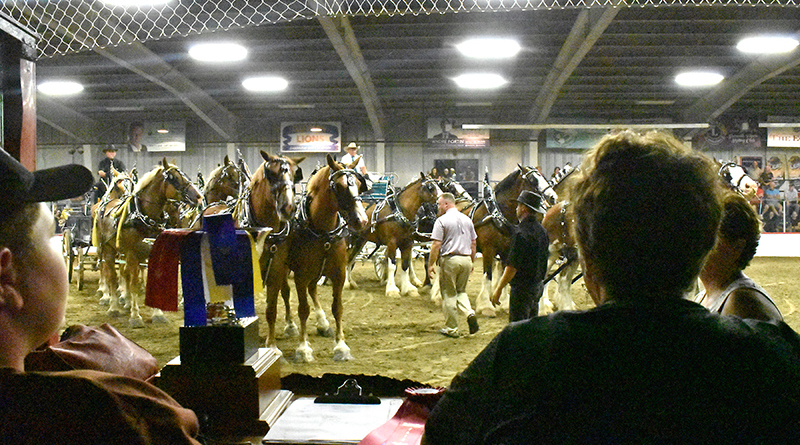
The shows included the 4-H Market Steer and Lamb Show and the Heavy Draft Horse Hitch Show on Friday.
Saturday saw the Draft Heavy Horse Line Classes, the Beef Pee Wee Show for those too young to join 4-H and the Draft Heavy Horse Hitch show.
And Sunday finished the showing with the 4-H Regional Club Show and the light Light Horse Show.
Judges were brought in to help pick the best of the best of the livestock presented throughout the fair and THE EQUITY took the opportunity to talk to them to get an idea about what they were looking for in the animals.
Steve Burgomaster, a farmer out of Kawartha Lakes, Ontario, and . . .
food safety inspector with the government of Ontario was brought on to judge the various beef cattle competitions for the fair, including the 4-H shows.
He explained that animal shows can be based on current trends and are often up to individual judges’ tastes.
“The show ring is very trendy, like a lot of things and different people might like slightly different types, whether they like them a little bigger or a little smaller,” said Burgomaster.
In explaining the general characteristics he’s looking for in a market competition, he described the broad points of what he accesses.
“I like an animal that’s kind of like a rectangle, four sided, and the legs should come down kind of wide based off each of those corners, almost like a table. And then the front should be like wedge shaped if you want to put a triangle on it on the front so they’re very smooth through the front, kind of long neck, nice balanced head to it to really simplify the shape.”
Burgomaster also looked at the way cows held themselves.
“When they walk, you want them to be in a long stride, and so their back foot should kind of hit where their front foot leaves,‘’ said Burgomaster. “They should track very true in their gait. So they shouldn’t really waddle all over the place.”
There’s criteria also changes based on the breed he’s looking at which can vary a lot. Burgomaster wants to find the middle groud between finding a balance and the breed showing off their individual characteristics.
“If you bought beef in the grocery store, chances are they’re mixed, or crossbred of a number of different breeds. Probably the most popular breed marketing wise today are Black Angus, so they’re very recognizable. They’re known to be good mothers, and they lay down good, so that’s like fat content. Herford are the red and white ones, those are British breeds. And then quite often they would cross them with the European or the continental breeds such as Charolais , which I breed at home. They’re faster growing and a little leaner muscle so when you take faster growing and leaner muscle.”
Kyle Rivington, a dairy farmer out of Carp, Ontario was brought on to judge, the Jersey and Holstein cows at the dairy shows. He described what he’s looking for was assessing the livestock brought in front of him.
“You want them to be as functional as possible really, ‘’ said Rivington. “You want them to be feminine, fine boned but have enough strength and the proper structure to calve properly.”
However, if you couldn’t guess, the most important thing is in assessing dairy cows are the utters because that’s where your milk comes from.
For the Draft Heavy Horse Hitch show, the criteria are very different.
Mike Stokes of Guelph, Ontario, was brought out to judge many of the horse competitions, including the carriages.
Discussing how he assesses the hitch competition, which is the horse carriage competition that ranged between a two horse hitch and six horse hitches, Stokes said he’s looking for horses to demonstrate how they work together.
“The biggest thing is just working together as a team, especially when you get upto six horse hitches,” said Stokes. “All the horses are together not shying away from the boards, kind of working as a team.”
Also in that competition, the total aesthetic package of the carriage also played a big role in how he determined the winner, according to Stokes.
But these kinds of shows are more complicated that they look, especially in a relatively confined space like the arena. The hitch competition requires the participants to perform commands for the judge and therefore they need someone else to manage “traffic” in the relatively confined arena.
For Saturday’s show that job belonged to Barry Virgil.
“I’m like the traffic cop, ‘’ said Virgil. “ I’m in charge of making sure that the hitches get in the ring and get around. I’m sort of the eyes and ears of the judge. And then all Mike has to do is concentrate on his judging. We have a system here and we work out our signals beforehand, so he knows I know when he wants me to reverse the hitches and it’s seamless in the ring.”
THE EQUITY also asked judges how soon they can tell who the winners are going to be.
For Burgomaster, he says certain animals have ascertain confidence that sets apart from the start.
“It’s very much first impressions,” said Burgomaster. “I don’t know if you think a cow can look pretty but I can look at one and it’ll stand out and have that flash. It’s a little bit of a beauty contest. The true show animals are very unique. They just kind of have that little bit of an attitude to them. They just they almost know that they’re good.”
For Rivington, it’s a little more subtle.
“I mean, you’re, you’re looking for the complete package and there’s ones that grab your eye, off the start, but sometimes most of the functional parts are behind the cow,” said Rivington about dairy cows.
However for something more complicated like the hitch shows, first impressions hold less water.
“Yeah, you get a first impression, but we just watch it,” said Stokes. “You know, somebody makes a mistake a couple of laps in and that can change things.”
Despite the the strangeness of these competition that may strike outsiders, Burgomaster says they play an important role in the agricultural industry.
“You know the fairs as a way of producers comparing their stock and a little bit of bragging rights,” said Burgomaster. “But agriculture as a whole in the food industry is benefited because then everybody’s trying to do better. Out here you’ll see a lot of genetics and I know there’ll be some animals out here today that are from some of the top herds that can go out and compete anywhere in North America and at the biggest of shows. so it’s kind of a treat to get to see some of those animals that will go on and compete at the highest level.”
He went on to say that some of these animals are worth big money.
“They’ll market their genetics, so they might harvest embryos or they might sell semen off these bulls or they might syndicate that animal itself for the genetics. It’s kind of like your seeing Formula One race cars, and then you know, there’s gonna be some Suzuki’s and Honda’s over here too,” concluded Burgomaster about the nature of these shows.