





Zainab Al-Mehdar
Pontiac July 27, 2022
In the 10 years that the western bean cutworm has been researched, many have collaborated on the project not only to understand it but to also be able to advise producers in the region.
The western bean cutworm is native to the western and central United States and is considered a major pest of corn and dry beans. It was discovered in Quebec in 2009.
As a follow-up to the July 13 story about the pest,
THE EQUITY spoke to Christine Rieux, the field crop advisor from the MAPAQ office in Shawville. She explained that . . .
she has been involved in the project since 2015 and collaborated with Julien Saguez, the entomologist, in 2017.
In collaboration with entomologists working at Quebec’s Centre de recherche sur les grains (CÉROM), MAPAQ’s role was to monitor and watch for trends and invest money and time to go and sample and help farmers out. Provincially MAPAQ also finances most of the different research projects.
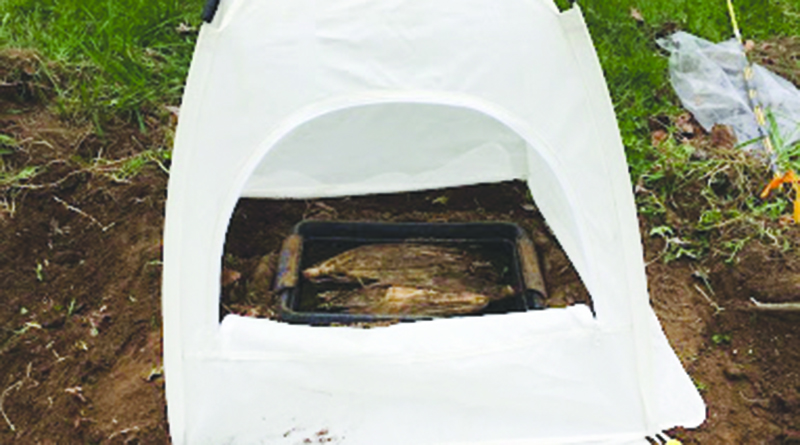
They started studying the pest by first setting up a small camp in a garden just to test it by putting the caterpillars with sweet corn in the ground to see if the western bean cutworm will hibernate, Rieux said.
Since they had some survive, they decided to go on a bigger scale with the emergence cages like the ones installed on Jennifer Dale and Scott Judd’s property.
Rieux highlighted that Shawville was the first region to report the infestation of the western bean cutworm and it was reported in national media all over Canada at the end of the 90s, and early 2000s.
Much of the work they do involves monitoring when the pest comes in and when peak moths captures are. They usually start end of June and go weekly until the end of August. Sometimes they capture a few moths a week at the beginning of the season and other times it can reach 500 to 1,000 in a week at the peak.
When they see the number increase they relay that knowledge to farmers in the region through their crop pest alert network weekly newsletter (Réseau d’avertissement phytosanitaire). This practice is to warn farmers that there’s a lot that have been captured. But it doesn’t mean farmers will find many in their fields, nor does it mean they should spray an insecticide.
“It means it’s time to go scout thoroughly your fields because now is the time to see if the moths have laid eggs in your corn and then if you do need to do something before the caterpillars hide in your crop, so this is our role,” said Rieux.
MAPAQ were also involved in a research project where natural predators that can kill the pest were introduced.
“What I like is being out in the field, seeing the producers and also seeing them getting interested in what’s going on in their fields,” she said.
Things farmers can do
For years they have been trying to understand the western bean cutworm’s biology and now they are trying to see how they can treat it without necessarily relying on insecticides and genetically modified corn explained Rieux.
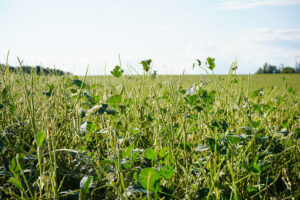
Rieux urges farmers to start scouting. Farmers can start looking for egg masses as soon as the tassels start coming out. She recommends farmers do that every week for a month after tassling and then keep a close eye on their crop to see if they see caterpillars or damage to their crop from late August to mid-September.
“What your scouting at tassling is going to tell you is should I spray or not before the caterpillars hide in the corn ears? Do I have too much that its worth it to spray or I do have a little bit and it’s not going to be economically feasible to do so,” she said.
Rieux also highlighted some prevention practices farmers can take to avoid having to use insecticides. One thing farmers can do is utilize subsidies made for them to hire an agronomist or a technician for certain issues. Another method Rieux encourages is good crop rotation, and biodiversity, in terms of natural predators who will eat the pests.
Another thing when it comes to prevention is trying to have your crop as uniform as possible, like ensuring your crop flower at the same time. Moths prefer fields with uneven tassling when they are looking for a spot to lay their eggs, she explained.
The western bean cutworm is more prone to pick sandy soils than clay ones so if that’s a characteristic of your field it is recommended to scout more in those fields. Lastly, as you are looking to buy corn she advises going for ones that are genetically modified and ones that will have the genes that will protect against the pest. But only if you have the problem, she emphasized.
When asked what was the most fulfilling aspect of the job Rieux laughed and jokingly said what’s fulfilling for her is not always a good thing for the producers. “When we scout and we find nothing in the field, it’s good for the producer. It’s boring for us.”
“What is fulfilling for me is to be out there and to see my clients and their crops and what makes them proud,” said Rieux. “What’s also fulfilling is to have had three summer students that come from the Pontiac work on this these past years and train the agronomist of tomorrow to be aware of that. It makes me proud to see that they’re learning about their area and they’re learning how to help farmers.”
Some resources that people can benefit from are the newsletter, mapaq-rc-mktg.powerappsportals.com/abonnement-RAP/ and their Facebook page www.facebook.com/RAPGrandesCultures.