





Caleb Nickerson
SHAWVILLE July 2, 2017
It is not often that an institution can say it predates the nation it resides in.
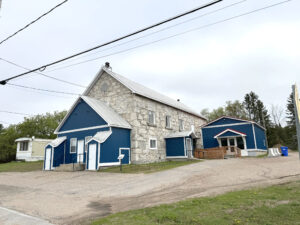
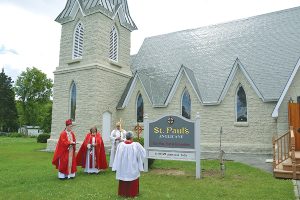
As many local residents were celebrating the 150th anniversary of Confederation, parishioners at St. Paul’s Anglican Church in Shawville gathered to commemorate 175 years in the community.
Many guests and dignitaries were present for the event, including the Primate of the Anglican Church of Canada, Anglican Archbishop Fred Hiltz, Pontiac MP Will Amos, Warden Raymond Durocher, Shawville Mayor Sandra Murray and Chief White Owl of the Pontiac Algonquin Outaouais Tribe, Garry Belair.
Belair was invited by St. Paul’s rector, the Ven. Mavis Brownlee, to perform a ceremony prior to the service.
“We did a special smudging ceremony to be able to have the First Nations emphasis at the ceremony,” he said. “It’s white sage, we light it up and make it smoke up. We use a feather to spread the smoke on all the people that want to be smudged and that purifies their spirit for the Great Spirit to come inside of them.”
Hiltz traveled from Toronto for the service and delivered a moving sermon that touched on the birth of Canada and the strides we have made as a nation over the last century and a half.
“It is significant that the Prime Minister would stand on Parliament Hill on Canada Day and say that it doesn’t matter where you come from or what your religion is or who you love, you are welcome here,” he said. “We have a Prime Minister who acknowledges quite openly the sins of the past with regard to our relationship with the First Nations of this land, declaring that we must be committed in every way to address that legacy and move on in a spirit of reconciliation and respect. He spoke about a country, imagine this, being born again.”
“On an occasion like this, I am very conscious that one of the many freedoms we enjoy in this country is religious freedom. That is the freedom to gather and worship, to confess our faith whatever tradition it may be and to give ourselves to serving the community in the name of whatever God in whom we put our trust,” he continued. “I have said for a long time, when it comes to the gravest issues that face humanity – extreme poverty, oppression, the trafficking of human beings and the degradation of the earth – we must, as people of all faith traditions, join hands because it is when we join hands together and speak up together that we will have a significant impact for good.”
He even regaled the congregation with a few archival tidbits about the journey of Bishop Jacob Mountain to Clarendon in the spring of 1843. The bishop had planned to make the journey by boat, but the engine died and he was forced to travel by horse.
“May 19 he made it up to Clarendon Mills, via a horse supplied, and I quote, ‘by James MacFarlane, a big, dour, Scottish Presbyterian of the strictest sort, who not only offered his horse but sent his several sons around the countryside to tell people of the arrival of the bishop,’” he said. “‘Meanwhile, the axmen who were accompanying the bishop went ahead felling trees, repairing bridges over large creeks and widening the trail for the arrival of the bishop.’”
“Things have changed,” he said, evoking a chuckle from the crowd. “Five days for Bishop Jacob Mountain to get here. It took me five hours.”
He added that the pioneer spirit that drove the early settlers in the Pontiac was the same as the spirits of the apostles Peter and Paul.
Following Hiltz’s message, Scott Judd played a variety of Sunday school tunes, from “Jesus loves me” to “I just want to be a sheep” with a good deal of involvement from the congregation.
After the service, everyone filed out of the church and gathered on the front lawn to witness Hiltz dedicate the church’s new sign. Everyone gathered was invited to a potluck lunch that was served in the parish hall.