






Glen Hartle
Shawville November 15, 2022
On Tuesday, Nov. 5, the Pontiac Archives invited author Nancy Dale Conroy to offer insights into local history via her presentation entitled Shawville at the beginning: The Early Years, 1821-1827.
Conroy leaned heavily here on the research she did for her book From Derry to the Pontiac, where she delved into her family roots in the area and tried to unearth the corresponding origin stories.
She had a keen audience in mostly locals, from Shawville and the broader municipalities of Bristol and Clarendon, salted with a few from further afield, being Orleans, Ottawa and Arnprior. Despite an apparent geographic divide, there was no division on interest in the topic.
Conroy approached the session in an interactive and low-key fashion, starting things off with a short “How well do you know your Clarendon history?” volley touching upon who, where, when and why. This was effective in ensuring all were vested from the start and likely assisted in easing her into the drivers seat for an engaging talk and discussion. While Conroy led things, there was constant audience participation which ended up creating a type of “town-house” familiarity.
The website for the town of Shawville offers that “The earliest history of the Shawville area remains shrouded in the mists of time. The region as a whole was occupied by Algonquin hunting peoples.” Conroy took it from there, using a bit of empirical evidence from her research and a bit of creativity to craft compelling justification for the subtitle of her book: “How the Dales Journeyed to the Canadas and Helped to Found the Village of Shawville, Quebec.”
Conroy led the gathering through the somewhat established lore of the original settlement’s founding by John Dale and Thomas Hodgins, into areas perhaps less well known. She spoke of land grants and surveys, fluidity of land allocations, religious considerations, population numbers and settler skill sets.
On the research front, Conroy credited fellow author Lloyd Armstrong for having written the “only book that explains how Shawville came to be” and then openly mused as to where he could have possibly dug up some of his story, suggesting some of it may border on fiction. “He wrote that they had a wonderful, lovely sailing across the ocean and I’m thinking: I couldn’t find the ship they were on; I couldn’t find out when they left; and I couldn’t find out when they got to Quebec City. I couldn’t find any documentation and he’s saying they had a pleasant journey across the ocean? Where did he get that?” There was irony in that the narrator of her own fact-or-fiction book is her long gone great-great-great-grandmother Elizabeth and extensive creative license was exercised in giving her a voice.
Conroy’s presentation included a list of families considered first settlers of the Shawville area. Surnames of Dale, Hodgins, McDowell, Dagg, Armstrong and Hamilton were familiar to most even though the names of the gathered didn’t quite align. At least not directly, and that’s part of what makes the treasure-hunt of history so compelling. As attendee Barb Haughton suggested, “I love finding all the connections.”
Indeed, most of those gathered offered that they were actively researching their own family stories and how those intersect with that of the community within which we were all seated.
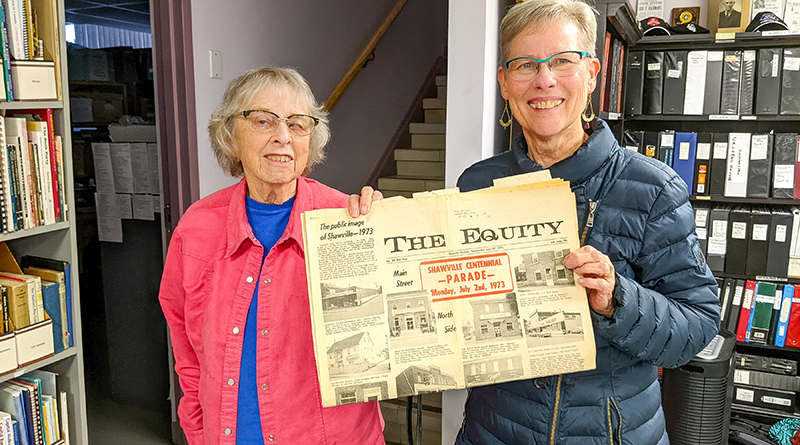
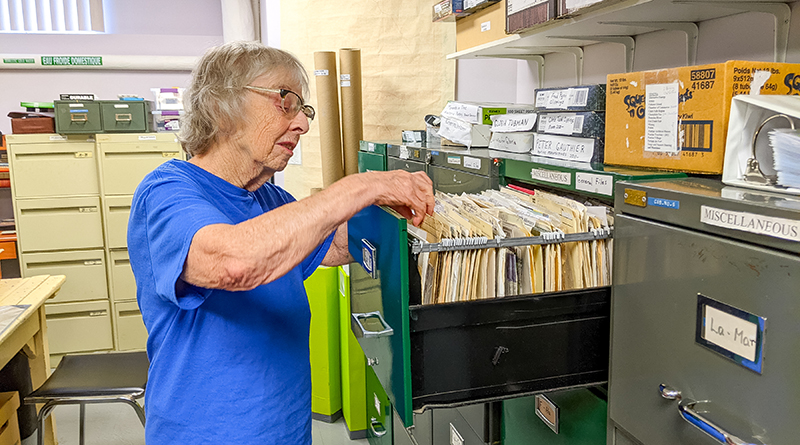
Archive host-historian, Venetia Crawford, herself locally synonymous with all things history-related, was clearly enjoying things. After all, Shawville is noted as the “Historic Hub of the Pontiac” and the Pontiac Archives is essentially her pied-à-terre on Main Street. Entertaining a group of like-minded persons at the heart of it all was an easy decision to make.
There is a certain timeliness to the presentation in that Shawville is soon to celebrate 150 years since its inception as its own municipality and there is likely to be an elevated interest in all things Shawville as a consequence. On that note, the Pontiac Archives is located at 358 Main St., Shawville and is open from Tuesday to Thursday starting at 9 am. “We close at 4, unless we get tired – and then we close earlier” muses Crawford. The phone number is 819-647-7013 and a copy of Conroy’s presentation and book are available.