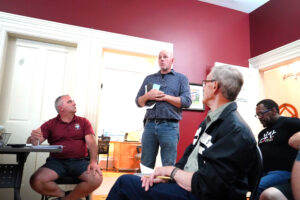






A public forum to raise awareness of the health threat posed by radon, planned for this Saturday in Campbell’s Bay, sounds well worth checking out.
Long-term exposure to high levels of radon can significantly increase the lifetime risk of getting lung cancer. Anywhere you find uranium, you are likely to find radon. And parts of the Pontiac are known to contain uranium.
The event follows last week’s release of a study indicating that the number of homes in Canada with radon levels above what the federal government considers acceptable is twice as high as was previously believed to be the case.
The Evict Radon study published last Thursday says that, on average, one-in-five Canadian homes exceeds the level of 200 Becquerels per cubic meter (200 Bq/m3), double the previous one-in-ten figure that was based on research published in 2012.
Canada considers radon levels acceptable at twice the international standard of 100/Bq/m3 set by the World Health Organization (WHO). If the WHO standard were applied here, many more Canadians would be considered to be living with unacceptably high levels of radon.
According to Health Canada, exposure to radon is the leading cause of lung cancer among non-smokers. A person who has had long-term exposure to high radon levels has a 1-in-20 chance of developing lung cancer. When combined with exposure to cigarette smoke, the risk of developing lung cancer increases to 1-in-3.
Radon gas can enter your home through cracks in the walls or floor of the foundation, or through gaps around service pipes, window casements, floor drains, sumps and other openings. But because radon is invisible and odorless, you can’t see or smell it. The only way to know the level of radon in your home is to test for it.
Testing for radon is fairly easy to do. You can buy a test kit for $50 to $60 at some hardware stores, online or from the Quebec Lung Association (you’ll find a link on the Protection Against Radon section of the MRC Pontiac website).
The test involves placing the radon measurement device on a surface in the lowest lived-in level of your home, leaving it in place during the test period for a minimum of three months, ideally during the cold-weather months when doors and windows are mostly closed, and then mailing it to the lab for analysis.
Your results will be sent to you by mail or email.
If the test shows you have a high radon level in your home, sealing up the cracks in your basement or improving your home’s ventilation may be enough to bring your radon levels down to an acceptable level. Some homes will require the installation of a system to capture radon gas under the foundation slab and vent it outdoors.
Saturday’s event is being convened by Judith Spence, spokesperson of Citizens of the Pontiac, the same group that held a very well-attended public information session on the incinerator issue in March. The radon forum is being produced in collaboration with the CISSS de l’Outaouais and MRC Pontiac.
The Radon Awareness Public Forum will be held at the RA Centre in Campbell’s Bay from 1 to 3 p.m. this Saturday, and admission is free.