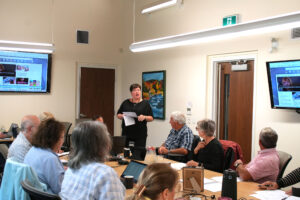



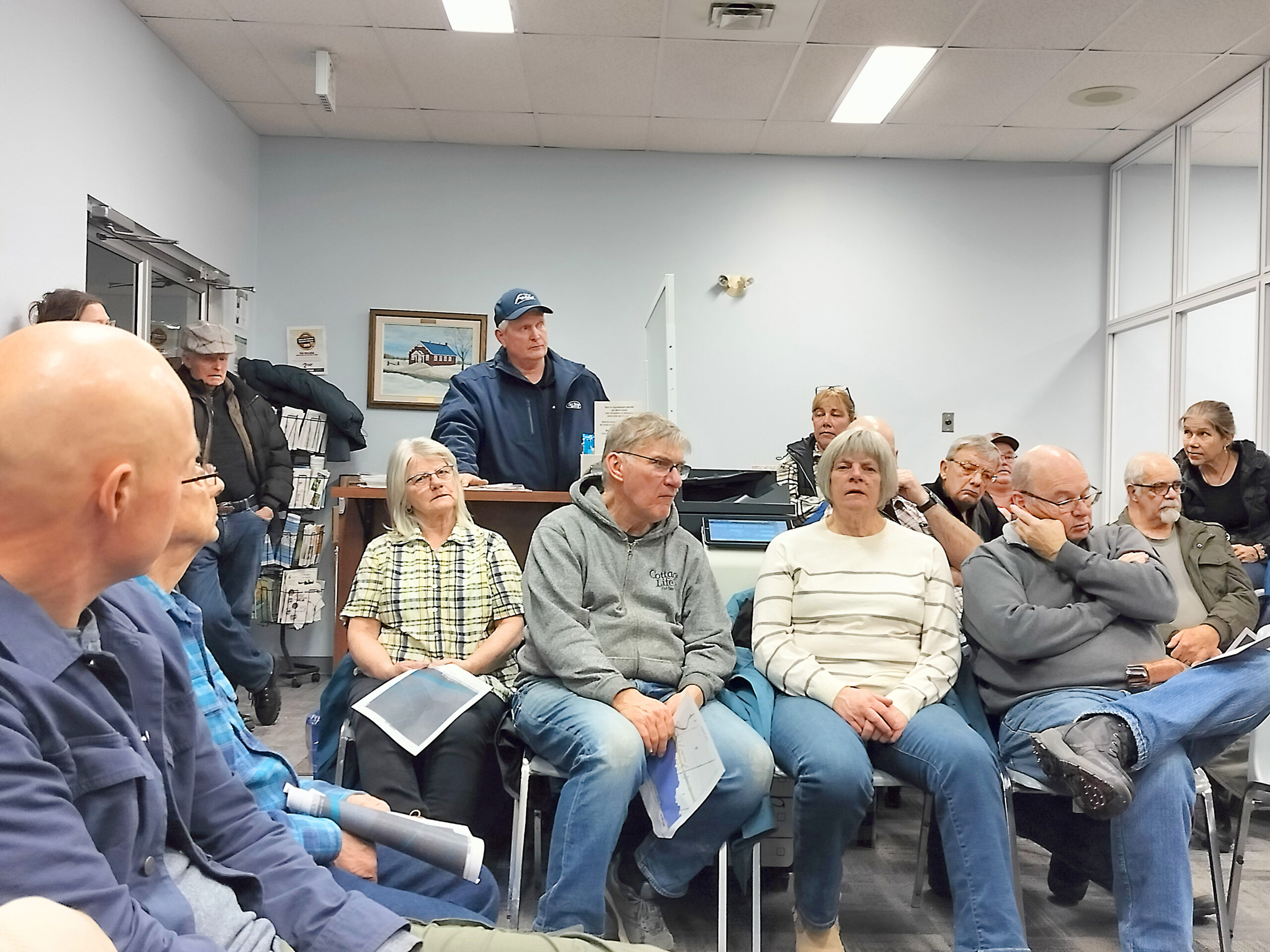



Bristol residents concerned about the future of a large municipal property in Pontiac Station filled Bristol’s town hall at the Feb. 2 council meeting to make their opinions heard.
In the fall of 2025, Bristol council received an offer of purchase from the Nature Conservancy of Canada (NCC) for a 95-hectare piece of land near chemin de Pontiac Station. The lot has been owned by Bristol since 1994, but the municipality has not done much with the land aside from some minor logging activities.
Since late January, Bristol councillor Greg Graham has been urging council to refuse the offer in the hopes of someday creating a park. Graham cited the beach access and historical and potential archaeological value of the land as reasons why the municipality should keep the land.
Some members of the packed crowd at Monday’s meeting agreed with Graham’s appraisal. One woman was concerned for the future of recreation for the next generations of the community, and felt that the municipality would be in the best position to ensure access to the land.
“If it’s not costing, I think we should take time in my opinion,” she said.
Others welcomed the possibility of the NCC managing the land, adding that people in the community already use NCC-owned lots in Bristol for recreational purposes such as hiking, snowshoeing and birdwatching.
“The NCC have been very good stewards of that land. They have been very responsive with any concerns respecting the use of their lands,” said resident Cathy Collins. “Where is the stewardship of the land better placed? Could the municipality do as good a job as the NCC would do with that land, while keeping it open for public use?”
Some in attendance were concerned the municipality would use the land for development, but Graham responded that is not the council’s intention. Much of the lot is designated wetland, and the municipality is still awaiting new flood maps and wetland maps.
“Development [ . . . ] was not in the plan of Bristol, and at this point I think I can safely speak for everyone to say that that hasn’t been discussed or contemplated,” Graham said.
He said if there was to be some sort of historical or archaeological site on the property, the NCC would not allow the construction of even a simple structure.
Bristol mayor Valerie Twolan-Graham said the meeting was productive and that the council will take the feedback under consideration. She said the council only just sat down with the NCC earlier on Monday night to look at the offer of purchase, and council members had the chance to ask their own questions about the offer.
“It was just a chance for us to look in an organized way all together at this offer, and it didn’t even get into the fine print of the offer. It really had to do with why the NCC would be interested in the land and why councillors might be interested in Bristol not selling the land,” said Twolan-Graham.
She added that the NCC representative could return at a future date to give a more in-depth presentation and discuss the offer in more detail. But first, she said her council must figure out what its priorities are for the property. She said some concerns the council has is the access that residents will still have to do things such as hunt, snowmobile, walk and other things.
“We have an opportunity to negotiate [ . . . ] can we do this? And [would] the NCC still find the property attractive and be interested in it?”
Graham said he remains unconvinced council should sell the lot. He said while the NCC is an admirable conservation organization, he feels that Bristol can better ensure that residents get to enjoy the land.
“We’re in a far better place to balance public enjoyment with conservation,” he said.
Twolan-Graham said that the council does not feel pressed to make a decision, but added that the NCC representative told them the project funding could be withdrawn for another project.
“We’re going to make a decision in a way where I think all sides are considered and a public forum is held, but I don’t think we have a long period of time,” she said.
“I think there’s just a belief that we need to consider this carefully and that we want to make sure that future generations can use this piece of property.”
Des résidents de Bristol préoccupés par l’avenir d’une grande propriété municipale à Pontiac Station ont rempli l’hôtel de ville de Bristol lors de la réunion du conseil municipal du 2 février pour faire entendre leurs opinions.
À l’automne 2025, le conseil de Bristol a reçu une offre d’achat de Conservation de la nature Canada (CNC) pour un terrain de 95 hectares près du chemin de Pontiac Station. Le lot est la propriété de Bristol depuis 1994, mais la municipalité n’a pas fait grand-chose avec le terrain, mis à part quelques activités d’exploitation forestière mineures.
Depuis la fin janvier, le conseiller de Bristol, Greg Graham, exhorte le conseil à refuser l’offre dans l’espoir de créer un jour un parc. M. Graham a cité l’accès à la plage, ainsi que la valeur historique et archéologique potentielle du terrain comme raisons pour lesquelles la municipalité devrait conserver le terrain.
Certains membres de la foule nombreuse présente à la réunion de lundi étaient d’accord avec l’évaluation de M. Graham. Une femme s’est dite préoccupée par l’avenir des loisirs pour les prochaines générations de la communauté et a estimé que la municipalité serait la mieux placée pour assurer l’accès au terrain.
« Si ça ne coûte rien, je pense que nous devrions prendre notre temps, à mon avis », a-t-elle dit.
D’autres ont salué la possibilité que la CNC gère le terrain, ajoutant que les gens de la communauté utilisent déjà des lots appartenant à la CNC à Bristol à des fins récréatives telles que la randonnée, la raquette et l’observation des oiseaux.
« La CNC a été une très bonne gestionnaire de ce terrain. Elle s’est montrée très réactive à toute préoccupation concernant l’utilisation de ses terres », a déclaré la résidente Cathy Collins. « Où la gestion du terrain est-elle le mieux placée ? La municipalité pourrait-elle faire un aussi bon travail que la CNC avec ce terrain, tout en le gardant ouvert à l’usage public ? »
Certains des participants craignaient que la municipalité n’utilise le terrain pour le développement, mais M. Graham a répondu que ce n’était pas l’intention du conseil. Une grande partie du lot est désignée comme zone humide, et la municipalité attend toujours de nouvelles cartes des zones inondables et des zones humides.
« Le développement [ . . . ] n’était pas dans le plan de Bristol, et à ce stade, je pense pouvoir parler en toute sécurité au nom de tous pour dire que cela n’a pas été discuté ou envisagé », a déclaré M. Graham.
Il a dit que s’il devait y avoir une sorte de site historique ou archéologique sur la propriété, la CNC n’autoriserait pas la construction, même d’une simple structure.
La mairesse de Bristol, Valerie Twolan-Graham, a déclaré que la réunion était productive et que le conseil prendrait les commentaires en considération. Elle a dit que le conseil venait tout juste de s’asseoir avec la CNC plus tôt lundi soir pour examiner l’offre d’achat, et les membres du conseil ont eu la chance de poser leurs propres questions sur l’offre.
« C’était juste une chance pour nous d’examiner de manière organisée, tous ensemble, cette offre, et ça n’a même pas abordé les petits caractères de l’offre. Il s’agissait vraiment de savoir pourquoi la CNC serait intéressée par le terrain et pourquoi les conseillers pourraient être intéressés à ce que Bristol ne vende pas le terrain », a déclaré Mme Twolan-Graham.
Elle a ajouté que le représentant de la CNC pourrait revenir à une date ultérieure pour donner une présentation plus approfondie et discuter de l’offre plus en détail. Mais d’abord, elle a dit que son conseil devait déterminer ses priorités pour la propriété. Elle a dit que l’une des préoccupations du conseil est l’accès que les résidents auront toujours pour faire des choses telles que la chasse, la motoneige, la marche et d’autres activités.
« Nous avons l’occasion de négocier [ . . . ] pouvons-nous le faire ? Et [la] CNC trouverait-elle toujours la propriété attrayante et y serait-elle intéressée ? »
M. Graham a déclaré qu’il n’était toujours pas convaincu que le conseil devrait vendre le lot. Il a dit que, bien que la CNC soit une organisation de conservation admirable, il estime que Bristol peut mieux veiller à ce que les résidents profitent du terrain.
« Nous sommes beaucoup mieux placés pour équilibrer le plaisir du public avec la conservation », a-t-il dit.
Mme Twolan-Graham a déclaré que le conseil ne se sentait pas pressé de prendre une décision, mais a ajouté que le représentant de la CNC leur avait dit que le financement du projet pourrait être retiré pour un autre projet.
« Nous allons prendre une décision de manière à ce que, je pense, toutes les parties soient prises en compte et qu’un forum public soit organisé, mais je ne pense pas que nous ayons une longue période de temps », a-t-elle dit.
« Je pense qu’il y a simplement la conviction que nous devons examiner cela attentivement et que nous voulons nous assurer que les générations futures pourront utiliser cette propriété. »