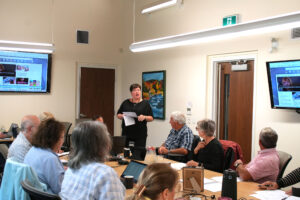







The SADC Pontiac hosted a tech summit at Bristol’s Pine Lodge on Friday to help local entrepreneurs understand how they can use technology to help their businesses.
The keynote address in the morning focused on how entrepreneurs can use technology to shift from merely working in their business to working on their business, while a talk by Stephane Pharand discussed cybersecurity, giving business owners advice on how to protect their customers’ data, as well as their own.
After lunch, Jon Stewart of Calumet Media spoke about the use of artificial intelligence in business, and how it can help automate and fast-track tasks and processes.
To finish the day there was a panel featuring four local businesspeople who have adopted technology as part of their business model. SADC business advisor Amy Taylor, who also moderated the panel, said the idea was to give business owners an idea of how other Pontiac businesses have incorporated technology into their business models.
“What people are saying is that they really enjoy hearing from their neighbours, and people they can approach and ask questions to,” Taylor said.
Pine Lodge owner Adam Thompson spoke about the restaurant sales system the owners installed in 2012, which helped reduce mistakes and improve the customers’ experience. He said the business’ implementation of various technological systems has also helped to reduce other mundane tasks such as checking campground meters or processing T4 tax forms at the end of the fiscal year.
“Something that used to take a day, now takes five minutes and lets us do other things that make money, ideally,” he said.
Kristine Amyotte Beck of Beck Family Farms spoke about how the farm’s new voluntary milking system for its dairy cows improved their ability to monitor the health of her cattle even when she is not on-site at the farm.
“I can go on and see who’s not feeling well, and I can see that somebody has already medicated her, somebody has already treated her,” she said, adding that the automation of tasks has freed up her staff to do other things.
“It’s just taken away a lot of tasks that are admin-oriented to allow us to focus other places.”
She also said technology has helped save time every two weeks for payroll, when she used to manually add up her workers’ hours.
“The starting point was people literally keeping notes on their phones and sending me screenshots, and I’m sitting there adding up these hours,” she said, adding she was thinking to herself there has to be a better way.
Now, the farm has a geo-fence that starts an employee’s time clock when they drive into the yard, and stops the clock when they drive out.
“[The employees] don’t have to do anything. At the end of the pay period, I go onto the timesheets, it’s become a 15-minute job.”
Jared Hamilton, co-owner of Mountainview Turf in Quyon, started to implement technology on a bigger scale when he and his sister officially took over the business from their parents in 2020, and said technology can help make the entire experience smoother, for staff and customers.
He said in previous years when a customer placed an order he would manually add it to a cutting list.
“Everything was written in by hand,” he said, adding that they implemented a software to manage the task, from the cutting of the sod to its delivery at the customer’s door.
“That was then digitized onto an online software [ . . . ] every client that you took, every phone call, was now permanently tracked.”
He said even their delivery drivers have the information on an app, which alerts the customer when the driver is on their way and gives them an estimated arrival time. Then, when the delivery is dropped off, the invoice is automatically generated and emailed to the customer.
“That’s a lot of work to set that up, but it was definitely the cornerstone of setting up our automation and systems,” he said.
Hamilton said the change over to using technology was “painful,” especially for those people who might resist technology, but he told the crowd that initial pain will be worth the time investment in the end.
“Every time we have made an advancement technologically, it has taken longer than I have wanted to, it cost more than I wanted it to, and anytime I tried to delegate it hasn’t worked exactly,” he said.
“It’s going to take more of your time than you wanted it to, and I can tell you the technology you pick isn’t going to work the first time. It’s going to get a lot harder and worse before it gets better, but then three or four years later it’s going to be better than you ever expected it to be,” he said, adding he is now able to laugh with his team about how they used to do things.
“You have to wade through those waters,” he said of the initial growing pains, “but don’t think it’s going to be easy.”