






CALEB NICKERSON
CAMPBELL’S BAY
Aug. 15, 2018
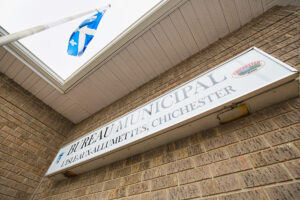
The MRC Pontiac received a warning from the Office québécois de la langue française due to a plaque on a historic monument inscribed only in English.
The monument in question was unveiled in its new location in front of the MRC offices by Warden Jane Toller in December of 2017, to mark Pontiac Council’s 170th anniversary. The monument – a sizable stone sitting on a concrete slab with a metal plaque bolted to its face – was created in 1947 to mark the 100th anniversary of Pontiac county council’s first sitting on Dec. 13, 1847.
MRC Pontiac Director General Bernard Roy said that the representative from the language office gave the warning about two weeks ago.
“He said he came because … someone made a complaint to the organization,” Roy said. “He said we have to communicate in both languages.”
The plaque was taken down shortly after, and as of print, the stone remains bare. According to Quebec’s Charter of the French Language, the MRC falls under section 29.1, which makes allowances for public organizations that deal with large minority language groups. One of the Charter’s stipulations is that bilingual signage must display French predominantly.
Roy said that he’s not sure when the bilingual replacement plaque will arrive, but added that it will include the location of the original meeting, which was held at the home of Samuel Morehead along Hwy. 148.
“We said we’d do it in both languages,” he said. “To remove the old one is a sign that we will do this in the near future.”
Though the sign has only just been removed, the MRC was aware that the English plaque violated their Charter obligations when they installed the monument. An MRC press release announcing the unveiling ceremony, dated Dec. 8, 2017, noted that a French plaque would be installed in the “near future.”
When asked why it had taken over eight months to translate and install the plaque, Roy said that the file had been on the desk of former Strategic Communications Advisor Danielle Belec, who retired earlier this year.
He noted that the Office québécois de la langue française had not given the MRC a date by which they had to complete the change, only a warning.
The original plaque will be kept in the MRC, though Roy wasn’t sure how it would be displayed.
“It’s a historical plaque,” he said. “I don’t know how we’ll use it inside.”