




CALEB NICKERSON
GRAND CALUMET ISLAND
Sept. 5, 2019
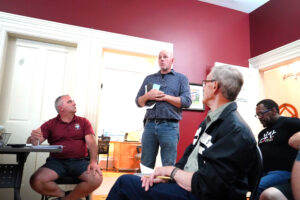
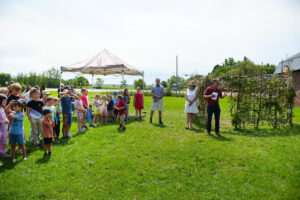
On Thursday members of the MRC’s national park committee gave local officials and the press a tour of . . .
the property they hope to augment with suspension bridges and ATV trails.
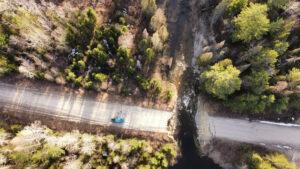
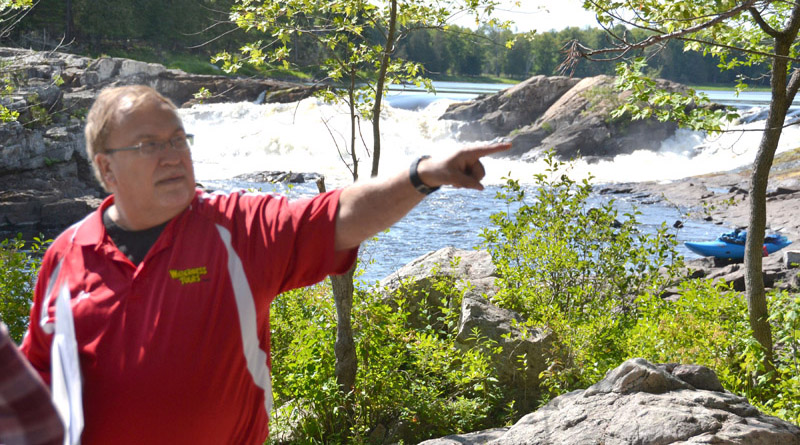
Led by Wilderness Tours owner Joe Kowalski, the tour first took the participants down to Garvin’ s Chute, a set of rapids on the middle channel (between French Island and Calumet Island). The group of islands that sit on the west coast of Grand Calumet Island (French, Lafontaine and Green) are collectively known as the Lafontaine Islands.
Pontiac MP Will Amos, Warden Jane Toller and Vern Barr of the Kitchissippi Indigenous Association were some of those invited on the tour, along with Alastair Baird of the Ottawa Valley Tourist Association and MRC Tourism Marketing officer Chantal Lair.
The plan to develop the property dates back to the 1980s, when the Native Alliance, a non-profit for Metis and non-status Indigenous people, managed the property. According to the front page of the April 30, 1986 edition of The Equity, the project received $90,000 to complete a feasibility study, with an additional $10,000 from the Alliance. Kowalski said that he had pitched an earlier version of the project to a crowd of about 300 people in Bryson around that time, but couldn’t generate enough enthusiasm.
The islands are currently owned by the Quebec government and managed by the MRC.
The islands have trails along their periphery, but the committee envisions six wire suspension bridges, capable of supporting ATVs criss-crossing the various channels. They are currently planning to seek provincial park status from the Société des établissements de plein air du Quebec (SEPAQ).
Kowalski began by explaining that the river is the crown jewel that the region has to offer, as the Ottawa is very warm and has some incredible rapids. He said that he got the idea to start buying up land around the islands, both in Quebec and Ontario after a trip down the Trent-Severn Waterway, where he was struck by all the development along the waterfront.
He currently owns 6,000 acres of key waterfront property around the islands.
When he began to discuss the potential for the Pontiac region, he misstated the population, claiming it had dropped from approximately 14,000 to 11,000. When corrected by Toller, that the currently population of the MRC is actually around 14,000 people, Kowalski doubled down with a second falsehood.
“Oh,then since I subscribe to both The Equity and The [Pontiac] Journal, they’re reporting the wrong numbers,” he said.
According to Stats Canada, MRC Pontiac had a population of 14,251 people in 2016, down from 14,358 in 2011.
The park committee was first announced and presented their proposal to the public at the Campbell’s Bay RA in November 2018, and in the meantime they have applied for more than $400,000 in federal grant money, from the Canadian Experiences Fund, a program by Innovation, Science and Economic Development Canada.
MRC engineer and committee member Kim Lesage explained that she put the proposal together with Lair, asking for $250,000 for a ecological study, $100,000 for a site development plan and $60,000 for a public consultation. She said they applied in June and are still awaiting a response.
Amos peppered the committee and Kowalski with questions about the project, like why Quebec officials would support a park that is primarily accessible from Ontario. The primary road to access the rapids from the Quebec side crosses Kowalski’s land and is very rough and steep. On the Ontario side, the paths to the shore are far more developed, and the province recently announced that it would be extending the four-lane section of Hwy. 17 to Storyland Road in the coming years.
“I don’t see why Quebec would want to be racing forward with financing tourism going to the other side of the river, which largely would not trickle into the Pontiac,” Amos said, acknowledging that he was merely speculating about the provincial decision-making process. “I think they would be wanting to know, how would the tourists be flowing through Pontiac?”
He also questioned whether they had an estimate for how much it would cost to improve access from Calumet Island.
Kowalski said that tourists would primarily be coming from Ontario, as it is currently better developed, but said that parking revenues could be put toward developing the Calumet side. He added that he would raise the money to build the infrastructure, but only once they secured park status.
“This could be done with no government money,” he said.”When I started this thing I didn’t anticipate any government money at all. That’s why it’s so easy to do, we don’t have to ask anyone for money … I’m sure that if Quebec would commit to establishing a Parc National on those islands, I could raise the money to build the bridges.”
“It doesn’t matter as long as you are getting a share of the tourism dollar,” he continued. “It shouldn’t matter if people drop in from the sky, as long as the money is shared equally.”
At the meeting in November, Calumet resident John Wootton gave some insight on the process of getting accredited by SEPAQ, a long and arduous process.
Amos echoed these sentiments, questioning whether the committee had thought about seeking regional park status, or other alternatives to a SEPAQ certification.
“I do know that the SEPAQ process is slow because there are a lot of different proposals that have been in line for many years,” he said. “Has the MRC or the municipality contemplated alternative options around the establishment of a regional park, for example, which could benefit from provincial funding?”
Calumet Island Mayor and committee member Serge Newberry said that their scope is bigger.
“We realized we needed more money than would be available for regional parks,” he said.
Kowalski explained that the designation is important because it would draw English-speaking visitors.
“While it’s a Parc National to Quebecers, it’s a national park to the rest of the English-speaking world,” he explained. “National parks have soft spots in everybody’s psyche. People want to visit national parks.”