





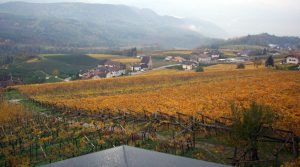
Sinn family’s bio-certified vineyard near Bolzano, Italy. The Dolomites are visible in the background.
Pontiac farmer and agriculture advocate David Gillespie recently returned to the Pontiac after nearly two weeks in Italy, where he toured local farms and gave a presentation at an international agritourism conference.
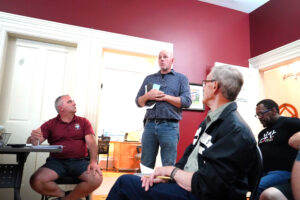
Nestled in the mountains in the top end of the boot, Bolzano is the home of Eurac, a private research facility that studies a wide range of topics. The facility hosted the First World Congress on Agritourism from Nov. 7-9, bringing together researchers and stakeholders from 42 countries to discuss the issue.
“I spoke about the CANAMEX trail,” Gillespie explained. “There were a lot of PhDs there, and I’m not a PhD, I’m just a farmer so it was a little intimidating but in the end I could pull my weight as much as anyone else.”
CANAMEX is a proposed argritourism trail stretching across two U.S. states – New York and Vermont – as well as Quebec and Ontario. Also representing CANAMEX at the conference was Linda Chase, a researcher from the University of Vermont, who presented alongside Gillespie.
He said that many of the questions following their discussion focused on issues like bio-security (protecting farms from pests and disease), as well as border issues with the United States.
“The chair of the whole conference, [Thomas Streifeneder of Eurac’s Institute for Regional Development] came to my presentation with Lisa. He was very curious about our trail system because he knew it was going to be one of the world’s longest,” said Gillespie. “It was nice to see him there. He said it was really engaging.”
He said after an initial session to kick off the conference, the group was divided into multiple sessions that took place concurrently.
“It was very, very intense,” he said. “There was no break till two in the afternoon and then we were finished at, I don’t know, 7:30. They really expect you to pack it in.”
The sheer number of countries and climates represented around the table meant that the topics discussed were incredibly diverse. One moment that stood out for Gillespie was during session when a map of farms by country was displayed. Apparently, Canadian authorities hadn’t submitted data to the researchers, which irked Gillespie and made him vow to uncover the information when he returned.
“I told the director that they will get [the stats],” he said. “I need to get a hold of the government to see what’s going on.”
Gillespie said the next step for CANAMEX will be making contacts with the newly elected provincial governments, as well as meeting with the trail’s committee to discuss specific issues, like border and farm security.
Following the conference, Gillespie spent the remaining time touring local farm operations in the mountains around Bolzano. He said that one of the main differences between farming in Italy and Canada is the use of space.
“The villages are very close to each other … the farms are very small and they’re competing with the population,” he said, noting that the going price for land is €25 per square metre. “It works out to $151,000 CDN per acre, or $373,000 CDN per hectare.”
The high overhead costs mean that many farmers opt for operations like orchards or vineyards, which produce more revenue per acre.
“At that price, every square metre of land is taken care of and we’re talking really steep terrain, like up to 50 degree slopes,” Gillespie said. “They’re farming on [mountains] and most of it isn’t terraced, it’s really steep slopes. I wouldn’t dare drive a tractor up them.”
Another trait that differentiates the area from the North American farming is the strong emphasis on tourism to bolster their income. In that region, roughly 2,800 farms out of 20,000 practice some form of agritourism.
Gillespie said that many farms he visited had excellent accommodations, home cooking and hosts that could converse in English. He said he interviewed many of the owners about both the agriculture and tourism aspects of their operations.
“The revenues from tourism [can be] very substantial,” he said, adding that he might put together a presentation for locals who are interested in the information he gleaned from his travels. “People come from all over Europe. One [farm] even had people come from China for the first time this year.”
Gillespie said he hopes that a project like CANAMEX will encourage some of the practices he saw in Europe to take root in North America.
“If they’re doing this, why can’t we?” he said.
by Caleb Nickerson