





Something smells
Dear Editor,
As a former land owner and developer in the Pontiac at Clarendon Point, I have one question to ask regarding the ‘proposed’ road ruining and smoke emitting garbage Incinerator, planned for the MRC.
That ONE question is: what areas of location and near what villages are the Incinerator sites being considered, and do the neighbors, or anyone, know?
I was thinking of working on a new development plan in the Pontiac and I want to make sure I am miles, I mean kilometres, away from that damn climate and land monstrosity.
It will drive the land, cottage and home prices into the contaminated ground in that area for decades to come.
There now, I have had my ‘five minutes’.
Something smells…literally.
Mick Armitage, Ottawa
Pontiac needs industry
Dear Editor,
On October 31st 2008, it was announced that Smurfit Stone Mill at Portage would close. 300 people lost their jobs. This caused a domino effect and we lost many other mills, related businesses, restaurants and retail that were supported by these employed people. A promise was made by the provincial government that tourism would replace forestry. Gradually we are seeing tourism grow. This makes us a destination for wilderness experiences, adventure, eco and agritourism. This is great with spin-off benefits but to be truly sustainable and to grow our population we need new industry which offers permanence with good pay to local residents.
Revitalizing the Pontiac to attract new residents is important but we also need to improve the quality of life for the families who are here now.
Today we have many residents that need to travel each month to Alberta, the Northwest Territories and Northern Quebec so that they can feed their families and pay their mortgages in the Pontiac. The people of the Pontiac have always had the reputation for being the best workers especially with forestry, heavy machinery, construction, the trades and mining.
With respect to the energy from waste (EFW) proposal, many people have contacted me with their support saying that “more than anything, Pontiac needs industry.” These people are long-time residents who remember the heavy industrial boom times of the Pontiac.
Some other people have concerns about the potential number of trucks carrying waste from Ontario and Quebec to Pontiac or are concerned about the content of emissions.
Let’s compare to our former industry where Monday to Friday the Portage mill received daily 90 round wood trucks, 60 wood-chip trucks and six chemical trucks. The trucks were at least 53 feet long and crossed at the Chenaux Dam as 50 per cent of the wood was coming from Ontario. It was from the Renfrew County mills as well as private and crown land from Mattawa. The AFA were sending trucks from Algonquin Park. The other 50 per cent came from Quebec where Highway 148 and Highway 301 were heavily used from Vallee de la Gatineau, Laurentides and Mont Laurier. The Smurfit-Stone mill had emissions that had a smell of a pulp and paper business. At the time the people in the Pontiac were proud of this industry.
In comparison, the EFW facility will have approximately 35 trucks per day total.
The emissions from the EFW facility will have no odour and the steam that is emitted is 99.9 per cent pure to the air. The product produced is electricity which Quebec and especially the Pontiac will always need.
As we look to Pontiac’s future it is my hope that we can work together with an open mind to investigate every opportunity so that we can attract new industry and also ensure that it is good for the well-being of our residents to help us once again be an economically successful region.
Jane Toller, Warden MRC Pontiac
Celebration of the Dumoine River
Dear Editor,
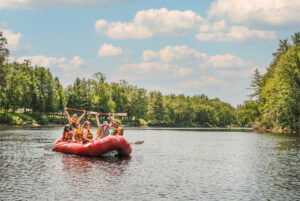
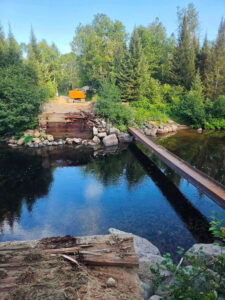
At the western border of the Pontiac riding, the Dumoine River flows south into the Ottawa River. On August 27, I had the privilege of paddling down the river, with the help of an experienced canoe guide, joining one of three brigades including a total of 22 canoes and two kayaks.
This remarkable event was coordinated by Wally Schaber, an expert on the Dumoine, author and founder of Friends of the Dumoine. It was part of a celebration of the opening of the new Tote Road Trail.
The trail, historically an important portage route for First Nation peoples, also became an important access route for loggers working on the river. With many volunteers, experts and some of the region’s most experienced guides, the day was an unforgettable experience.
As my first visit to the Dumoine, the approximately 15 km paddle from Lac Robinson to the Ottawa River revealed incredible landscapes, free flowing rapids, extensive forests, and spectacular rock cliffs.
On August 30, the Quebec government announced 11 new protected territories in the province including 332.2 square kilometres within the Dumoine watershed, as well as 852.6 square kilometres within Noire and Coulonge River watersheds (referred to as “Three Sisters”). This is an important step in protecting these diverse habitats and ecological corridors. ZEC Dumoine and the Canadian Parks and Wilderness Society (CPAWS) have also been important partners in working to protect these rivers and restore the Tote Road Trail.
ArtPontiac and CPAWS are also celebrating the Dumoine River with an exhibit at the Stone School Gallery (Portage du Fort) including more than 50 artworks created during a residency along the Dumoine River.
Jennifer Haughton, Shawville
About the Fair
Dear Editor,
Much has been said about the Shawville Fair; here are a few points you may have missed.
Being associated with the Pontiac Museum, I had opportunity to observe the summer-long preparations that were done all over the grounds – cleaning, painting, installing new paddock areas, etc.
That made for a Fair that came together and then apart very efficiently. The organizers are to be congratulated on a job exceptionally well-done.
The bands were all very good, but the bass was over-amped to such a degree that I couldn’t listen on the fairgrounds, and found it more enjoyable listening from half a block away. Mind you, I’m a singer-guitar player in a rock band, so I’m not at all allergic to loud music, and I’m not alone in my assessment of the over-loaded bass. I’d like to have had a better look at the performers, but listening to them at a distance was alright.
There was no facility for separating food waste, cans and paper or plastic; I found that troubling at first, then I just had to relax and tell myself that it’s just one week, and then we can all be more careful with putting leftovers where they belong. The post-Fair cleanup was surprisingly quick and thorough.
Bigger isn’t always better, but this year’s Fair was both.
Robert Wills, Shawville and Thorne