




CALEB NICKERSON
SHAWVILLE July 25, 2018
On July 25, a local historian launched his new book on the founder of Quyon, entitled, John Egan: Pine & Politics in Ottawa Valley at the Shawville Community Lodge.
Michael McBane is a Quyon native and expert on John Egan, a lumber baron and politician who lived in the Ottawa Valley during the early 1800s.
“I knew he was an important local figure, had founded Quyon and played an important role in Pontiac history,” McBane said, explaining why he chose to study Egan in particular. “There was so little written about him that I thought, ‘Well, I’m going to see what I can find and see if I can write something about him.’’’
In addition to founding Quyon and Eganville, Egan was a dominant force in the local lumber trade and was a strong voice for the Ottawa Valley in Parliament. An immigrant from Ireland, he arrived in Canada in 1830. By 1841, he was elected Warden for the District of Sydenham (Ottawa County).
McBane combed through records at Archives Canada, including correspondence between Egan and his peers, as well as newspaper clippings and legislative records.
“He would write letters to Ruggles Wright as his business partner and the Wrights kept everything,” he said. “So those are one of the only sources of Egan’s letters.”
It was only after months and months of sifting through patchy records that McBane thought he would have something people might actually want to read.
“It took several years of research before I realized that I had enough material,” he said. “I didn’t know I had a book at first. I said to my wife Joanne, I put out a source book, which is a collection of documents. She said, ‘Well, that’s not interesting, people aren’t going to read it. Turn it into a story and they’ll read it.’ That’s when I realized that I had a story here.”
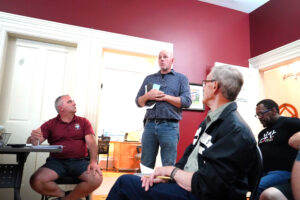
McBane read several passages from the book to give the audience a sense of who Egan was and what he stood for. He chose an anecdote near the end of Egan’s career and public life, when his lumber business was on the rocks and he was sailing back and forth to England to parlay with bankers.
“His health was starting to fail, so he said, ‘Look, I can’t continue as your political representative.’ Well 600 free voters signed a petition that was published in the Ottawa Citizen,” McBane said. “It’s an interesting list, because if you look at the names on that list, many people here would have ancestors on that list.”
“This one petition is evidence of Egan’s coalition because of how diverse it is. He did not appeal to one ethnicity or region,” he continued. “Egan served his constituants in the Ottawa Valley, and he also contributed to the emergence of a liberal democratic society in Canada, in an era when all politics was sectarian, particularly among Irish immigrants. Egan had no tolerance for any kind of bigotry.”
Though Egan died a decade before Confederation, he was a key player in the coutry’s formation, and McBane asserts that he embodied a lot of the traits we value in our political system.
“He contributed to the building of a liberal democracy in Canada that came to be articulated as peace, order and good government,” he said. “Most citizens today take for granted the social achievement that our political institutions represent. The passion and compassion of this generous Irishman, made his adopted country a better place.”