






It was on a sunny Friday afternoon that I decided to take a trip to the Pontiac Historical Museum.
Growing up I was always a bit of a history nerd, though I tended to focus on the parts that seemed interesting to a young boy, namely WWI and II.
Having moved here just under a year ago, I was vaguely aware that there was a museum in Shawville, similar to how I was aware of the fire hydrant outside my apartment building. Footnotes in the annals of my brain.
“Ah, yes, the old red thing in the front lawn, it’s for fighting fires or something right?”
“Ah yes, the old red building in the corner of the fairgrounds, it’s a museum or something right?”
I set out from the office mostly devoid of expectation, but with the intent of learning something new about the community I have come to inhabit.
When I arrived, I was greeted by two high school age girls, Rebecca Kelly and Makayla Kluke. They were summer hires and had begun working at the museum just a week earlier.
It appeared that my arrival had interrupted a jam session of theirs on an old piano in the corner, so I kept my interrogation as brief as possible and sought out their boss, Chris Seifried.
I found him outside in his car, presumably enjoying his lunch break. I have impeccable timing.
Seifried has served as president of the Pontiac Historical Society for the past six years and has a background in heritage work.
“I worked most of my life at the National Archives of Canada,” he said. “So I had a lot of experience with historical collections.”
He added that he also has experience in government operations, which allowed the Historical Society to seek out grants.
“We’re trying to keep the place young by applying for these grants every summer. We apply for two grants, one from Canada Summer Jobs and the other from Young Canada Works,” he explained. “We’ve been doing this for about five or six years now and it’s great because we’re able to give a chance for young, local kids to get some experience in a field of work that isn’t all that common in the Pontiac.”
I thought back to my own summer job in high school, grinding points onto countless metal croquet wickets in a sweltering shed. I felt a twinge of envy, but it soon passed.
“Thanks to the students, we can keep the place looking pretty good. Every year we do a really thorough cleaning after the winter is over and we try to refresh the exhibits and keep them interesting,” Seifried continued. “We have our opening on Canada Day and we have a lot of visitors on Canada Day. During the week it’s kind of slow and steady, on the weekends it picks up a bit … at the Shawville Fair it just explodes and we get hundreds and hundreds of visitors.”
Given my aversion to crowds, it seems I picked an opportune time. Seifried started my tour off with an explanation of how the museum came to be.
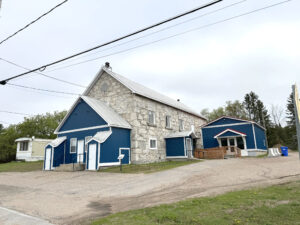
The building itself is an old railway station from the days of yore. Back in the 1880s, the Pontiac Pacific Junction Railway was constructed as an alternative to river travel and ran the extent of the Pontiac, ending in Waltham. When the passenger line closed in the late 1960s, the building was boarded up and was eventually sold off in the spring of 1972.
“When the rail service was discontinued, the CPR wanted to get rid of it. Back then they would just sell these things to people for a few dollars to somebody that wanted the scrap lumber,” he said. “They had already arranged to sell it to someone that was going to demolish it and a number of citizens, including Mayfred Dodds, who was one of the founders of the Pontiac Historical Society, said ‘Oh no, it’s an important landmark for the town.’”
A coalition of young people was formed and along with help from the Rotary Club, they purchased the old station. In 1974, they donated it to the Pontiac Agricultural Society and a year later the building was moved a few blocks down from Centre Street to its current resting place on Lake St., tucked away in a corner of the Fairgrounds.
Former Prime Minister John Diefenbaker was the guest of honour at the grand opening of the museum on Oct. 9, 1976.
“Apparently that day there was a huge turnout to see the ribbon cutting,” Seifried said. “They came for the opening and they got the biggest thunderstorm in history, just when the cutting ceremony was supposed to happen. This building filled up with about 200 people.”
I struggle to imagine fitting more than 50 people in the building, let alone 200.
The museum is divided into sections, focusing on different eras of the region, starting from Champlain’s map-making expedition up the Ottawa River in 1613. Seifried explained that he starts with the arrival of European settlers because he lacks expertise on First Nations culture, but acknowledges that the region was named Pontiac County in 1885, after the great Indigenous war chief.
Europeans started arriving in the area en masse in the early 1800s. Seifried points to a weathered register on the wall that details all of the residents of Clarendon in 1827, most of whom were Irish. Many surnames are familiar: Hodgins, Armstrong, Dagg, and McDowell.
The land agent at the time, a Mr. James Pendergast, was responsible for divvying up the plots in the region.
“Clarendon was unique because he wouldn’t give out any of the land to people that were Roman Catholic,” Seifried explained. “That’s why there’s no Catholic church in Clarendon or Shawville.”
This was one tidbit that I was already familiar with. When my grandfather, a staunch United Church man, heard I was working in Quebec, he immediately grilled me on the ratio of Catholics to Protestants. He seemed rather taken aback by my response, but was relieved that there was a United Church in my vicinity.
One wall of the museum is nearly entirely made up to look like an old-fashioned general store. The counter and many of the items behind it originated from the Ivor Currie-Mills store in Yarm, which lies just a few kilometres up the road from Shawville.
“Back then, when the only way to get around was horse and buggy, you didn’t want to have to go more than a couple of hours in any direction to get what you wanted so you could be home the same day and still do your chores,” Seifried explained. “Most people were on farms and they had animals to feed.”
He added that the same rule was applied to courting. Back then, they didn’t travel far to seek out a mate.
The opposite wall holds a collection of farming implements and there is also a selection devoted to the Pontiac’s military history. Seifried gestured to an old photo of men in military uniforms.
“A lot of the men were in the lumber business, they were foresters. The Canadian Army actually had a forestry corps: The No. 12 Foresters Company,” he said, explaining that their expertise in harvesting timber was immensely useful. “They had a very important role because all of World War I was fought in trenches and the trenches needed to have beams and forest products for support.”
With my inner military historian satiated, I asked Seifried what kind of oddball items the museum had in its inventory. He immediately headed for the storage room in the attic and I knew I was about to get a glimpse of something strange.
“We’ve had it on display before but it’s a little macabre,” he said, pointing to a display of what looked like interlaced branches or twine.
“These things were very common. It’s a hair wreath, it’s made out of human hair,” he said, explaining that they were created as a memento for deceased loved ones.
I barely contain a shudder.
I think I’ve experienced enough history for one day.
I thank Seifried and the girls and head back to the office, slightly more knowledgeable about my surroundings than when I left.