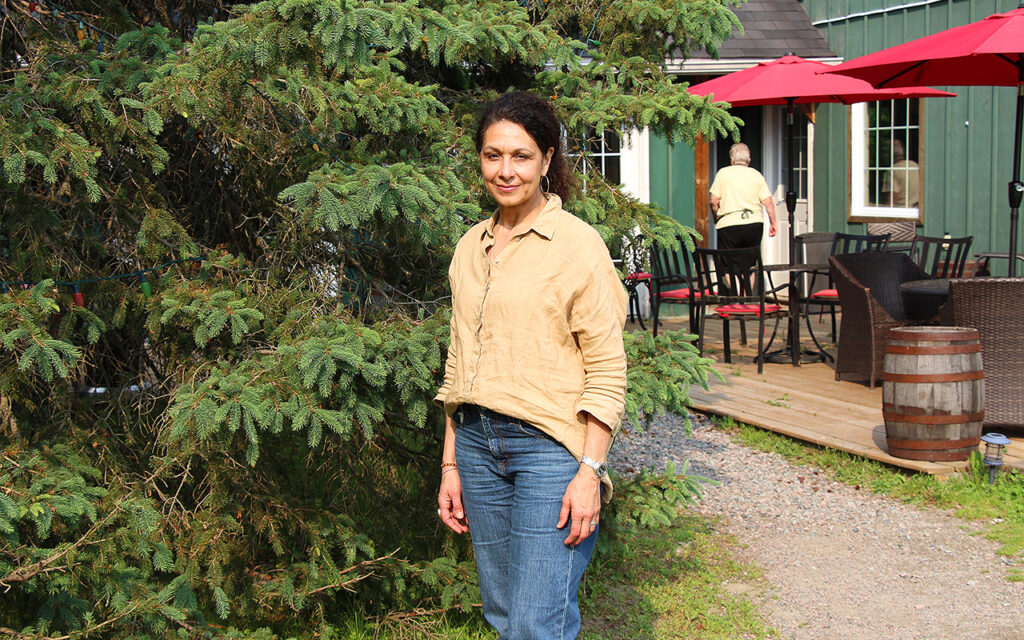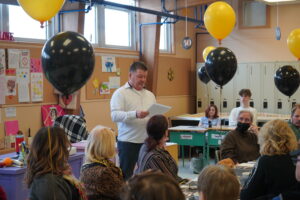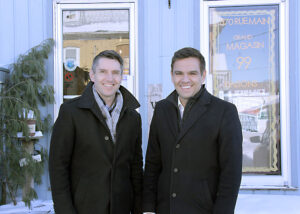



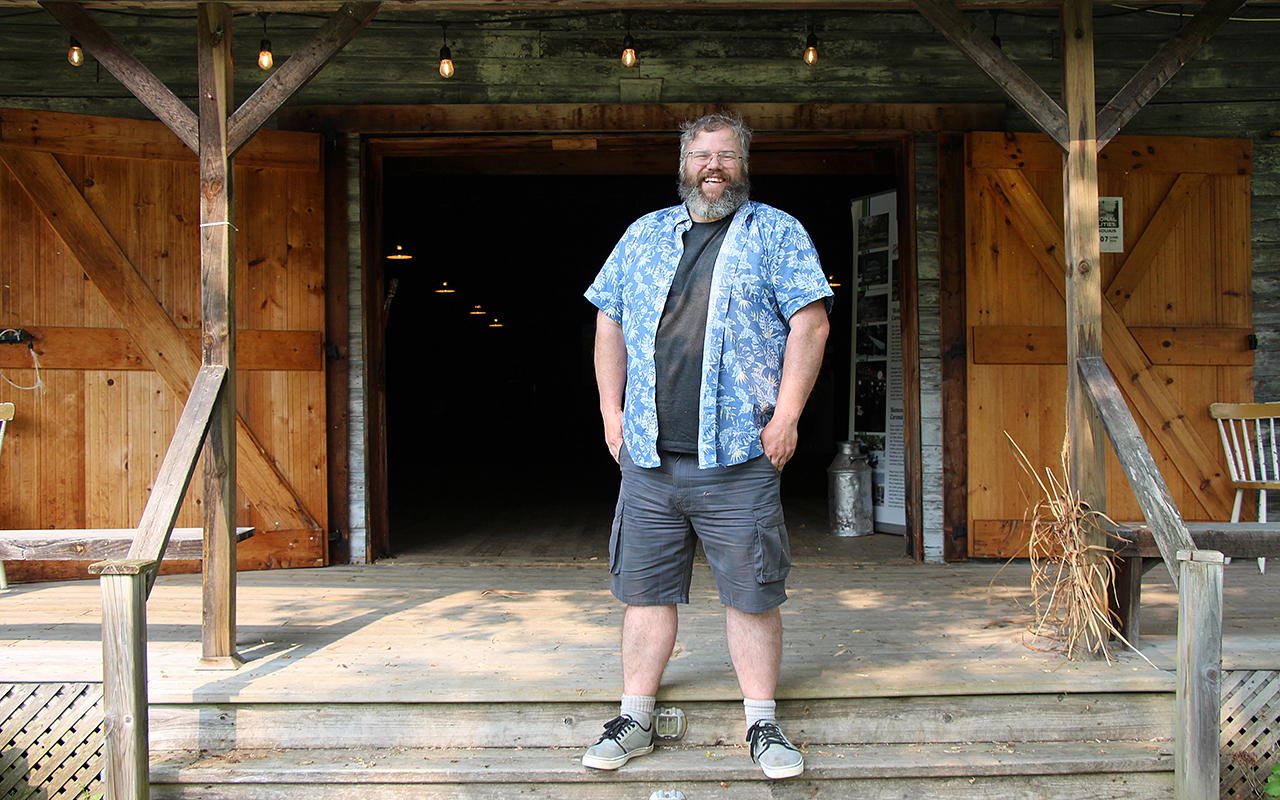

Bristol’s Greg Graham was one of several English-speaking Outaouais residents to share their experiences in a new short film titled Regional Realities: Outaouais that was screened on Saturday at Coronation Hall.
The film, one of two episodes in a new series by a Concordia-based research group called QUESCREN (Quebec English-Speaking Communities Research Network), highlights the experiences and challenges of English speakers in the Outaouais.
Director Anita Aloisio, who is a researcher examining issues of immigration, language and politics in Quebec, said she wanted to broaden the conversation around the experiences of English-speaking Quebecers, one that is often limited to just Montreal.
“I did not know, and many Montrealers have no idea that there are pockets of English speakers across the province,” she said, adding that she found common challenges throughout different regions, notably frustrations with recent reforms to Bill 96, a law overhauled in 2022 to require businesses to make French markedly predominant on signage, and smaller business to undergo a “francization” process to ensure French is the predominant language in the workplace.
Alosio said after meeting Graham a year and a half ago and hearing his experiences as an English-speaking Quebecer, she approached him to be a part of the film’s roughly 10-minute segment on the Pontiac.
Graham, who is the executive director of the Western Quebec Literacy Council, a former commissioner for the Western Quebec School Board and a current municipal councillor in Bristol, said access to education is a challenge that is top of mind for him and his family.
“My children want to study [ . . . ] Will they go to CEGEP in Quebec? There are other colleges in Ontario where you can simply study what you want, you’ll be paid more and you’ll be ready to work at a younger age,” he said in the film.
He said the closure of Heritage College’s satellite campus in Campbell’s Bay was a blow to English education in the region, and all because the government wanted to introduce French classes into the curriculum.
“They couldn’t fold the French into it, they couldn’t make it work,” he said, adding that he is frustrated seeing the government’s French-first focus come at the expense of a region already lacking in educational opportunities.
“If they took just a tenth of the money they used to slap down signs and put it into education, what could we become?” he said in an interview.
Graham also spoke in the film about higher salaries for healthcare workers in Ontario, and asked why the bonuses offered last summer to Outaouais imaging technicians did not initially apply to the Shawville hospital, although the same bonuses were offered eventually.
“Why not us? Is it because we are an English-speaking community?”
He said despite these challenges, he believes the English community in the Pontiac is still strong because it does not see itself as a minority.
“We don’t identify people primarily by what language they speak. How many people do you know who’ve got one French-speaking parent and one English-speaking parent?” he said.
The film also featured perspectives from Wakefield’s Low Down newspaper about how it has covered issues of English rights, as well as the executive director of Connexions Resource Centre on the organization’s approach to offering services for English-speaking residents of the Outaouais.
Aloisio said she believes the film puts a human face on a region that can often get treated as just a number by desk jockeys in the province’s big cities.
“It brings a human perspective to the impacts of the linguistic laws,” she said. “And it really looks at a minority that is federally protected as a minority, [but] is nonetheless suffering and is not accessing what is due to them by law.”
She said while there are common challenges across the regions, she wanted to highlight people in the community trying to overcome those challenges.
“I feel like the film provides not only concerns for the vitality of the English-speaking communities in various areas in the Outaouais, but also affirms their willingness to continue to contribute and to work together and to collaborate, even though it’s difficult.”
She said one thing she found interesting among English speakers she spoke with was a connection with Quebec, despite not seeing their language represented or supported.
“The francophone majority is very attached to Quebec, [but] so are the other founding people that are very attached to the reality of Quebec.”
Graham, a sixth-generation English-speaking Quebecer with roots in Bristol, said his dream for an ideal Quebec is one where the government can keep the French language alive without taking away opportunities for others.
“One of the takes was just my dream of a better Quebec, thinking, ‘Wouldn’t it be nice to open up the newspaper and just read about something that the provincial government did to support and lift up a minority, not treat us like a disease that has to be smacked down?’” he said.
“We can all win, and it feels like the province doesn’t want certain people to win.”
Aloisio said the film will be available on QUESCREN’s website later this year.