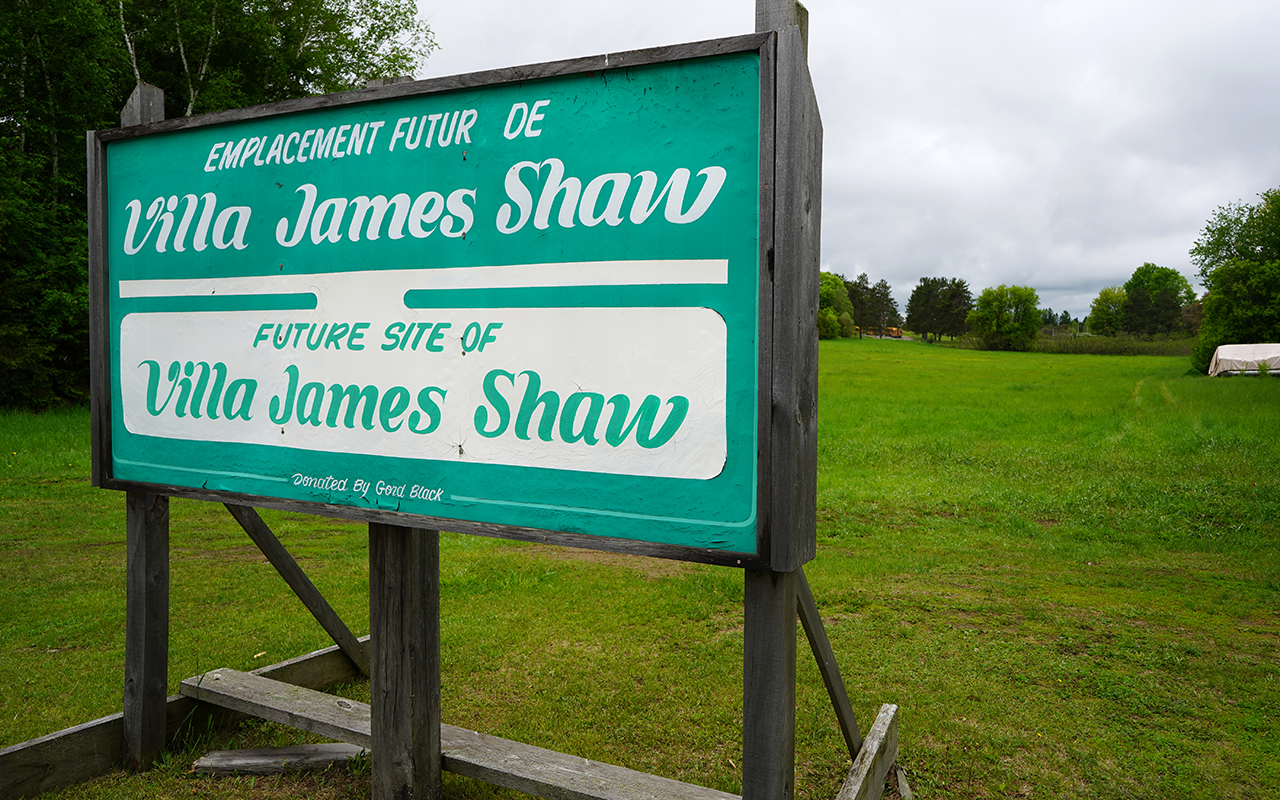



The board of directors working to build the Villa James Shaw independent seniors home in Shawville is going back to the drawing board after receiving conclusions from a financial consultant who found the 50-unit residence it was planning would not be financially viable.
Board president David Gillespie joined the group several years ago to find it had no business plan that laid out how the residence would pay its bills, including its mortgage, once it was built.
“We already had put money into a building that was being proposed, so before we went any further we needed to validate whether this was feasible or not,” Gillespie said.
The board hired a financial consultant, who had also recently helped Chapeau’s Résidence Meilleur work through some financial challenges, to help put together a business plan.
Board members met last month to discuss possible directions for the business plan, at which point the financial consultant told them their current proposal for a 50-unit, three-floor building would not be financially sustainable because of two reasons.
“One is the building cost itself,” Gillespie said, noting covid-induced spike in building costs forced the board to reconsider the scale of the building it was planning.
“But the big killer is not so much the building it, it’s the operating it afterwards . . . maintenance costs, electricity, your variable costs. If they go up, and you didn’t plan for that, that’s where a lot of them are failing.”
Combined, these considerations led the board to scrap the architectural plans for the building, which were about 25 per cent complete.
“We’re going to have this in-depth study done to see exactly what our needs are in terms of units required, what’s the demand for them, and we’ll have to build in accordance with that,” he said, adding this would likely be a one-story building to eliminate the need for elevators.
He said to reduce operating costs, the residence will no longer include a kitchen staff and cafeteria for residents, but that the board is considering other local alternatives for getting premade meals to residents who don’t want to cook.
“This is an aging community, so the need for a seniors’ home is very high. We know there’s a need . . .
Now what we need is [to] tailor the project to those needs.”
Board vice-president and Shawville mayor Bill McCleary said the original survey done to understand market demand only surveyed the 180 or so people who were already paying membership fees to the board.
“So it was kind of skewed,” he said.
Funds from an MRC FRR 2 provincial grant originally obtained in 2022 to finance environmental assessment studies for the building will be used to conduct the study.
Gillespie said he expects the results of that in September, which will be used to put together a business plan.
A return to original vision
McCleary has been on the board since it first formed in 2014 and said the news that the 50-unit plan is not feasible is not surprising.
“The original board felt 20 to 30 units was the way to go. All the studies we did at that time showed that,” McCleary said, explaining that at some point the Canada Mortgage and Housing Corporation encouraged the group to expand to a 50-unit building to receive a higher mortgage at a favourable rate.
“You can’t blame the board of the time,” Gillespie said. “They relied on the project manager along with the grants available at the time.”
McCleary said he was not surprised to hear the consultant’s conclusions.
“We don’t really have to go back to the drawing board, we have to go back to what we wanted in the first place. It was more of a relief than anything,” he said.
“The project they tried to put on us would have been 20 or 30 million dollars. Even if you got 80 per cent of the funding, how do you pay for the rest? The one we’re looking at now could possibly be a five or six million dollar project.”
McCleary assured no community donations have been used thus far.
“Luckily we haven’t had to spend any donated money. Everything we’ve done we’ve been able to get grants for from the Quebec government,” he said.
“We haven’t squandered the donations that people made to us and it was an agreement all along that should the project not go ahead, this money would be either returned to the people that donated it or they could say donate it to a different charity.”
McCleary said while membership has dwindled because of lack of action on this project, the board plans to waive the $20 membership fee going forward.
McCleary said he imagines the renewed energy for the project and the upcoming survey will bring more community members back to their next annual general meeting, planned for sometime in September.
Le conseil d’administration œuvrant à la construction de la résidence autonome pour aînés Villa James Shaw à Shawville retourne à la case départ après avoir reçu les conclusions d’un consultant financier qui a estimé que la résidence de 50 unités qu’il prévoyait ne serait pas financièrement viable.
Le président du conseil, David Gillespie, a rejoint le groupe il y a plusieurs années pour constater qu’il n’y avait aucun plan d’affaires détaillant comment la résidence paierait ses factures, y compris son hypothèque, une fois construite.
« Nous avions déjà investi de l’argent dans un bâtiment qui était proposé, alors avant d’aller plus loin, nous devions valider si cela était faisable ou non », a déclaré M. Gillespie.
Le conseil a embauché un consultant financier, qui avait également récemment aidé la Résidence Meilleur de Chapeau à traverser certaines difficultés financières, afin d’élaborer un plan d’affaires.
Les membres du conseil se sont réunis le mois dernier pour discuter des orientations possibles du plan d’affaires, moment auquel le consultant financier leur a dit que leur proposition actuelle pour un bâtiment de 50 unités sur trois étages ne serait pas financièrement durable pour deux raisons.
« L’une est le coût de construction lui-même », a déclaré M. Gillespie, notant que la hausse des coûts de construction due à la COVID a forcé le conseil à reconsidérer l’ampleur du bâtiment qu’il prévoyait.
« Mais le principal problème n’est pas tant le bâtiment en soi que son exploitation par la suite… les coûts d’entretien, l’électricité, vos coûts variables. S’ils augmentent et que vous ne l’avez pas prévu, c’est là que beaucoup échouent. »
Combinées, ces considérations ont mené le conseil à abandonner les plans architecturaux du bâtiment, qui étaient achevés à environ 25 %.
« Nous allons faire réaliser cette étude approfondie pour voir exactement quels sont nos besoins en termes d’unités requises, quelle est la demande pour celles-ci, et nous devrons construire en conséquence », a-t-il dit, ajoutant qu’il s’agirait probablement d’un bâtiment de plain-pied pour éliminer le besoin d’ascenseurs.
Il a déclaré que pour réduire les coûts d’exploitation, la résidence n’inclura plus de personnel de cuisine ni de cafétéria pour les résidents, mais que le conseil envisage d’autres alternatives locales pour fournir des repas préparés aux résidents qui ne veulent pas cuisiner.
« C’est une communauté vieillissante, donc le besoin d’une résidence pour aînés est très élevé. Nous savons qu’il y a un besoin…
Maintenant, ce dont nous avons besoin, c’est d'[adapter] le projet à ces besoins. »
Le vice-président du conseil et maire de Shawville, Bill McCleary, a déclaré que l’enquête originale menée pour comprendre la demande du marché n’avait interrogé que les quelque 180 personnes qui payaient déjà des frais d’adhésion au conseil.
« C’était donc un peu faussé », a-t-il dit.
Les fonds d’une subvention provinciale du FRR 2 de la MRC, obtenue initialement en 2022 pour financer les études d’évaluation environnementale du bâtiment, seront utilisés pour mener l’étude.
M. Gillespie a déclaré qu’il s’attend à recevoir les résultats en septembre, lesquels serviront à élaborer un plan d’affaires.
Un retour à la vision originale
M. McCleary fait partie du conseil depuis sa formation en 2014 et a déclaré que la nouvelle selon laquelle le plan de 50 unités n’est pas réalisable n’est pas surprenante.
« Le conseil d’origine estimait que 20 à 30 unités était la bonne approche. Toutes les études que nous avions faites à l’époque le montraient », a déclaré M. McCleary, expliquant qu’à un certain moment, la Société canadienne d’hypothèques et de logement avait encouragé le groupe à s’étendre à un immeuble de 50 unités pour obtenir une hypothèque plus élevée à un taux avantageux.
« On ne peut pas blâmer le conseil de l’époque », a déclaré M. Gillespie. « Ils se sont fiés au gestionnaire de projet ainsi qu’aux subventions disponibles à ce moment-là. »
M. McCleary a déclaré ne pas être surpris d’entendre les conclusions du consultant.
« Nous n’avons pas vraiment à retourner à la case départ, nous devons revenir à ce que nous voulions en premier lieu. C’était plus un soulagement qu’autre chose », a-t-il dit.
« Le projet qu’ils ont essayé de nous imposer aurait coûté 20 ou 30 millions de dollars. Même si vous obteniez 80 % du financement, comment payeriez-vous le reste? Celui que nous envisageons maintenant pourrait être un projet de cinq ou six millions de dollars. »
M. McCleary a assuré qu’aucun don de la communauté n’a été utilisé jusqu’à présent.
« Heureusement, nous n’avons pas eu à dépenser d’argent provenant de dons. Tout ce que nous avons fait, nous avons pu obtenir des subventions du gouvernement du Québec », a-t-il dit.
« Nous n’avons pas dilapidé les dons que les gens nous ont faits, et il y a toujours eu un accord selon lequel si le projet n’allait pas de l’avant, cet argent serait soit retourné aux personnes qui l’ont donné, soit elles pourraient dire de le donner à une autre œuvre de bienfaisance. »
M. McCleary a déclaré que bien que le nombre de membres ait diminué en raison du manque d’action sur ce projet, le conseil prévoit de renoncer aux frais d’adhésion de 20 $ à l’avenir.
M. McCleary a déclaré qu’il imagine que l’énergie renouvelée pour le projet et l’enquête à venir ramèneront davantage de membres de la communauté à leur prochaine assemblée générale annuelle, prévue en septembre.