



Mark Zuckerberg recently announced that his company Meta (formerly known as Facebook) will stop fact-checking content.
This does not come as a complete shock. It’s really just an admission of what we have all known for a long time, that Meta’s various sites cannot be counted on to be much more than rumour mills, safe havens for unsubstantiated gossip, fake news and conspiracy theories.
As such, it is probably a good business move for Zuckerberg as it brings his social media empire more in line with Elon Musk’s X (formerly known as Twitter) and Donald Trump’s Truth Social, and so will not be at a competitive disadvantage with these renowned promulgators of fiction.
Why does this matter?
It doesn’t really, as long as your engagement with these platforms is for sharing pictures of your kid’s graduation, your vacation or your kitten’s latest antics.
It doesn’t matter at all. Unless you are susceptible to the algorithms designed to promote negativity, and sculpt and twist our perceptions of the social and political realities in which we live. Unless you are at risk of falling for the propaganda commonly found on such sites designed to undermine the credibility of western democracies and anyone who dares to stand up to the quest for power of right-wing authoritarians.
Nor would it matter if so-called social media (rapidly becoming better known as anti-social media) were not so prominent and considered by a sizable chunk of society as their primary source of information.
Unfortunately, all of these things seem to be happening. And along the way, we are losing newspapers which, with some exceptions, have tended to be fairly reliable sources of information about the world around us.
For newspapers, knowing the difference between fact and fiction is our stock and trade. It is why we hire reporters who adhere to the highest standards of journalistic integrity. Their names appear on their articles, as does the name of the publication, and the reputations of both are at stake. Sure, we make our share of mistakes, but we publish corrections as soon as we become aware of any errors. That’s part of our accountability to publishing the truth, to the best of our ability to discern it.
Apparently, this is not the case for some Ottawa-based media that got some of the basic facts wrong about the possible sale of this newspaper. For the record, here are the facts of the matter.
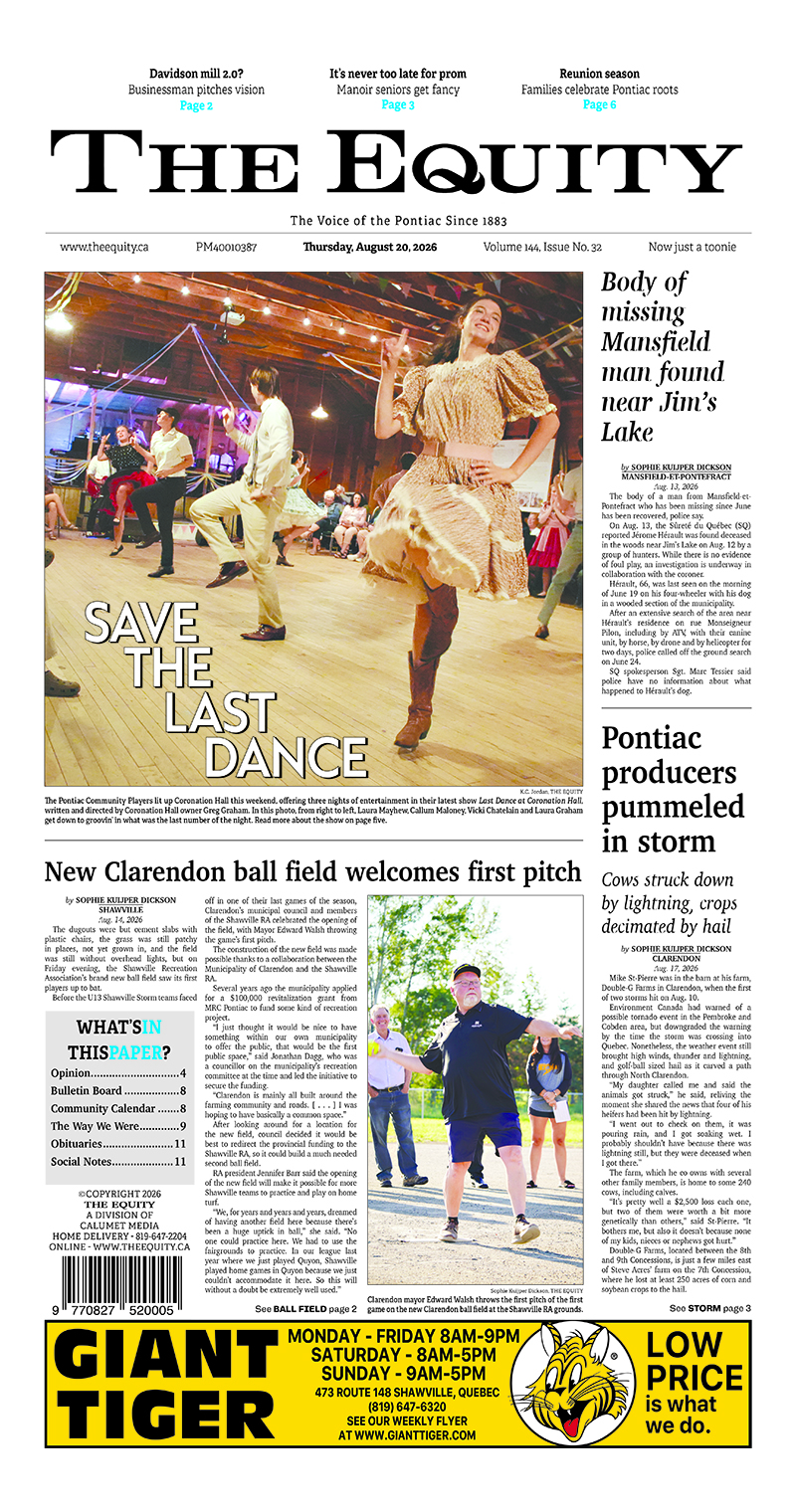
THE EQUITY, now in its 143rd year, has been able to continue publishing long after many similar newspapers have had to close. In the world of newspaper publishing, this is a huge success, due in part to the fact that this newspaper is one of Pontiac Printshop’s multiple revenue streams.
In the life of every business, there comes a time when the owner needs to retire. This is the case here, which is why we have opened discussions with a potential buyer, Jon Stewart of Calumet Media, who shares our commitment to keeping this publication going. Like Pontiac Printshop, Calumet Media has a diversity of complementary revenue streams sufficient to back up this commitment. While there are still some details to be worked out, the sale of this business appears likely in the coming weeks.
As you know, we have been improving our website and digital version of this publication for more than a decade, to which Jon has contributed significantly over the past year. Under his ownership, this will certainly continue as the demand for digital content grows. There may come a day when this newspaper, like so many others, is available only in digital form. But for the time-being, borrowing from Mark Twain, rumours of the demise of the print version of this newspaper have been greatly exaggerated. THE EQUITY will continue to be printed on newsprint for the foreseeable future, just as it has been for the past 142 years.
These are the facts as we know them, and you can count on us to let you know as soon as any transaction takes place.