





An unfortunately weak resolution on the proposed Chalk River nuclear dump was passed at the December meeting of the Pontiac Council of Mayors, and the question is why.
The plan being advanced by Canadian Nuclear Laboratories (CNL) is to locate an enormous above-ground facility loaded with radioactive wastes less than a kilometer from . . .
the Ottawa River, just across from Sheenboro, upriver from much of the Pontiac, not to mention the nation’s capital and the metropolis of Montreal.
An excellent briefing provided early in the December meeting by Joann McCann of the Old Fort William Cottagers’ Association (OFWCA) presented many reasons our mayors should be deeply concerned about this project. Yet, the resolution on which they voted seeks only to urge the federal government to locate the dump “well away from the Ottawa River.”
Asked by THE EQUITY how far “well away” would be, the warden responded that the CNL experts would have the answer to that.
It’s a fair bet that the CNL experts believe that their proposed site is, in fact, already sufficiently well away from the river. It is unlikely that they will see anything in the MRC resolution requiring a re-think of their proposal, and might well take it as an indication that there really is no serious opposition to their plans being mounted in the Pontiac.
At the same time, it is arguably a step in the right direction that the warden and mayors of Pontiac MRC have issued a resolution expressing any concern on this issue at all. The OFWCA, which has been pressing them to take a stand for years, would be right to see this as a bit of a victory.
But it is hard to deny that the resulting resolution is effectively a hollow gesture that might look like progress but falls short of making the case for a different plan. It represents a very poor showing on a matter that deserves serious attention and action by this county’s leaders. How did this happen?
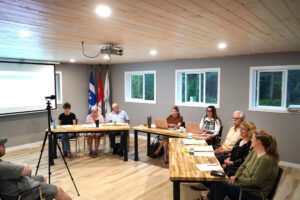
For one thing, contrary to agreed practice, the nuclear item was added to the agenda of the mayors’ meeting at the last minute. The first time the mayors got to see the proposed resolution was when it was flashed, barely legibly, onto the projection screen just minutes before they were asked to vote on it, with no real opportunity to discuss the matter, consider how this move fits within any strategic game-plan, or propose stronger wording.
Normally, these sorts of discussions are held in closed-door sessions a week before the public meeting, where mayors can air their views through frank and open conversation. This obviously didn’t happen on this most serious of issues. And if it had happened, how would we, the public, know it had? How would we know how the discussion unfolded, who took what positions, and what arguments won the day?
All the public gets to see is what happens at the public meetings, when the cake is fully baked, or half-baked, as in this case of the dump site resolution. At these meetings, what we see is mayors dutifully raising their hands in support of a rapid succession of resolutions, sometimes flying by so fast that they’re clearly not always sure what they’re voting for.
It is a very tidy process that one could mistake as a model of harmonious and efficient decision-making, but it seems to fall short of what some might expect of something called democracy.
Democracy is messier than that. In democracy, there is debate. There is disagreement and dissension. There is the added value that a diversity of views can bring to addressing the issues.
But at the MRC council, mayors are treated to a declaration on decorum, read at the beginning of every meeting. With the laudable intent of keeping the discussion respectful and civil, its warning that “any words of negativity or criticism of anyone else” will not be tolerated go a bit far.
The council chambers are not a public library, the meeting is not a church service. People need to feel empowered to stand up for proper process and to express their views even if they part company with others in the room, and this can be very difficult to do without seeming to be negative and critical.
And in democracy there needs to be transparency in order for there to be public accountability. If there is debate of the issues at the Mayors’ Council, it must be happening out of public view at the closed-door sessions, because it is certainly nowhere to be seen at the public meetings.
The question of the nuclear dump site proposed for the shores of the upper Ottawa River is just one of many issues that need to be addressed with vigor for the Pontiac to realize its amazing potential. We need our local governance institutions to be firing on all cylinders, where weak ideas are openly challenged and great ideas are championed.
The days of operating quietly in the dark, and providing unquestioning support for half-hearted resolutions that have been deprived of the benefits of fulsome public debate need to be over. We rely on the people elected to these bodies to make sure this happens.
Charles Dickson