





When Mike Lamothe first walked the grounds of L’Île-du-Grand-Calumet’s Sainte-Anne cemetery many years ago, he knew nothing of the names on the tombstones flanking him, names that to him were long lost to history.
But as he and other volunteers from the Groupe l’Île-du-Grand-Calumet began to research those who were buried there, many without tombstones, they found more than just names. Several years of research yielded stories of mine workers, shopkeepers, and housewives – the stories of the forefathers and foremothers of many who still live on the island today.
Since 2018, Groupe L’Île-du-Grand-Calumet has been working to revitalize this cemetery and piece together the stories of the ancestors buried there. They called this project Honorons Nos Racines (Honor Our Roots).
After hundreds of hours group members have spent poring over parish records and talking with community members since they first began trying to collect the lost names, they have identified a list of more than 1,500 people that have been buried at the cemetery, only a small number of whom currently have a monument.
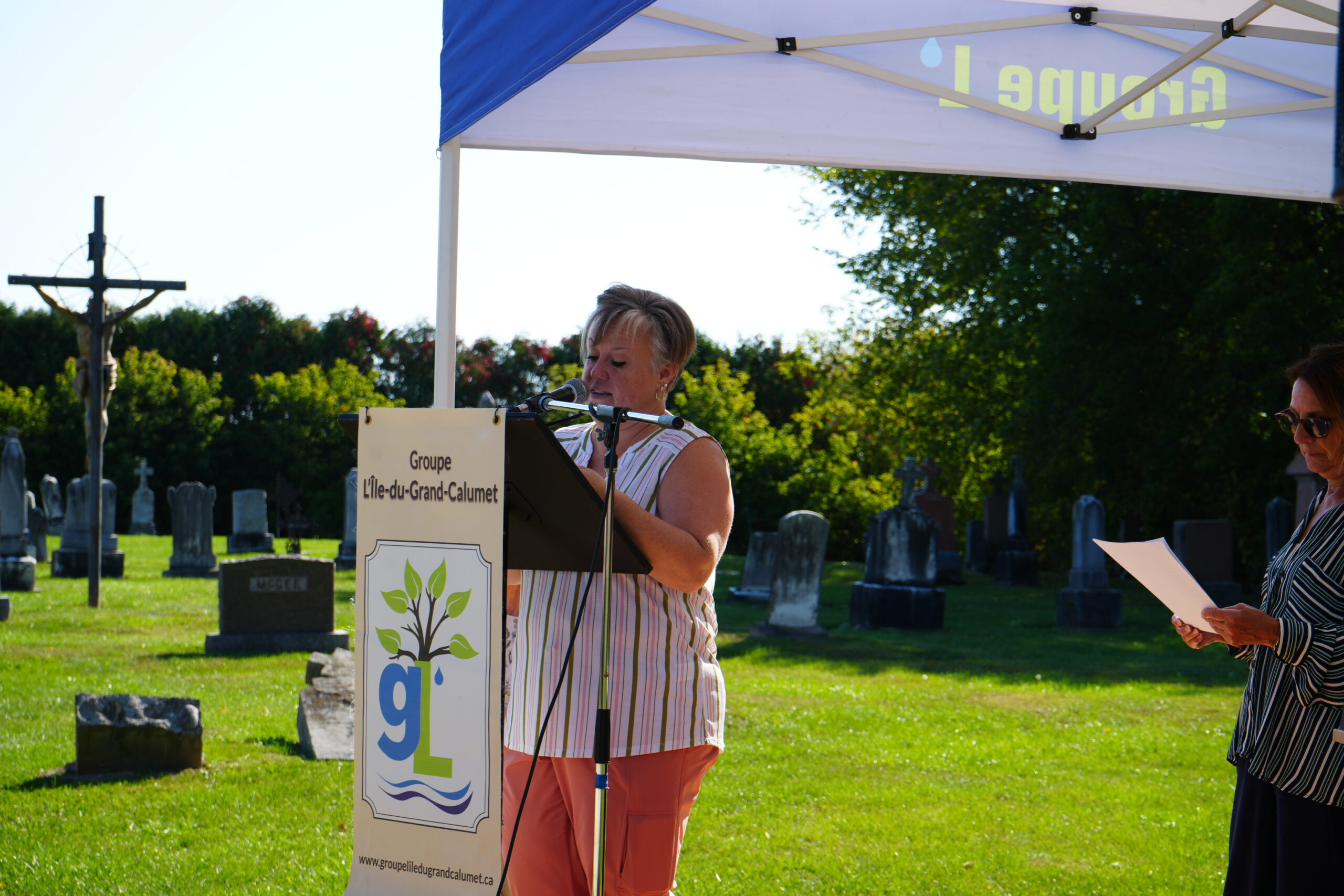
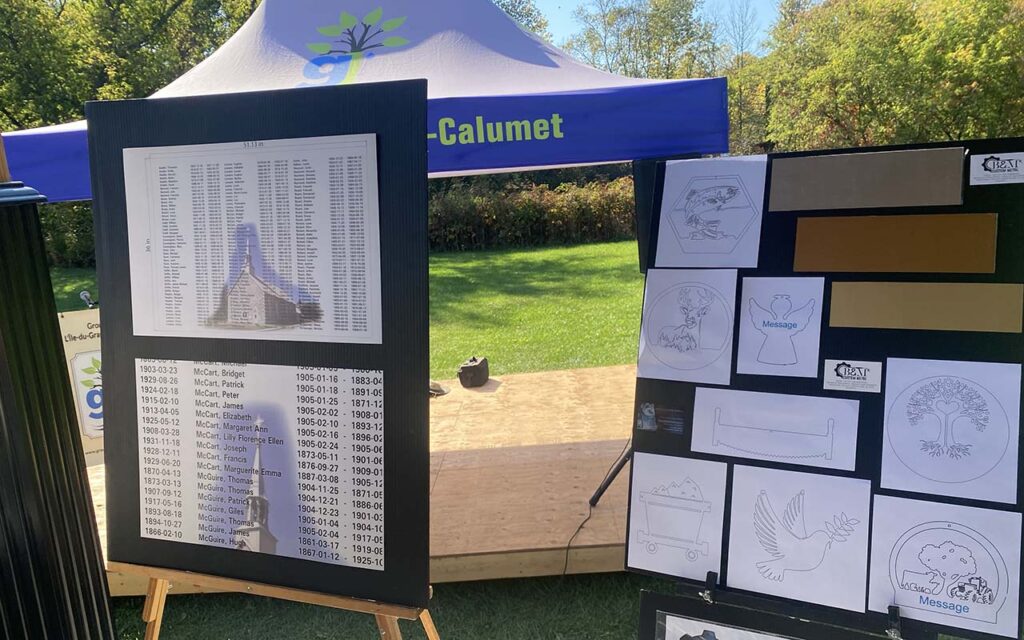
On Monday, Sept. 29, members announced via press conference the third and final phase of this project – the construction of panels in the cemetery’s recently built pavilion on which will be printed the 1,500 names of yesterday’s Islanders buried at that site.
A key part of this final phase will be crowdsourcing every last piece of biographical information that can be gathered from anybody who might know some of those names.
This could mean adding a name, a date of birth, or any piece of information that could help piece together someone’s story.
“We want to spread the word around, and to say, ‘This is the list, we have these names, could you tell us [what you know about them],” said Lamothe, who has taken on much of the work of putting the list together.
“Right now, I feel it’s like a race, and we see the finish line, and it’s like the last sprint,” said Guylaine La Salle, president of Groupe L’Île-du-Grand-Calumet.
La Salle said there has already been lots of community support for the project via fundraisers and information given about those buried, but they are looking to reach even more people.
“People are calling us, so it’s pretty cool to see the word going around, but we would like the word to go more,” she said.
Lamothe said the goal is to identify as many individuals as possible and be able to tell some of their stories via the panels and the group’s website, which will have even more information.
“The first thing that’s important is getting something physical that people can look at with the name and the date, and the second thing is having a QR code that will then refer them to our website with information that we’re given,” he said.
The project’s estimated cost is around $25,000, over a third of which the group has already collected through various fundraisers, but volunteers are looking for help raising money to complete the project.
Part of this fundraising includes selling stainless steel plaques of different shapes that people can get engraved with a personalized message.
“People will choose a plaque and choose what they want to write on it,” La Salle said, adding that the plaques will be suspended from wire cables from the pavilion’s roof.
“My great-grandfather really loved the bush, and I love the bush, and I’m thinking maybe I’ll get one for him with a cross-cut saw,” offered Lamothe as an example.
La Salle said the group is happy to be getting the next generation involved in the project as well. Sixteen-year-old Island resident Xavier Lagarde used a 3-D printer to make one of the eight different plaque shapes people can choose from, including a dove, a deer, a fish, an angel, a tree, a farm scene, a saw and a mining cart.
La Salle said it’s more than just a volunteer project, it’s the group’s way of making sure their ancestors are not lost to time. “These are our roots,” she said.
Lamothe said for him the project is a way to ensure that people have the information they need to learn about their ancestors – ancestors that live on in their descendents be it through a particular eye colour, facial shape, or that little dimple in the cheek.
“There is a thread from the people buried here to those who live on [ . . . ] we have a part of them in us,” he said.
Lamothe said while it’s very unlikely the group will ever have a comprehensive list of everyone buried at the cemetery, the call to action encourages people to take interest in knowing what – and who – came before.
For now, Lamothe and the group will be preparing for the flow of information that is sure to come their way from the community.
“There never will be a final list, because the information just keeps coming in,” he said.
You can find the Groupe L’Île-du-Grand-Calumet on Facebook or on their website.
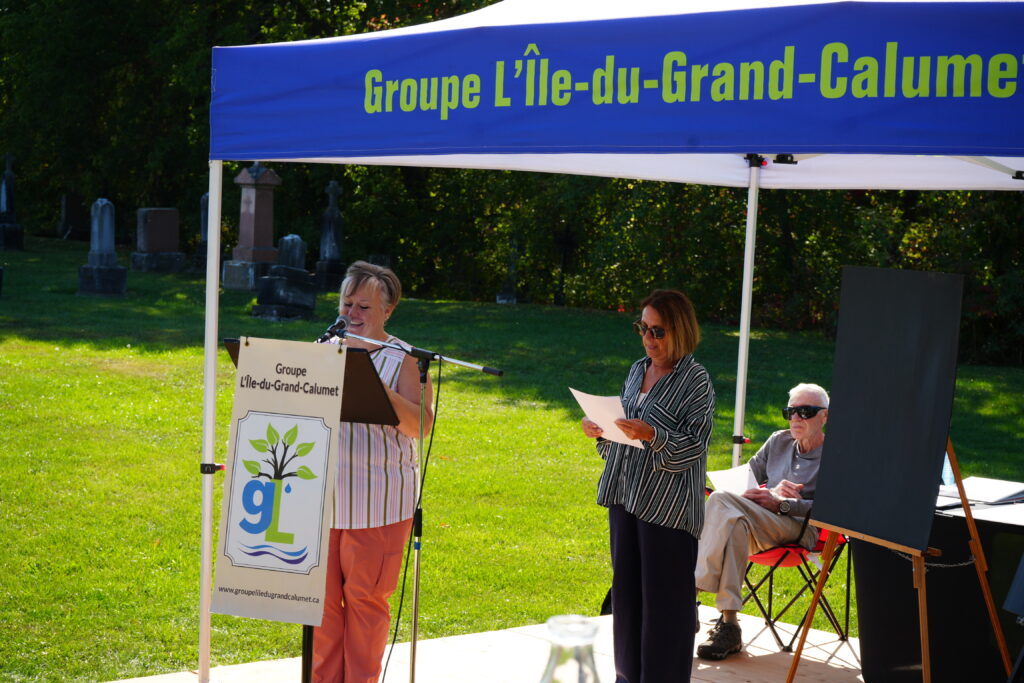
Lorsque Mike Lamothe a foulé pour la première fois les lieux du cimetière Sainte-Anne de L’Île-du-Grand-Calumet il y a de nombreuses années, il ne connaissait rien des noms inscrits sur les pierres tombales qui l’entouraient, des noms qui pour lui étaient depuis longtemps perdus dans l’histoire.
Mais alors que lui et d’autres bénévoles du Groupe l’Île-du-Grand-Calumet commençaient à faire des recherches sur les personnes qui y étaient enterrées, beaucoup sans pierres tombales, ils ont trouvé plus que de simples noms. Plusieurs années de recherche ont révélé des histoires de mineurs, de commerçants et de femmes au foyer – les histoires des ancêtres, hommes et femmes, de nombreux habitants qui vivent encore sur l’île aujourd’hui.
Depuis 2018, le Groupe L’Île-du-Grand-Calumet travaille à la revitalisation de ce cimetière et à reconstituer les histoires des ancêtres qui y sont enterrés. Ils ont appelé ce projet Honorons Nos Racines (Honor Our Roots).
Après des centaines d’heures passées par les membres du groupe à éplucher les registres paroissiaux et à discuter avec les membres de la communauté depuis qu’ils ont commencé à tenter de recueillir les noms perdus, ils ont identifié une liste de plus de 1 500 personnes qui ont été enterrées au cimetière, dont seul un petit nombre a actuellement un monument.
Le lundi 29 sept., les membres ont annoncé, lors d’une conférence de presse, la troisième et dernière phase de ce projet – la construction de panneaux dans le pavillon récemment bâti du cimetière, sur lesquels seront imprimés les 1 500 noms des Insulaires d’hier enterrés à cet endroit.
Un élément clé de cette phase finale sera de solliciter auprès du public chaque dernière information biographique pouvant être recueillie de quiconque pourrait connaître certains de ces noms.
Cela pourrait signifier l’ajout d’un nom, d’une date de naissance ou de toute information susceptible d’aider à reconstituer l’histoire de quelqu’un.
« Nous voulons faire passer le mot et dire : « Voici la liste, nous avons ces noms, pourriez-vous nous dire [ce que vous savez à leur sujet] », a déclaré M. Lamothe, qui a pris en charge une grande partie du travail de compilation de la liste.
« En ce moment, j’ai l’impression que c’est une course, et nous voyons la ligne d’arrivée, c’est comme le dernier sprint », a déclaré Guylaine La Salle, présidente du Groupe L’Île-du-Grand-Calumet.
Mme La Salle a déclaré qu’il y avait déjà eu beaucoup de soutien de la communauté pour le projet par le biais de collectes de fonds et d’informations données sur les personnes enterrées, mais qu’ils cherchaient à toucher encore plus de gens.
« Les gens nous appellent, c’est donc très agréable de voir que l’information circule, mais nous aimerions qu’elle se propage davantage », a-t-elle ajouté.
M. Lamothe a déclaré que l’objectif est d’identifier autant de personnes que possible et de pouvoir raconter certaines de leurs histoires via les panneaux et le site web du groupe, qui contiendra encore plus d’informations.
« La première chose importante est d’avoir quelque chose de physique que les gens peuvent consulter avec le nom et la date, et la deuxième chose est d’avoir un code QR qui les renverra ensuite à notre site web avec les informations que nous recevons », a-t-il précisé.
Le coût estimé du projet est d’environ 25 000 $, dont plus du tiers a déjà été recueilli par le groupe grâce à diverses collectes de fonds, mais les bénévoles cherchent de l’aide pour amasser des fonds afin de mener à bien le projet.
Une partie de cette collecte de fonds consiste à vendre des plaques en acier inoxydable de différentes formes que les gens peuvent faire graver avec un message personnalisé.
« Les gens choisiront une plaque et décideront ce qu’ils veulent y écrire », a déclaré Mme La Salle, ajoutant que les plaques seront suspendues à des câbles métalliques du toit du pavillon.
« Mon arrière-grand-père aimait vraiment la forêt, et j’aime la forêt, et je me dis que je pourrais peut-être en prendre une pour lui avec une scie à bûches », a proposé M. Lamothe à titre d’exemple.
Mme La Salle a déclaré que le groupe est heureux d’impliquer également la prochaine génération dans le projet. Xavier Lagarde, un résident de l’île âgé de seize ans, a utilisé une imprimante 3D pour créer l’une des huit formes de plaques différentes parmi lesquelles les gens peuvent choisir, notamment une colombe, un cerf, un poisson, un ange, un arbre, une scène de ferme, une scie et un chariot minier.
Mme La Salle a déclaré que c’est plus qu’un simple projet bénévole, c’est la manière du groupe de s’assurer que leurs ancêtres ne soient pas perdus dans le temps. « Ce sont nos racines », a-t-elle affirmé.
M. Lamothe a déclaré que pour lui, le projet est un moyen de s’assurer que les gens disposent des informations nécessaires pour connaître leurs ancêtres – des ancêtres qui vivent à travers leurs descendants, que ce soit par une couleur d’yeux particulière, la forme du visage ou cette petite fossette dans la joue.
« Il y a un lien entre les personnes enterrées ici et celles qui vivent [ . . . ] nous avons une partie d’eux en nous », a-t-il déclaré.
M. Lamothe a déclaré que s’il est très peu probable que le groupe ait un jour une liste exhaustive de toutes les personnes enterrées au cimetière, l’appel à l’action encourage les gens à s’intéresser à ce – et à ceux – qui les ont précédés.
Pour l’instant, M. Lamothe et le groupe se préparent à un afflux d’informations qui ne manquera pas de leur parvenir de la part de la communauté.
« Il n’y aura jamais de liste définitive, car les informations ne cessent d’arriver », a-t-il dit.
Vous pouvez trouver le Groupe L’Île-du-Grand-Calumet sur Facebook ou sur leur site web.