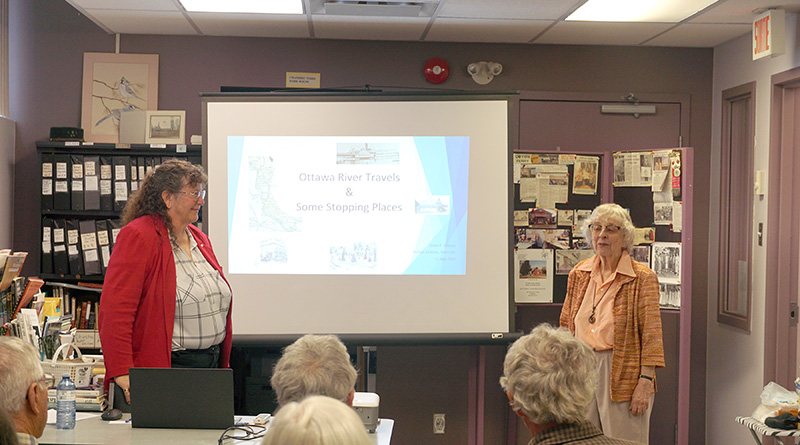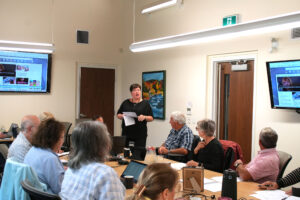






Local history enthusiasts sat down at the Pontiac archives on Wednesday morning to enjoy a presentation by genealogist Gloria Tubman.
The presentation centered around the Ottawa River, historically known as the Grand River, and discussed its significance as a travel route for lumbermen, detailing the various historic stopping places along the river.
“I’m going to take you on a trip from below the Quyon River, to Deux-Rivieres,” Tubman said, opening her presentation. “I want to talk about the bays, the inlets, rapids [ . . . ] And then the villages along the way and areas to portage.”
Tubman highlighted the transformation of the river over the years, from a crucial route for early settlers and lumbermen to its current state, controlled by numerous hydro dams.
One of the stopping places discussed was the town of Quyon, founded by Irish lumber baron John Egan.
Tubman also delved into the history of Gavan’s Hotel, a landmark known far and wide according to Tubman. She explained that on some of her trips around the world, she has bumped into people and through discussion found out they were familiar with Quyon.
Tubman’s presentation continued past Quyon, west to Chats Falls, which used to be spelled Shaw Falls according to a map found by Tubman dated from 1863.
It was at these falls that the first horse-drawn railway was constructed in the Pontiac region. The railway was built in the 1840s, and served to transport passengers coming up the river by steamboat from Pontiac Bay below Chats Falls to Pontiac Station above them.
“Three lumbermen were instrumental in it,” Tubman said. “Ruggles Wright, his lumber rights were . . .
on the Ottawa River, John Egan and Joseph Armand.”
Tubman’s presentation continued west along the river, as she highlighted stopping points in Norway Bay, Bristol and Portage du Fort.
The latter was a major stopping place according to an insurance map Tubman found of the area from 1889, which showed the area had a notable amount of hotels.
“If you’re looking at any little town or city, find the insurance maps, because it will tell you a great deal about not only the place, but the type of buildings that were there,” Tubman said.
Her presentation led attendees all the way to Calumet Island and afterwards to Rapides des Joachims, where she spoke of how steamboats like the John Egan, which operated from 1872 to 1886, would take people down the river to Pembroke.
The presentation also triggered some nostalgia in the crowd. Venetia Crawford, president of the archives, chimed in to share memories from a time when municipalities would plow parts of the Ottawa River during the winter to create what became known as ice bridges that would make it possible for vehicles to cross.
After the presentation, Crawford invited attendees to have lunch at Café 349 and continue the conversation.