


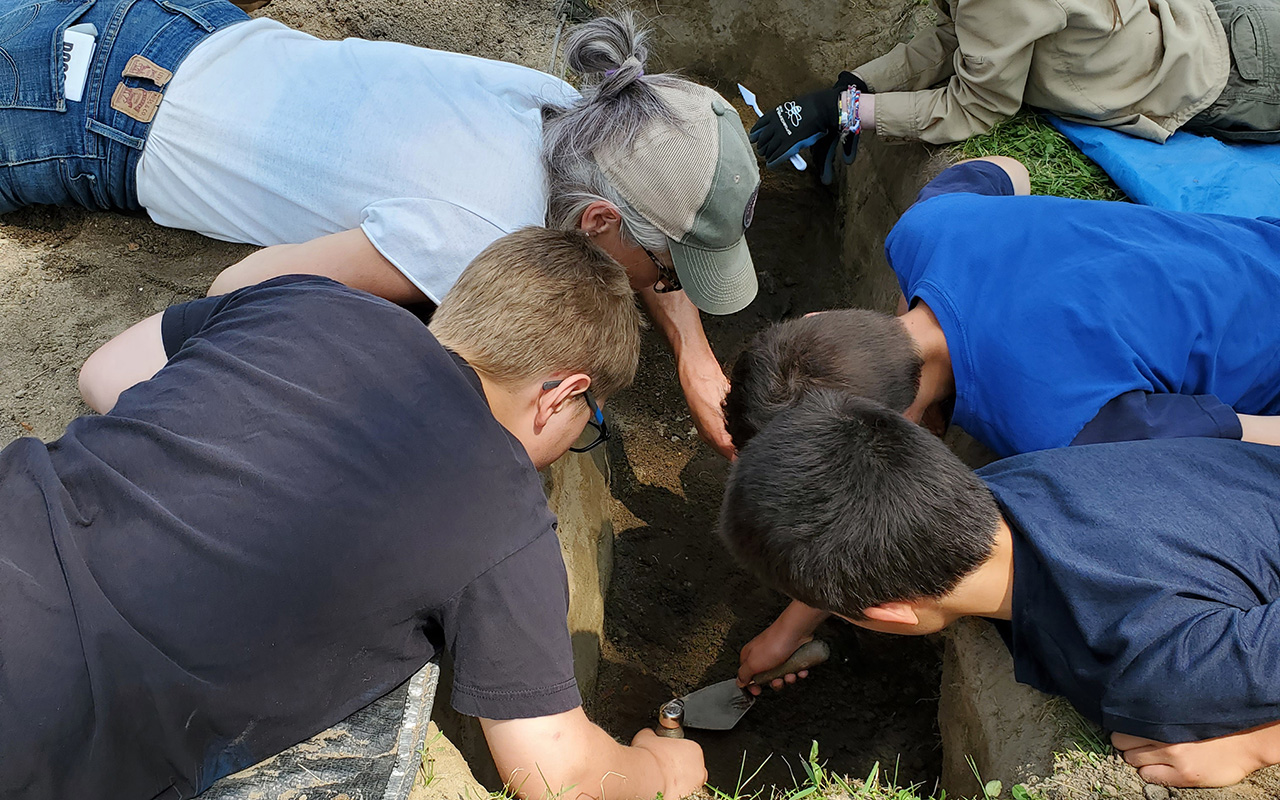



A local archaeology group is hoping returns from a survey done on June 8 on a new site in Quyon might hold clues to the region’s past.
For the past few years the Friends of Chats Falls and Archéo-Pontiac have jointly hosted public digs at a site at Pointe-à-l’Indienne, a small peninsula that sticks out into the Ottawa River just upriver of Quyon where the groups invited community members and schoolchildren to participate in hands-on history.
On June 7 and 8, the groups chose to sink their spades into new ground, hosting their first-ever archaeological dig on the old Quyon fairgrounds, surveying 23 different places across the site.
“Given the anniversary of the official foundation of Quyon, there was an interest to see if there could be an archaeological site in the community that could be the place where public archaeology could be done in September,” said Jean-Luc Pilon, a professional archaeologist volunteering as a counselor with the project.
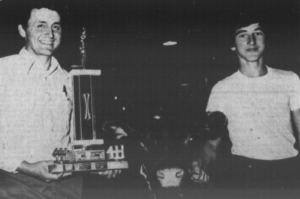
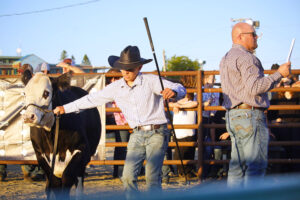
According to historian Maude Lambert, the land was donated in the 1910s by the family of Philemon Wright to the Quyon Agricultural Society, and was the site of the annual agricultural fair from 1920 until 2001.
Buildings were constructed to shelter the animals and the exhibitioners alike, including two stables for cows, three more for horses, a refreshments counter, and a half-mile racetrack for the horse races.
“These were among the most popular in the entire Ottawa Valley, and the updates done to the exhibition grounds over the years made it into one of the most beautiful rural parks in the region,” Lambert said.
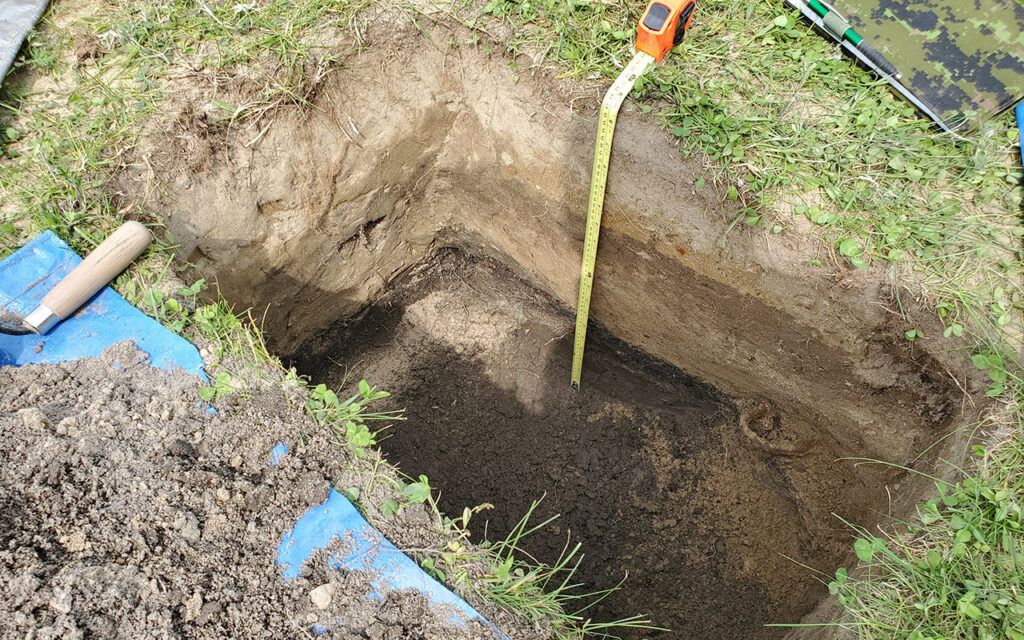
Pilon said the dig revealed visibly different layers in the soil that line up with some of the grounds’ uses over the years.
“Every time someone pulls out a picture of the Quyon fairgrounds, you’re probably going to be seeing different uses that would have modified the landscape [ . . . ] and we see that in some of the test pits,” he said.
He said the dig yielded up to 150 individual pieces of artifacts, including fragments of bottles, metal, nails, bones, a 22-inch pipe, and the bones from several beef roasts. But without a full analysis it is hard to say exactly how old the artifacts are and what they might reveal.
Over the summer, the artifacts will be dated and analyzed, at which point the group will decide if it is worth returning to the site for a more formal dig.
“There’s a range of objects that really have to be looked at and considered. We have to look at the soils that they were contained in and consider what processes might have produced those soils before I can really suggest viable options,” he said.
‘Where two rivers meet’
Lambert said she is hoping the site will offer new insights into the lives of the early European settlers of Quyon, about which she said very little is known, as well as about the pre-contact history of the site since it is not known how long the site had been used prior to European contact.
“It’s where the two rivers meet and not far from the Portage des Chats, so there is always a potential that the site was used by the First Nations [ . . . ] Some ancient archaeological discoveries have been made recently across the river in the Fitzroy Harbour park,” she said.
Members of Archéo-Pontiac believe there might in fact be a wealth of artifacts from throughout history buried somewhere in or near the village, in part because of its location at the confluence of the Ottawa and Quyon rivers.
“If you’re going there to fish, it’s also a place where you can gather plants and medicines and all sorts of other resources,” said Audrey Lapointe, organizer of the Archéo-Pontiac digs who specializes in pre-contact history.
And the Quyon river gives you access to the hinterlands further away, so it’s a point of access for transportation and communication.”
Besides Pointe-à-l’Indienne, a site known to have been home to a trading post later taken over by the Hudson’s Bay Company, Quyon also played an important role in the industrial history of the Ottawa Valley. It became a hub for the lumber industry with the establishment of the Egan mill in 1846, as well as several other mills that fueled the local economy.
“There’s also the quay that has been there since the end of the 19th century, so we know that there have been different kinds of activities,” said Lapointe.
“At the beginning of the 20th century Quyon was really a thriving municipality where there was a lot of money [and] a lot of investment because of the wood industry.”
One thing the group has been hoping to find for several years is one of the homes of Ottawa Valley lumber baron Philemon Wright, which is believed to have stood somewhere near the water near the site of the old fairgrounds.
“We know that [for] Philemon Wright, in and around 1830, there is a house being built, and there’s probably barns and outbuildings associated with that,” said Pilon, who added that local historian Michael McBane had the idea four years ago.
He noted this was only one of the reasons the group chose that particular location for the dig. “I’m not looking for the Holy Grail,” he said. “Our intention last weekend was to learn about the archaeological resources that may or may not exist in this park.”
Lapointe, a teacher at Vallée-des-Voyageurs Elementary School in Luskville, said for her the discoveries are important, especially on the 150th anniversary of the village.
“It’s such a great opportunity to make a chance to maybe find something. For me, the fact that it’s Philemon Wright’s house, it’s not that important, it’s just that we could find a colonial site,” she said.
But she said it’s also important for her to get kids involved in history by doing digs like these.
“How do you make the kids love the heritage? Bring them to do archaeology. My first-year students know the word ‘artifact,’ so my job is done.”
That’s why, come September, she is hoping Archéo-Pontiac can return to the fairgrounds site to see what it can dig up – Philemon Wright homestead or not.
“The questions in suspense is, are we going back to Indian Point to continue to reveal the site of the Hudson’s Bay Company trading post, or are we going to the municipal park in Quyon?”
Un groupe d’archéologie local espère que les résultats d’un relevé effectué le 8 juin sur un nouveau site à Quyon pourraient révéler des indices sur le passé de la région.
Au cours des dernières années, les Amis des Chutes des Chats et Archéo-Pontiac ont organisé conjointement des fouilles publiques sur un site à la Pointe-à-l’Indienne, une petite péninsule qui s’avance dans la rivière des Outaouais, en amont de Quyon, où les groupes ont invité des membres de la communauté et des écoliers à participer à une exploration pratique de l’histoire.
Les 7 et 8 juin, les groupes ont choisi de planter leurs pelles dans un nouveau terrain, organisant leur toute première fouille archéologique sur l’ancien champ de foire de Quyon, et explorant 23 endroits différents sur le site.
« Étant donné l’anniversaire de la fondation officielle de Quyon, il y avait un intérêt à voir s’il pouvait y avoir un site archéologique dans la communauté qui pourrait être l’endroit où l’archéologie publique pourrait être pratiquée en septembre », a déclaré Jean-Luc Pilon, archéologue professionnel bénévole à titre de conseiller pour le projet.
Selon l’historienne Maude Lambert, le terrain a été donné dans les années 1910 par la famille de Philemon Wright à la Société agricole de Quyon, et a été le site de la foire agricole annuelle de 1920 à 2001.
Des bâtiments ont été construits pour abriter les animaux et les exposants, notamment deux étables pour les vaches, trois autres pour les chevaux, un comptoir de rafraîchissements et une piste de course d’un demi-mile pour les courses hippiques.
« C’était parmi les plus populaires de toute la vallée de l’Outaouais, et les améliorations apportées aux terrains d’exposition au fil des ans en ont fait l’un des plus beaux parcs ruraux de la région », a dit Mme Lambert.
M. Pilon a indiqué que les fouilles ont révélé des couches de sol visiblement différentes qui correspondent à certaines utilisations du terrain au fil des ans.
« Chaque fois que quelqu’un sort une photo du champ de foire de Quyon, vous verrez probablement différentes utilisations qui auraient modifié le paysage [ . . . ] et nous le voyons dans certaines des tranchées d’essai », a-t-il dit.
Il a dit que les fouilles ont livré jusqu’à 150 pièces d’artefacts individuelles, y compris des fragments de bouteilles, de métal, de clous, d’os, une pipe de 22 pouces et les os de plusieurs rôtis de bœuf. Mais sans une analyse complète, il est difficile de dire exactement l’âge des artefacts et ce qu’ils pourraient révéler.
Au cours de l’été, les artefacts seront datés et analysés, et à ce moment-là, le groupe décidera s’il vaut la peine de retourner sur le site pour une fouille plus formelle.
« Il y a une gamme d’objets qui doivent vraiment être examinés et pris en considération. Nous devons examiner les sols dans lesquels ils étaient contenus et considérer quels processus pourraient avoir produit ces sols avant que je puisse vraiment suggérer des options viables », a-t-il dit.
« Là où deux rivières se rencontrent »
Mme Lambert a dit qu’elle espère que le site offrira de nouvelles perspectives sur la vie des premiers colons européens de Quyon, sur lesquels elle a dit que très peu de choses sont connues, ainsi que sur l’histoire pré-contact du site, car on ignore depuis combien de temps le site était utilisé avant le contact européen.
« C’est là où les deux rivières se rencontrent et non loin du Portage des Chats, il y a donc toujours un potentiel que le site ait été utilisé par les Premières Nations [ . . . ] Certaines découvertes archéologiques anciennes ont été faites récemment de l’autre côté de la rivière, dans le parc de Fitzroy Harbour », a-t-elle dit.
Les membres d’Archéo-Pontiac croient qu’il pourrait en fait y avoir une multitude d’artefacts de toutes les époques enfouis quelque part dans ou près du village, en partie à cause de son emplacement au confluent des rivières des Outaouais et Quyon.
« Si vous y allez pour pêcher, c’est aussi un endroit où vous pouvez cueillir des plantes et des médicaments et toutes sortes d’autres ressources », a déclaré Audrey Lapointe, organisatrice des fouilles d’Archéo-Pontiac, spécialisée dans l’histoire pré-contact.
Et la rivière Quyon vous donne accès aux arrière-pays plus éloignés, c’est donc un point d’accès pour le transport et la communication. »
Outre la Pointe-à-l’Indienne, un site connu pour avoir abrité un poste de traite plus tard repris par la Compagnie de la Baie d’Hudson, Quyon a également joué un rôle important dans l’histoire industrielle de la vallée de l’Outaouais. Le village est devenu un centre de l’industrie du bois avec l’établissement de l’usine Egan en 1846, ainsi que plusieurs autres usines qui ont alimenté l’économie locale.
« Il y a aussi le quai qui est là depuis la fin du 19e siècle, donc nous savons qu’il y a eu différents types d’activités », a déclaré Mme Lapointe.
« Au début du 20e siècle, Quyon était vraiment une municipalité prospère où il y avait beaucoup d’argent [et] beaucoup d’investissements en raison de l’industrie du bois. »
Une chose que le groupe espère trouver depuis plusieurs années est l’une des maisons du baron du bois de la vallée de l’Outaouais, Philemon Wright, qui aurait été située quelque part près de l’eau, à proximité de l’ancien champ de foire.
« Nous savons que [pour] Philemon Wright, vers 1830, une maison est en construction, et il y a probablement des granges et des dépendances associées à cela », a déclaré M. Pilon, qui a ajouté que l’historien local Michael McBane avait eu l’idée il y a quatre ans.
Il a noté que ce n’était là qu’une des raisons pour lesquelles le groupe avait choisi cet emplacement particulier pour les fouilles. « Je ne cherche pas le Saint Graal », a-t-il dit. « Notre intention le week-end dernier était d’en apprendre davantage sur les ressources archéologiques qui peuvent ou non exister dans ce parc. »
Mme Lapointe, enseignante à l’école primaire Vallée-des-Voyageurs à Luskville, a déclaré que pour elle, les découvertes sont importantes, surtout à l’occasion du 150e anniversaire du village.
« C’est une si belle occasion de peut-être trouver quelque chose. Pour moi, le fait que ce soit la maison de Philemon Wright n’est pas si important, c’est juste que nous pourrions trouver un site colonial », a-t-elle dit.
Mais elle a dit qu’il est également important pour elle d’impliquer les enfants dans l’histoire en réalisant des fouilles comme celles-ci.
« Comment faire aimer le patrimoine aux enfants ? Amenez-les à faire de l’archéologie. Mes élèves de première année connaissent le mot « artefact », alors mon travail est fait. »
C’est pourquoi, en septembre, elle espère qu’Archéo-Pontiac pourra retourner sur le site du champ de foire pour voir ce qu’il peut déterrer – qu’il s’agisse de la ferme de Philemon Wright ou non.
« Les questions en suspens sont les suivantes : allons-nous retourner à la Pointe-à-l’Indienne pour continuer à révéler le site du poste de traite de la Compagnie de la Baie d’Hudson, ou allons-nous au parc municipal de Quyon ? »