






As the nights get colder, the kids are back to school or far away at college. Everybody that is still with us has celebrated another birthday this year and we reminisce about our old friends that left us this year or maybe our old dog or cat. Whether they died with millions in the bank or not is not what we remember. We remember what they left behind – a hard-working honest family, how they helped people out when tough times surrounded them, or how they treated their employees were the thoughts that stuck in our minds.
Even though we had a great summer for vacationing and traveling, when we received a couple of greatly needed rains at the end of two months of a very dry August and September, farmers thanked God for greening up the brown pastures and helping the corn crop plump up the very small kernels. Most crops were below normal in yield, but when farmers drove around, they saw many fields browner and shorter than at home. Most farmers had learned their lesson during past dry years and had stored an extra barn full of hay, and extra bunk full of silage more than they needed for that dry year that comes along now and again.
Any dry summer always drives feed prices higher, and that in turn causes all our food prices even higher. Farmers are consumers too and even though some of them have a garden, some fruit trees, their own beef, pork, or milk, when the wife goes to buy groceries, she loudly tells the farmer that food is too expensive.
When we drive around the country, we see many fields of corn that have already turned brown with lack of rain or an early frost. Many farmers that already chopped their corn silage were surprised at how much moisture was still in that corn silage. Corn is an amazing crop and even when the plant is brown and looks dead, immature corn stocks are still trying to suck water from that dry looking soil.
When the corn is chopped up into half-inch pieces and those big self-propelled choppers roll the chopped corn silage, those processor rolls squeeze the juice from the stocks, crush the kernels and pieces of cob into pieces no bigger than a “BB”, and scuff the waxy coating off the little pieces of leaf and stock which helps it digest faster in the animals’ stomachs. Often that dry looking brown corn will test 70 per cent moisture when chopped and processed. Most farmers aim for about 50 per cent moisture sweet smelling corn silage.
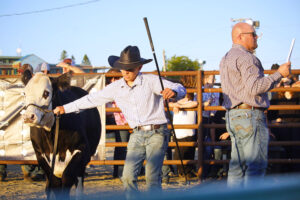
Farmers who have kids in 4-H are just coming through a very busy, exciting time when those kids are preparing and showing 4-H projects at one or more fall fairs. Whether the project is a chicken, rabbit, goat, sheep, horse, beef or dairy animal, this is a fast-learning experience for the kids involved when they help each other to clip, groom, train, and show the animal to its finest. When we watch the shows, the judges explain to the kids and the audience why one animal is placed higher than the next. Whether it’s a five-year-olds first time Pee Wee showperson or a 20-year-old winner, everybody learns. The 4-H members also compete in judging and public speaking competitions to prepare them to be leaders in our community. Many of the 4-H members today are not farm kids, but all kids “learn to do by doing” and everybody can benefit from that.
Farmers are also leaders in the fight against global warming by not leaving a field barren for the winter, but planting a cover crop after harvest which will germinate and prevent wind and water erosion that often occurs in fall and spring when the fields are left bare all winter. If that crop is fall wheat, it can be the first harvested crop the following fall. If it is some other cover crop, it can be tilled into the ground in spring leaving more organic matter and fertility in the soil. If manure is applied to corn stocks left in the field after combining, and then the field is chiseled or lightly tilled, the manure supplies organic matter and fertilizer which the microbes in the soil will break down and help add both organic matter and fertility for next year.
Corn cutting and grape picking happens about the same time as the “brix” level of sugar content in the grapes increases. Fall is very busy on farms getting the buildings ready for winter, the antifreeze levels checked on all vehicles, winter tires installed, gardens harvested and prepared for winter, having plastic silo-wrap on hand for covering haylage and corn silage. Correct sealing of silages can save as much as 50 per cent of the feed value in that silage! University trials have shown that spoilage in silage storages can percolate down up to four feet in uncovered silage piles. Animal feed rations must be adjusted for energy to compensate for animals that live in the open or in buildings that are below 42 degrees Fahrenheit. Water bowls and pumps must be prepared for those below freezing temperatures. A supply of salt and sand must be ready to sand the yard for the milk truck to get to the barn! Make sure the snow blower is ready and not sitting where it could be covered with a snow drift in the first snowstorm (yes, one year I didn’t do that and had no snow blower until the snow melted the following spring). Don’t forget to attend Oktoberfest. It’s our next big cultural celebration in the Valley!
Chris Judd is a farmer in Clarendon on land that has been in his family for generations