





Life altering experiences can be quite difficult to accept. Twenty-two years ago this coming November, I had a stroke while sitting in the doctor’s office waiting for a regular check-up. I had just driven home the night before after lobbying the Quebec government for some badly needed help for our farmers after mad cow disease had devastated the entire world market with a decline in beef consumption. Canadian consumers had understood that there was no danger of contaminated meat getting onto our store shelves, our consumers stood behind our Canadian farmers, and beef consumption in Canada didn’t decrease like it did in most other countries.
However, the prices received by our farmers dropped drastically. One neighbour shipped a healthy large cow and after paying trucking and sales barn fees, his check was only 37 cents for a cow that should have brought two thousand dollars. He never cashed that check, he just pinned it on the wall as a reminder of how bad farming can get.
I was very lucky that I had the stroke in my doctor’s office and was transported to the hospital only a half mile away in minutes. I was extremely lucky that my doctors decided not to give me that new clot-busting drug to dissolve the clot. A later MRI showed that the stroke was caused by a bleed and not a blood clot. That new clot busting drug would have killed me by causing another bleed. When I came to in the ER at the hospital, I was very happy that my right side was still as good as it was before, and I could still talk, hear, and see. I also still had some feeling on my left side too. I immediately accepted that I was still living, had a great doctor, and was still a good half man. My life would be different, some things I could not do, but I had taught my family and employees to do almost everything that I formally did.
Jeannie, recently after waiting a long time, received a knee replacement. She didn’t think that it would be as big a change in her life. Every movement hurts. Getting out of bed is a real procedure. Using a walker is an experience that she didn’t expect. Jeannie has never been so restricted in what she can do before. The pain is getting less every day, and movement is slowly becoming easier. Total acceptance is not quite here yet.
Quite a few years ago, our best respected neighbour bought a new tractor (one of the most powerful in the area). I congratulated him on his well deserved new, larger tractor. I will never forget his reply. Russel said, “it doesn’t matter how big the tractor is, if no one sits on the seat, the tractor will do nothing.” I then realized that an old, reliable tractor working in the field is better than a new one with a mixed-up computer. With today’s computerized machinery, that statement has even more meaning. A good work ethic has value that every employer in the world values more, and the employee’s language or skin color has very little value.
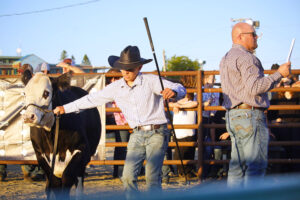
Dad told me many years ago that whether you place first or last in a class at the fair, doesn’t matter as much as whether you learned why. Besides, all the showmen or show women that place above you will sure be happy. It is truly heartwarming to watch a judge of the 4-H classes explain to each show person why they were placed as they were. Learning is a never-ending part of our lives, whatever we do.
Whether we live in a multi-million dollar home or a rented house-trailer isn’t nearly as important as it is to cut the lawn and keep everything neat and tidy. Whether we drive a new Cadillac or an old half-ton, if it’s clean and polished up, it is more impressive. A well kept little raised bed is more impressive than a large garden full of weeds.
The leaders of a country should be more interested in keeping their own citizens fed and healthy than trying to intimidate other countries and invade or take over their neighbors. A country’s natural resources are a saviour in tough times to keep its citizens free, fed, housed, and healthy. Too often we are too quick to criticize and don’t appreciate the good that we have. Trying to make everyone else do exactly like we want them to is something that we might not want them to do to us. Acceptance of the good that we have and satisfaction of what we have would make a much more enjoyable life.
Chris Judd is a farmer in Clarendon on land that has been in his family for generations.